

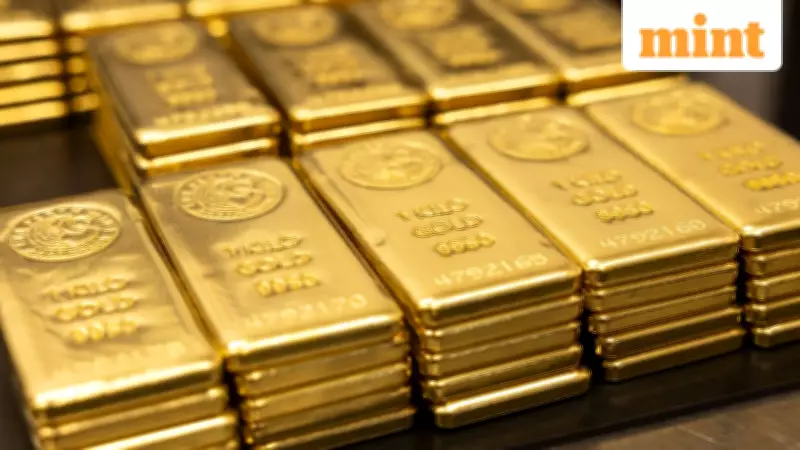
Economic Survey 2026: Gold's Strategic Resurgence in India's Economic Framework
The Economic Survey 2026 has positioned gold at the forefront of India's economic narrative, transforming it from a traditional asset into a strategic stabiliser within an increasingly volatile global landscape. According to the comprehensive analysis, the remarkable surge in gold prices represents more than a cyclical trend—it reflects fundamental shifts in global risk perception, real interest rates, and confidence in conventional financial instruments.
Gold's Price Trajectory: A Response to Global Fragility
The Survey meticulously documents gold's dramatic price escalation, which began in 2025 when prices climbed from $2,607 per ounce to $4,315 per ounce. This upward momentum continued into early 2026, with gold reaching $5,101.34 per ounce by January 26. Key drivers identified include:
- A weaker US dollar creating favorable conditions for gold appreciation
- Persistent expectations of low real interest rates reducing opportunity costs
- Escalating geopolitical risks amplifying safe-haven demand
The Survey explicitly states: "Financial markets are already pricing in fragility arising from geopolitical uncertainties, trade fragmentation and rising concerns over financial market stability." Gold prices have become a transparent indicator of these underlying economic stresses.

Gold's Dual Impact on India's Inflation Dynamics
The Economic Survey reveals gold's significant influence on India's inflation patterns during FY26. While headline inflation showed considerable moderation, core inflation demonstrated unexpected persistence. This apparent stickiness, however, was largely attributable to elevated precious metal prices rather than broad-based economic pressures.
The data presents a compelling contrast:
- Average core inflation increased from 3.5% in FY25 to approximately 4.3% in FY26
- Food inflation experienced substantial softening during the same period
- When excluding gold and silver prices, core inflation eased from 3.4% to 2.3% between June and December 2025
The Survey clarifies this divergence: "the apparent stickiness in core inflation is primarily attributable to the sharp increase in precious metal prices, while underlying inflation pressures remain well contained." This distinction proves crucial for policymakers interpreting inflation trends accurately.
Strengthening External Buffers Through Gold Reserves
Beyond inflation, gold has played an increasingly vital role in fortifying India's external economic position. The Economic Survey reports a substantial expansion in the gold component of India's foreign exchange reserves during FY26, even as foreign currency assets experienced marginal softening.
The transformation in reserve composition is striking:
- Gold reserves surged from $78.2 billion at March 2025's conclusion to $117.5 billion by January 16, 2026
- This increase reflects both valuation gains from higher global prices and strategic diversification
- The trend aligns with broader global patterns where emerging economies are increasing gold holdings
The Survey emphasizes: "the growing share of gold in foreign exchange reserves reflects a broader international trend of central banks diversifying reserve assets amid rising geopolitical and financial uncertainty."
Gold as a Strategic Hedge in Fragmented Global Order
The Economic Survey contextualizes gold's resurgence within a global economic framework increasingly characterized by fragmentation and heightened risk. As geopolitical considerations increasingly shape trade and financial systems, traditional economic efficiency metrics have diminished relevance, reducing safety margins across global markets.
The Survey cautions that "the narrowing margin of safety in global financial markets implies that modest disruptions can trigger outsized spillovers across economies." In this environment, gold has regained prominence as a hedge against systemic risks, extending its role beyond tradition to become a strategic economic anchor.

Contemporary Market Dynamics and Future Implications
Recent market activity underscores gold's continued relevance. On January 29, MCX gold February futures surged over ₹14,850, representing nearly 9% growth, to reach a historic high of ₹1,80,779 per 10 grams. Silver followed this trajectory, with MCX silver March futures rising more than ₹23,100 (approximately 6%) to achieve a record ₹4,08,487 per kg.
Supportive global factors included:
- International gold prices approaching $5,600 per troy ounce
- Silver advancing toward the $120 threshold
- Continued US dollar weakness against major currencies
- The US Federal Reserve's January 28 decision to maintain policy rates
The Economic Survey concludes with a powerful assessment: "gold's resurgence underscores its enduring role as a store of value and a stabilising asset in an increasingly uncertain and fragmented global economic landscape." This comprehensive analysis positions gold not merely as a commodity but as a strategic component of India's economic resilience framework.





