

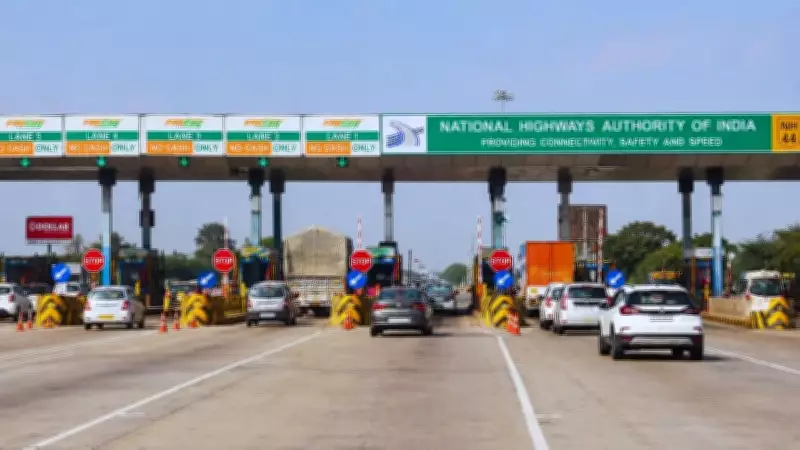
The commuters who travel in and around Delhi will soon experience a significant change in their highway journeys as India prepares to implement barrier-free toll collection to ease traffic congestion. Union Road Transport and Highways Minister Nitin Gadkari launched the new Multi-Lane Free Flow (MLFF) barrier-less tolling system at the Mundka–Bakkarwala toll plaza on the Urban Extension Road-II (UER-II). This marks one of the latest steps in India’s transition toward fully automated toll collection.
Addressing Traffic Delays at Toll Plazas
The new tolling approach aims to resolve the issue of traffic delays at toll plazas, one of the major grievances faced by highway travelers in India. With the MLFF tolling method, vehicles no longer need to stop and pay at booths; instead, tolls are automatically deducted as the vehicle passes through the toll plaza. This is achieved through the use of FASTags and Automatic Number Plate Recognition (ANPR) cameras.
Pilot Project in Gujarat
In what the government terms a milestone, the MLFF tolling method was recently rolled out at the Chorayasi Toll Plaza on the Surat-Bharuch stretch of National Highway 48 in Gujarat. Officials state that this is a step toward the government’s broader goal of upgrading highway infrastructure in India and eventually eliminating toll plazas by the year 2026.

Benefits for Travelers
Travelers will benefit immensely from reduced waiting times for payment. Regular toll gates often create bottlenecks during weekends, festive periods, and peak hours, especially near metropolitan centers. With barrier-free tolling, cars do not need to stop but can maintain their speed. The Ministry of Road Transport and Highways believes this innovation will promote fuel economy and help minimize exhaust emissions from stationary cars waiting to pass through tolls.
Technology Behind the System
The technology behind the barrier-less tolling innovation relies on FASTag compatibility. Cameras placed atop toll gates read the license plate numbers of passing vehicles, while FASTag sensors confirm the vehicle’s registration in the VAHAN database. AI-powered systems cross-check the two data entries and deduct the tolls. The Mundka toll gate on the UER-II corridor has been conducting MLFF trials in recent days.
Future Expansion
The government has stated that deployment may extend to other highways and cities, provided the technology is successfully adopted. This move would place India among many countries where barrier-less toll collection is already used on expressways and highways.
Challenges and Concerns
The process, however, may not be entirely problem-free. Experts have highlighted that the success of the project depends on proper data regarding FASTag usage, vehicle registration numbers, and the ability to penalize those using invalid FASTags. Additionally, issues related to incorrect billing and technical problems have been noted.
Government’s Vision
Nonetheless, the government views the implementation of the barrier-less toll payment system as a significant development in India’s highway sector in recent times. For frequent travelers, tourists, and logistics companies that rely on highway infrastructure, the system could lead to less hassle, reduced fuel costs, and shorter travel times.






