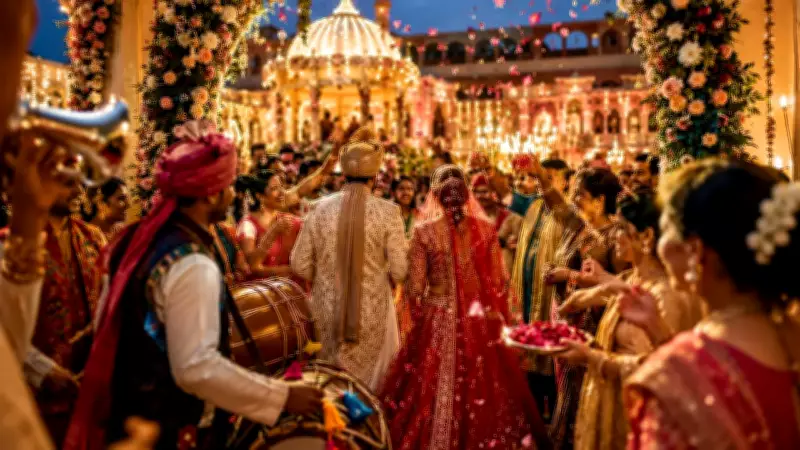
How do you define the perfect desi wedding? Your answer may not match that of the second person reading this, because no one answer fits all. The reason? Unlike any other industry, weddings in India do not fall under one static corporate umbrella. Shaadis are intimate, intensely personal, and almost like a self-healing, hyper-local network built on trust. To define it in a single sentence: Weddings are a social blockchain, and word of mouth and referrals drive the economy.
The Power of Referrals in Wedding Planning
A few months ago, a friend asked for a few references of caterers who could serve an exotic gluten-free menu at her wedding later this year. The entire wedding was planned as an intimate luxury micro-wedding with about 300 guests instead of the massive 1000+ gala planned earlier. But here is the kicker: the budget was not being scaled down. The focus was more on experiential storytelling, and this was done with the help of vendors, decorators, and planners, all handpicked through trusted personal networks. Why? Because referrals work in India, and traditional contacts beat algorithms.
India's Wedding Industry: A $130 Billion Behemoth
India's wedding industry drives an estimated $130 billion (roughly ₹12.31 lakh crore) in annual consumer spend. The data is backed by The Great Indian Wedding Market, published by the global investment banking and capital markets firm Jefferies. This staggering valuation positions India as the second-largest wedding market in the world, trailing only the United States, which sits at roughly $70 billion but handles significantly fewer weddings at a higher cost-per-event ratio. It is mind-boggling to think all this is being achieved by an ecosystem driven solely by referrals and word of mouth.

Why Trust Trumps Technology
Most couples admit they prefer verified social proof over digital apps to ensure a vendor does not fail them on their D-Day. So does this multi-crore business beget a business opportunity, a goldmine for venture capitalists that goes beyond the neighborhood aunties and local referrals? If tech disruptors and Shark Tank investors have not fully commercialized this space yet, it is because they are still figuring out how to monetize the desi heart. Would not we all agree that experience and trusted reputation act as an informal entry barrier in the wedding market? Because weddings are viewed as a high-risk, once-in-a-lifetime emotional event.
Research Confirms the Referral Economy
A comprehensive 2024 research study published by ResearchGate titled Survival and Growth in the Indian Wedding Industry: Insights from Industry Professionals reiterates exactly this. Thus, couples and desi families aggressively favor established, peer- or relative-recommended names. A wedding is essentially a short-term, high-capital joint venture. Families prefer face-to-face consultations and verified local referrals because social contract accountability carries a much higher cultural value than breaking a digital terms and conditions contract.
The Community-Building Approach
Any business trying to disrupt this space will fall flat if it relies heavily on a clinical or tech-first approach. In short, treat the business like a community-building opportunity where the transaction and ROI are sealed with the emotions of a typical desi shaadi that involves the mithaiwalas, local pandit, the dhol, bajaa, and all the taam-jhaam that turns the billion-dollar industry into the big fat emotional shaadi. Because to deliver on your promises, you first need to become part of the family, the Sooraj Barjatya way!