

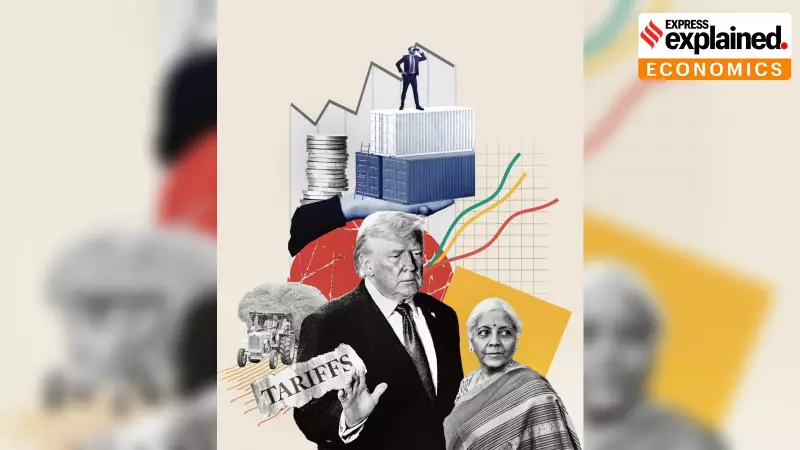
As 2025 draws to a close, the Indian economy presents a paradox of resilience amidst global turbulence. The world's fourth-largest economy has weathered a significant storm of US tariffs and external shocks to post a robust set of macroeconomic numbers, including controlled inflation and low interest rates. However, the path ahead into 2026 is lined with persistent challenges, where reviving domestic consumption emerges as the critical lever to stoke private investment and sustain high growth.
Navigating the Tariff Onslaught: A Story of Adaptation
The year began with policy circles in New Delhi hopeful that India would escape the brunt of President Donald Trump's tariff measures and secure an early trade deal with the United States. Both assumptions proved incorrect. India now faces the highest effective tariffs for its exports to the US, surpassing even China, with a trade agreement remaining elusive. The Trump administration's imposition of a 25% reciprocal tariff, followed by an additional 25% penalty on India's purchase of Russian crude, coupled with an immigration clampdown on H-1B visas, threatened a dual attack on both goods and services exports.
Despite these headwinds, India's export engine demonstrated notable adaptability. After a decline through September, exports to the US saw a robust uptick in November 2025. This resilience was fueled by strong performance in tariff-exempt sectors like pharmaceuticals and electronics, and genuine success in market diversification as exporters tapped alternative markets.

Domestic Reforms and the 2026 Outlook
Proving another adage true, Indian policymakers used the crisis to push through a series of significant reforms in the latter half of 2025. Despite a diminished mandate after the 2024 general elections, the NDA government moved on several fronts. Key actions included long-pending GST rate rationalisation, progress on labour law reforms, and amendments to nuclear sector laws to attract private and foreign investment—albeit with diluted supplier liability provisions.
Financial services saw major changes with rules allowing 100% foreign ownership in insurance and new investment norms for banks and pension funds. A late-year surge in Foreign Direct Investment (FDI), anchored by commitments from tech giants like Google, Amazon, and Microsoft in cloud and AI infrastructure, helped counter concerns over capital outflows and a widening Current Account Deficit (CAD).
For the coming year, India is projected to remain the world's fastest-growing major economy, with GDP forecast to grow 7.3% in fiscal 2026. Chief Economic Adviser V. Anantha Nageswaran, commenting on Q2 GDP data released on November 29, expressed confidence that full-year growth for 2025-26 would be "at least 7 per cent."
Sustaining Growth: The Consumption Conundrum
The central challenge for 2026, however, lies on the domestic front. While high-frequency indicators show economic activity holding up in the October-December quarter, signs of weakness are emerging. Festival spending and GST rationalisation provided a temporary boost, but the sustainability of demand is uncertain. Rural demand remains robust, but urban consumption is still in recovery mode.
Private investment shows mild signs of picking up, supported by non-food bank credit expansion and higher capacity utilisation, though it remains in the 75-77% range. As Axis Capital's 2026 Outlook notes, growth headwinds from fiscal and monetary tightening have abated, leading to a revival in FY26. The report forecasts monetary easing to drive growth of 7.5% in FY27.
Corporates privately indicate that demand visibility is crucial for stepping up investments. Capacity utilisation needs to hover around 80% for several quarters to justify greenfield projects. The ebbing of high-end urban consumption and government spending—which propped up the economy post-pandemic—alongside sluggish export forecasts, places the onus squarely on reviving broad-based domestic demand.

Persistent External Uncertainties and AI's Shadow
External factors continue to cast a long shadow. The full impact of US tariffs may yet materialise as American inflation rises. Furthermore, the US trade blockade on China risks diverting a flood of Chinese exports into Asian markets, including India, creating new competitive pressures.
Simultaneously, the artificial intelligence (AI) revolution presents both an opportunity and a threat. While the AI boom in the US has temporarily masked some tariff effects, it raises larger questions about labour substitution versus augmentation. Analysts like Sajjid Z. Chinoy of JP Morgan warn that the AI-fuelled stock market exuberance in the US could burst, with global repercussions.
For India, a key strength has been its rising share in global services exports, jumping from 2% to 4.5% in less than a decade. Tighter immigration policies in the US and Europe could paradoxically benefit India by forcing more work to be done remotely. However, financing the Current Account Deficit, which stood at 1.3% in Q2 of 2025-26, could become a concern if foreign investment outflows persist, despite healthy services exports and remittances.
As India steps into 2026, the equation is clear. The economy has demonstrated remarkable fortitude against external shocks. The reform momentum is a positive sign. Yet, to achieve the World Bank's estimated need for average growth of 7.8% to reach high-income status by 2047, the country must unlock its one sustained success story: stoking robust domestic consumption. This is the essential catalyst to break the cycle of tepid private investment and secure India's economic future amidst a volatile global landscape.





