

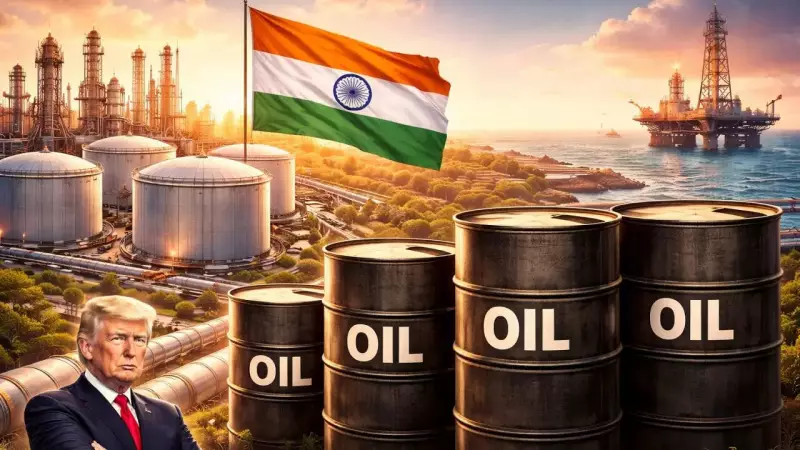
Often termed 'black gold,' oil is the fundamental fuel powering economic engines worldwide. For India, securing a stable and affordable supply of this resource has become a strategic imperative in an era marked by geopolitical flashpoints and potential supply chain disruptions. The nation's heavy reliance on imports, exceeding 85% of its crude oil needs, makes it vulnerable to global price swings and supply shocks, which can directly stifle economic growth and fuel inflation.
Navigating Geopolitics: The Shift in India's Crude Oil Basket
Recent global events have starkly highlighted these vulnerabilities. Tensions around the Strait of Hormuz, a critical chokepoint, US actions in oil-rich Venezuela, and former President Donald Trump's administration imposing tariffs on India for its Russian oil imports underscore the precarious landscape. A report by SBI Research previously estimated that every $10 per barrel increase in oil prices could push CPI inflation up by 25-35 basis points and drag down real GDP growth by 20-30 basis points.
In response, India's import strategy has undergone a dramatic and pragmatic transformation over the past five years. Data from analytics firm Kpler reveals a clear shift. While the Middle East dominated supplies in 2021, Russia emerged as India's top crude supplier by 2023, accounting for over 38% of imports. By 2025, early signs of rebalancing appeared, with Russia's share easing to around 35%, while Iraq (19%) and Saudi Arabia (13%) held steady. Notably, US crude regained a 6.5% share, reflecting a conscious drive for diversification.

"While India continues to acknowledge and factor in global sanctions frameworks, energy security and supply stability remain the primary considerations," explains Sumit Ritolia, Lead Research Analyst at Kpler. He notes that Russian crude remains key, though volumes have moderated due to compliance scrutiny and efforts to limit concentration risk.
The Pillars of India's Defence: Diversification and Storage
Experts agree that diversification is the cornerstone of India's enhanced energy security. Pranav Master, Senior Practice Leader at Crisil Intelligence, states that India has expanded its sourcing from fewer than 30 countries to around 40, spanning the Middle East, Africa, and the Americas. This is supported by a robust refining capacity of 258 MMTPA, allowing processors to swiftly switch between crude grades from Russia, the US, and the Middle East based on price and compliance.
Simultaneously, India is bolstering its emergency buffers. The country's Strategic Petroleum Reserves (SPR) currently hold about 5.33 million metric tonnes (approx. 39 million barrels) across Visakhapatnam, Mangaluru, and Padur. This provides a 9-10 day cushion against supply disruptions. However, as Ritolia points out, this is below the 90-day cover maintained by most OECD nations. The government's Phase-II plan to add 6.5 million tonnes faces delays, but new sites at Chandikhol and Bikaner are planned, with a capex allocation of around Rs 5000 crore.
When combined with commercial stocks held by oil marketing companies, experts estimate the total coverage improves significantly. While Ritolia suggests an additional 10-20 days, Pranav Master of Crisil puts the combined buffer at 70-75 days.
The Cost of Compliance and the Road Ahead
The big question remains: what is the financial impact if pressure from US tariffs forces a sharp reduction in discounted Russian oil? In 2025, India imported roughly 1.7 million barrels per day of Russian crude at a discount of $4–6 per barrel, translating to an annual advantage of $3-4 billion. Manas Majumdar, Partner at PwC India, warns that losing this access could inflate India's annual crude import bill by around $10 billion and shave 1-2 percentage points off refining margins, particularly for private refiners.

Looking forward, the consensus is clear: India must accelerate the expansion of its SPR capacity and ensure consistent filling. Experts also advocate for exploring salt-cavern-based storage and creating limited reserves of refined products near demand centres. Sourav Mitra of Grant Thornton Bharat notes India is doubling down on alternatives like LNG, renewables, and biofuels to reduce long-term oil dependency.
"Collectively, diversified sourcing, strategic and commercial stockpiles, and sustained efforts to strengthen domestic production place India in a relatively stronger position to navigate an increasingly uncertain global energy landscape," concludes Sumit Ritolia of Kpler. While challenges from geopolitical tensions and tariffs persist, India's pragmatic, multi-pronged strategy has moved it beyond being a passive price-taker, building crucial resilience for its growing economy.





