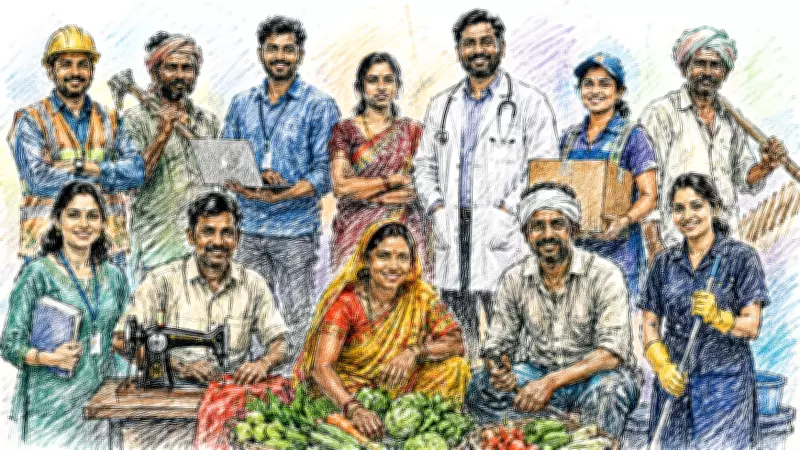
India's labour market is undergoing a significant transformation, yet the shift is far from uniform. Over the decades, employment has gradually moved away from agriculture toward non-farm activities and larger enterprises. However, agriculture continues to serve as the backbone of the country's job market, still accounting for a major share of employment.
Key Findings from SBI's PLFS 2025 Analysis
The latest Periodic Labour Force Survey (PLFS) 2025 unit-level data, analyzed by the State Bank of India (SBI), reveals how the workforce has evolved and highlights persistent inequalities. Gaps based on gender, caste, geography, and industry shape access to stable and better-paying work.
Agriculture's Declining but Dominant Role
Agriculture's share in total employment has fallen from 66% in 1987–88 to 43% in 2023–24, a decline of 23 percentage points over 37 years. As of 2025, it still employs 43% of the workforce. Outside agriculture, most jobs remain concentrated in small units: non-agricultural enterprises with fewer than 19 workers account for 42.3% of employment. Larger enterprises (20+ workers) employ 13.7% in 2025, up from 10.8% in 2024.

Labour Force Participation: Steady but Unequal
The labour force participation rate (LFPR) for individuals aged 15 and above stands at 59.3% in 2025, slightly down from 59.6% in 2024. However, gender disparities are stark: male LFPR is 79.1%, while female LFPR is only 40.0%. Rural India shows higher participation (62.8%) compared to urban areas (52.2%), indicating greater reliance on labour-based livelihoods outside cities.
Youth Unemployment Below Global Average
India's youth unemployment (ages 15–24) is 9.9% in 2025, below the global average of 12.6%. However, the report notes that the 15–29 age bracket may blur structural trends due to ongoing education. Among those aged 30 and above, unemployment is much lower: rural male unemployment is 0.78% (vs 2.6% in PLFS estimates), and urban male unemployment is 2.26% (vs 11.8%).
State-wise Variations
Employment outcomes vary widely by state. Lower unemployment is observed in Gujarat, Madhya Pradesh, and Karnataka. Higher-than-national-average unemployment (3.1%) is reported in Goa, Nagaland, Arunachal Pradesh (6.6%), Punjab (5.3%), and Telangana (5%).
Inequality in Work Types
The Gini coefficient reveals lower inter-state inequality in regular wage work (0.095) and higher inequality in self-employment (0.183). Casual labour shows a coefficient of 0.145. Gender differences are pronounced: women face higher inequality than men, especially in self-employment (rural + urban female Gini: 0.240 vs male: 0.163).
Household Structure and Education
Women heading households are 4.4% more likely to be in regular wage employment and 4.2% less likely to be in casual labour. In rural areas, female headship reduces casual labour by 5%; in urban areas, it boosts regular wage work by 10%. Education significantly reduces casualisation: the probability of casual labour falls from 0.21 among non-literate women to 0.03 for those with higher secondary education and above, while regular wage employment probability rises to 0.44.
Social and Sectoral Divides
Women from ST, SC, and OBC groups are more likely to be in casual labour than those from the 'others' category: ST women (+12.1%), SC women (+14.5%), OBC women (+4.4%). However, SC women also show a 5.4% higher likelihood of regular wage employment. Sectorally, casual labour is concentrated in construction and agriculture, while manufacturing and services show lower informality. Transport stands out, with women having a higher share of regular wage employment than men.
State Performance: Participation vs Quality
Some states achieve both higher participation and better job quality, such as Karnataka, Tamil Nadu, and Odisha. Others like Uttar Pradesh, Bihar, and Punjab report low participation and poor job quality. A third pattern emerges in Rajasthan and Chhattisgarh, where higher participation is coupled with weaker job quality, indicating gaps in social protection and job security.

Informality Dominates
Informal employment covers 80–90% of workers. State-wise informal employment shares: Punjab (82%), Uttar Pradesh and Bihar (81% each), Rajasthan, Chhattisgarh, Andhra Pradesh, and Madhya Pradesh (~74%). Sector-wise: agriculture (42%), trade and hotels (17%), other services (14%). Rural areas account for 59% of informal workers, urban 41%.
Drivers of Informality
Women are 4.8% more likely to be informal workers than men. Urban workers are 4% less likely to be informal than rural workers. Muslim workers are 8% more likely to be informal, while Christian workers are 3% less likely. SC workers are 2.6% more likely, and OBC workers 1.8% more likely to be informal. Sectorally, manufacturing reduces informality by 31.7%, services by 30.6%, and trade and hotels by 4.6%, while construction increases it by 4.5%.
Wage Compliance Gaps
About 25% of casual workers earn below statutory minimum wages. The worst-performing states include Chhattisgarh (70%), Odisha (66%), and Jharkhand (65%). Maharashtra and West Bengal also report nearly one-third of casual workers below minimum wage. Women constitute 45% of underpaid casual workers, despite being only 25% of the casual workforce.