

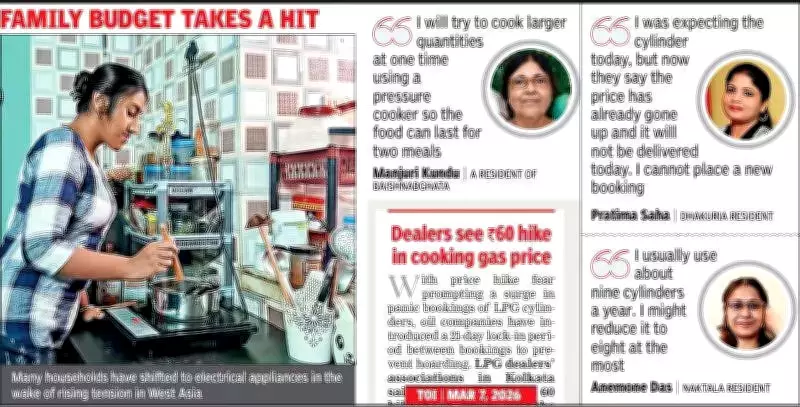
Kolkata Households Rework Kitchen Economics as LPG Price Hike Sparks Anxiety
The recent hike in domestic LPG prices, triggered by the ongoing conflict in West Asia, has prompted significant anxiety among households in Kolkata, with many residents stating it would severely disrupt their carefully managed "kitchen economics." In the wake of the Rs 60 increase in the domestic cylinder price, families have already started reworking their cooking habits as panic bookings surged dramatically since Saturday morning.
Immediate Impact on Household Budgets and Cooking Practices
With cooking gas being a daily necessity, families across the city are rapidly adopting small but impactful changes to minimize their reliance on LPG cylinders at the new higher cost. These adjustments range from cooking in bulk to relying more extensively on pressure cookers and utilizing electrical appliances wherever possible.
"The news of the price hike of the LPG cylinder is deeply worrying," said Srishita Das, a homemaker residing in the Howrah Maidan area. "It is bound to stretch the household budget considerably. We will have to rethink and implement creative ways in which we can save a little on our fuel consumption."

Surge in Bookings and Practical Difficulties
Oil marketing companies have already reported a substantial increase in bookings over the past few days as concerns grew that the price of domestic cylinders could rise further. On Friday alone, Indian Oil Corporation reportedly received approximately 1.5 lakh bookings across Kolkata, North 24 Parganas, and South 24 Parganas. This figure is significantly higher than the usual average of 1 lakh bookings per day, indicating widespread consumer apprehension.
Anemone Das, a resident of Naktala in south Kolkata, explained that cutting consumption significantly remains a difficult challenge for most families. "I usually use about 9 cylinders a year. I might reduce it to 8 at the very most," she stated. "To manage the escalating cost, I might sometimes shift part of the cooking to electric appliances, though it's not always convenient."
Supply Uncertainties and Communication Gaps
For some households, the uncertainty surrounding both supply and price has added considerable stress to managing everyday kitchen chores. One resident of Kolkata expressed frustration after her LPG cylinder, which was scheduled for delivery on Saturday, failed to arrive. She was later informed that the price had already increased and that the delivery would not proceed as planned.
"I was expecting the cylinder today, but now they say the price has gone up and it will not be delivered today. I cannot even place a new booking immediately," she lamented. She also raised serious concerns about the lack of prior information from suppliers. "How come they did not send us any alert or notification about this sudden situation? It leaves us in a lurch."
Shibani Das, a resident of Ramgarh in south Kolkata, highlighted how the recently introduced mandatory 21-day gap between bookings creates practical difficulties. "I need a cylinder almost every month. The booking gap makes it harder to manage because cooking cannot be delayed indefinitely," said Das. "Now I may resort to cooking once in bulk so the food can last for more than one meal, thereby reducing overall fuel usage."
Broader Concerns Over Rising Fuel Costs
The anxiety extends beyond kitchen economics to broader concerns about rising fuel costs potentially affecting transportation expenses. Akash Dey, a resident of south Kolkata who recently purchased a car, stated he does not plan to change his commuting habits immediately but might cut other discretionary expenses if fuel prices rise further.
"Using my car is more comfortable and efficient, so changing that would be difficult," he admitted. "If overall costs increase significantly, I may reduce spending on non-essentials like streaming subscriptions or eating out at restaurants to compensate."
Others indicated they would actively seek alternatives to reduce fuel use in their daily travel. Kapil Shrivastava, an office-goer who uses a scooter for commuting, warned that a further increase in petrol prices would force him to reconsider his travel expenses thoroughly.

"If fuel prices continue to rise, I may have to rely more on public transport or explore shared ride options to reduce personal costs," he explained. "Every additional rupee spent on fuel directly impacts the monthly household budget."
The collective response from Kolkata residents underscores a city adapting under financial pressure, with families proactively adjusting both their cooking methodologies and broader consumption patterns to navigate the challenges posed by the escalating LPG prices linked to international geopolitical tensions.





