

Panic Buying of LPG Cylinders in Kolkata Amid West Asia Tensions Fuels Black Market
Rising tensions in West Asia have sparked widespread panic buying of LPG cylinders in Kolkata, creating a lucrative opportunity for black-market operators. These illicit traders are selling cylinders, including those designated for poor households under the Pradhan Mantri Ujjwala Yojana (PMUY), at steep premiums, exacerbating the crisis for vulnerable communities.
Sharp Surge in Bookings Strains Supply Chain
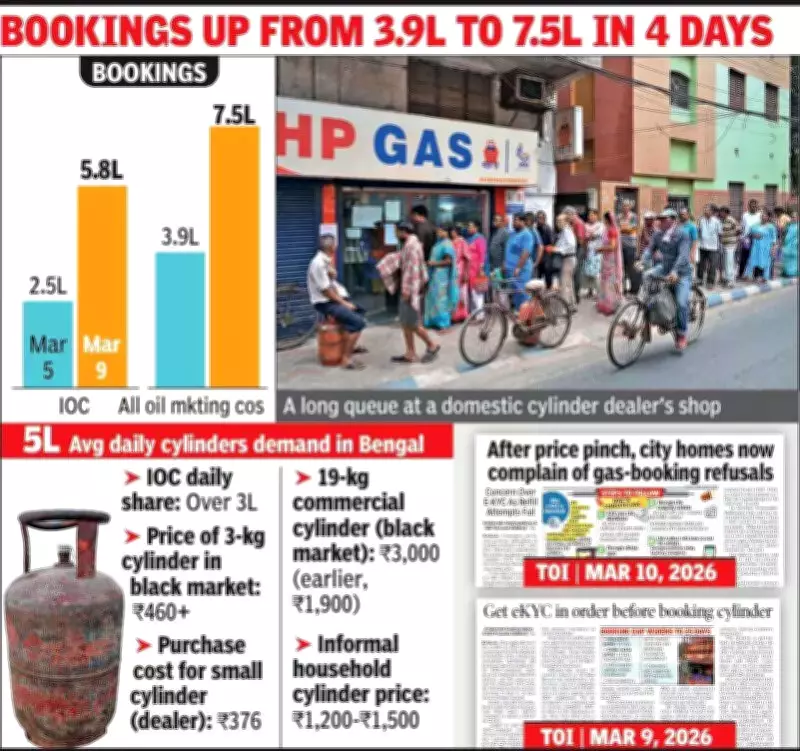
Oil industry data reveals a dramatic increase in LPG cylinder bookings over the past week, driven by consumer fears of potential shortages. According to sources in the oil sector, bookings for Indian Oil Corporation (IOC) cylinders within a 48-hour period surged from 2.5 lakh on March 5 to 5.8 lakh on March 9. When combined with figures from other major oil marketing companies like Bharat Petroleum Corporation Ltd (BPCL) and Hindustan Petroleum Corporation Ltd (HPCL), total bookings jumped from 3.9 lakh to over 7.5 lakh during the same timeframe.
This spike far exceeds normal demand levels, as West Bengal typically requires around 5 lakh LPG cylinders daily. IOC supplies more than 3 lakh of these, while BPCL and HPCL together account for the remaining demand. The unprecedented surge has severely strained the supply chain, enabling illegal traders to flourish, particularly in Kolkata's outskirts.

Exploitation by Delivery Personnel and Black-Market Operations
Reports indicate that some delivery personnel are exploiting the situation by encouraging households to book additional cylinders unnecessarily, then diverting them to the black market for higher profits. Cylinders meant for beneficiaries of welfare schemes are also being illegally sold. In areas like Azadgarh in south Kolkata, a 3-kg LPG cylinder is being sold in the black market for over Rs 460, significantly above the official price.
A trader involved in the grey market described the erratic supply, stating, "I received 11 small cylinders on Monday and seven-eight on Tuesday. Both days, the stock sold out before noon." He added that he purchased cylinders for about Rs 376 each and sold them for Rs 400, but prices are expected to rise as supply tightens. "The official price went up by about Rs 60. But shopkeepers are charging different amounts, often more than the official hike as supply has dropped," he explained.
Impact on Low-Income Households and Small Businesses
The shortage is disproportionately affecting low-income households, forcing them to pay inflated prices or risk running out of cooking fuel. A domestic help shared her ordeal, saying she was told to pay Rs 1,200 for a cylinder delivered within 24 hours through unofficial channels after failing to secure one via the regular booking system. "We struggle every day just to make ends meet. Cooking gas is essential. Are poor families supposed to go back to earthen stoves?" she lamented.
Small businesses reliant on LPG for daily operations are also suffering. A fast-food vendor on SN Banerjee Road reported paying Rs 3,000 for a 19-kg commercial cylinder that previously cost around Rs 1,900. "After searching for hours, I finally found someone selling a cylinder in the black market. He could arrange for only one. The cylinder will last two days. I don't know how I will run my shop if I can't find another," she said, noting her dealer warned the supply crunch might persist for three to four more days.
Increased Demand in Student and Rental Neighborhoods
Neighborhoods such as Azadgarh, Bijoygarh, and Bikramgarh, populated with students and renters from districts, are heavily impacted. Without permanent LPG connections, many depend on small cylinders sold through informal networks. Dealers report that even homes with official connections are turning to the black market to meet immediate needs amid the current shortage.

Even households that typically use LPG sparingly are now seeking additional cylinders. Srabanti Dutta, a 27-year-old private nurse renting in Bijoygarh, said a cylinder usually lasts her nine to 10 months, but she booked a new one after only three months due to fears of shortages. "My landlord advised me to book immediately as there might be shortages. I didn't want to take a risk," she explained. Similarly, Aritra Chakraborty, a tenant in Tiljala without a formal LPG connection, noted that his informal supplier increased the price from around Rs 1,000 to Rs 1,500 for a cylinder that lasts four months.
Government Response and Industry Insights
Industry sources indicate that while supply disruptions have remained limited, the wave of panic bookings has temporarily destabilized distribution networks, creating an environment where illegal traders thrive. The government has formed a panel to address commercial LPG supply disruptions, as hotels in major cities face potential shutdowns. This crisis highlights the broader impact of global tensions on local economies and daily life in Kolkata.





