

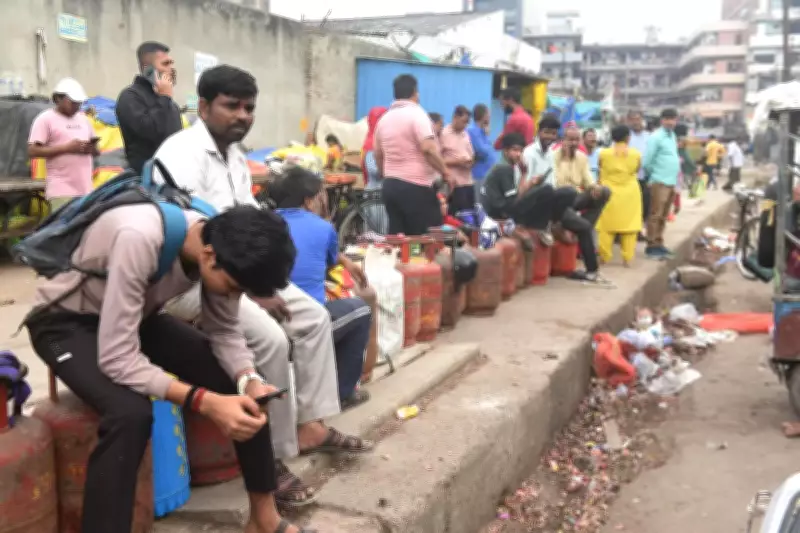
LPG Crisis Triggers Mass Departure of Informal Workers from NCR
In the bustling industrial hubs of Noida and Greater Noida, a deepening LPG cylinder shortage has unleashed a wave of distress among migrant workers in the informal sector. What began as a temporary inconvenience in early March has now escalated into a full-blown crisis, compelling many to abandon their jobs and return to their native villages. The situation, fueled by geopolitical pressures and a collapsed black market, is hitting hardest at the most vulnerable daily wage earners.
Black Market Collapse and Soaring Prices
The root of the crisis lies in the aftermath of recent US and Israeli attacks on Iran, which intensified scrutiny on global energy supply routes. This led to a crackdown on pilferage and illegal refills, effectively shutting down the black market that many migrant workers relied on for affordable LPG. Previously, these workers depended on portable 3 kg cylinder-cum-stoves, refilled informally at Rs 40-50 per kg. Now, with black market prices skyrocketing to Rs 400-500 per kg, their meager savings are being rapidly depleted.
Dharmendra Nagar, a labour contractor in Greater Noida and Noida, reported that nearly 2,000 out of 8,000 workers under his supervision have left their jobs and returned to villages in Badaun, Aligarh, Etah, Shahjahanpur, and Mathura. "Many departed on April 1, right after collecting their salaries," Nagar said. "Once a worker goes on leave without informing their supervisor, they effectively lose that job. But right now, their only priority is making sure they don’t go to sleep hungry."

Daily Struggles and Impossible Choices
For workers like Bharat Kumar, a daily wager in Greater Noida, the price surge has made survival untenable. "I used to get an LPG refill for Rs 50 per kg every two days. Now the rate has hit Rs 400 per kg. How do I save for rent, send money home, and still eat?" he lamented. His landlord in Devla village has even prohibited him from building mud chulhas, closing off a traditional fallback option.
The alternative of eating at roadside stalls is no longer feasible either, as vendors pass on higher LPG costs to customers. Madan Prajapati, a mason in Surajpur, noted, "A Rs 50 thali now costs Rs 80, and a paratha that was Rs 20 is now Rs 40. I can only afford to eat out once every four days." This has forced many to reconsider their stay in the expensive National Capital Region.
Impact on Factory Workers and Families
While daily wage earners are exiting in droves, blue-collar factory workers with contract jobs and better salaries have largely remained. However, staying has come at a significant cost. Their daily routines have been upended, with many starting their days early to queue for cylinders before their shifts begin.
Kuldeep, a printing line worker in Sector 10, was outside a gas agency in Harola at 8 am on a Saturday, two hours before his shift, trying to collect a cylinder booked two days earlier. "My shift starts at 10 am. I have to get the cylinder and deliver it home before," he explained. "Unlike daily wage workers, who can sometimes negotiate a late start, factory workers operate on rigid shifts where a missed day can mean a pay cut or dismissal."
Ramashankar, a security guard in Sector 6, has been trying to collect a cylinder booked on March 28, with no success. Maryam, a garment factory worker, faces a similar dilemma: home delivery was suspended in parts of Harola after delivery vehicles were allegedly looted, forcing her to collect cylinders personally despite the risk of being late for work.
Mounting Debts and Desperate Measures
Gangeshwar Dutt of the Centre of Indian Trade Unions highlighted that families where both spouses work factory shifts without valid gas connections are suffering the most. "They cannot just leave for their village. They have children to feed. So, they are being forced to buy cylinders at exorbitant prices, and then have to either convince their landlord to delay rent or borrow from the ration store. Either way, their debts keep mounting," he said.

The financial strain is stark: a 14.2 kg cylinder, once priced around Rs 1,100, now costs Rs 4,000-4,500 in the black market. For workers earning Rs 12,000 a month, this single expense can devastate their entire budget. Pradeep, a factory worker from Sector 57, asked, "With a salary of Rs 12,000, it is impossible to manage rent, fees, and food. How am I to buy a gas cylinder for Rs 4,000?"
Return to Traditional Methods and Community Impact
Some have resorted to wood-fired chulhas as a last resort. In Ghaziabad’s Arthala village, Seema, who works at a chemical factory in Sahibabad, has been cooking on a chulha for over a week. "Earlier, we somehow managed by buying small cylinders from local sources. Now nothing is available," she shared.
Kumkum, residing in a JJ colony in Sector 8 and employed at a garments factory in Sector 4, observed that several neighbours, mostly women working as domestic help, left for their villages with their children after running out of gas in mid-March. "We cannot take leave like them. I cannot risk losing my job," she stated.
Anxiety and Rumors Fuel Further Exodus
Rumors of a potential lockdown have compounded the anxiety, prompting more workers to leave. Bhola, a water delivery truck driver from a JJ Cluster in Sector 9, noted, "People thought everything might shut again." Another worker waiting in a queue outside a gas agency said he was anticipating the 10th of the month when salaries are credited, expecting more departures then. "More people will go back to their village around that time. At least there we can manage to cook food at home and not be forced to live off bread and biscuits," he added.
This crisis underscores the fragile existence of migrant workers in urban centers, where even minor disruptions in essential supplies can trigger widespread displacement and economic hardship.





