Middle East Conflict Exposes India's Vulnerability Beyond Oil and Gas
The ongoing conflict in the Middle East has sharply highlighted the global vulnerability of nations dependent on oil and gas imports. India, as the world's fifth-largest economy and third-largest oil importer, finds itself particularly exposed. A significant portion of its gas needs, including LPG and LNG, relies on imports routed through the critical Strait of Hormuz. With crude oil prices soaring above $100 per barrel, shockwaves are rippling worldwide, and India is bracing for an impact on its current account deficit as its oil import bill escalates.
Non-Energy Imports: A Hidden Risk for India
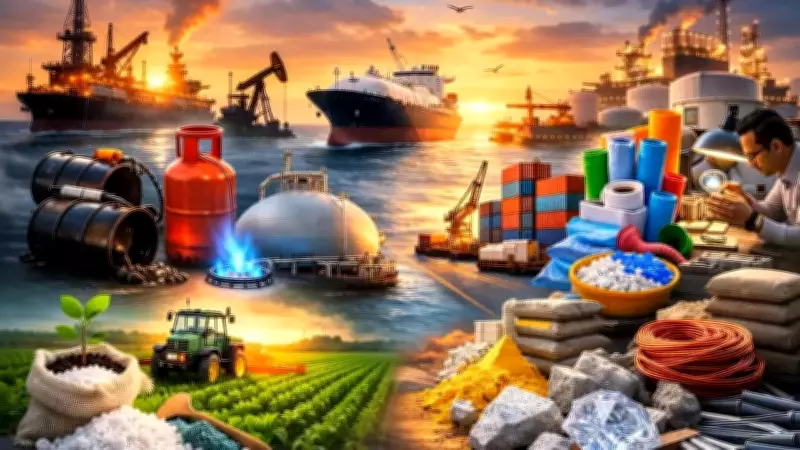
However, the threat extends far beyond energy. According to a report by Barclays India, the country's non-energy imports from the Middle East are substantial, accounting for approximately 10% of total non-energy imports in 2024. The report emphasizes that the Middle East's role in global trade transcends energy, with significant but often underestimated exposures across sectors like chemicals, construction, agriculture, and basic manufacturing.
Barclays notes that India's economic starting point is robust, with strong GDP growth, manageable inflation, and stable external and fiscal balances. This provides a cushion against the price and supply shocks emanating from the Middle East conflict. Nonetheless, specific sectors face heightened vulnerability due to their dependency on the region.

Key Sectors at High Risk
The research identifies several areas where India's import dependency on the Middle East is particularly acute:
- Diamonds: 47.5% of India's total imports come from the Middle East.
- Fertilisers: A staggering 63% dependency, especially for nitrogenous types.
- Polymers: 50% of imports originate from the region.
- Hydrocarbons: 48% reliance, impacting refining and chemical industries.
Countries such as Iran, Saudi Arabia, Israel, Iraq, Qatar, the United Arab Emirates, Oman, Kuwait, and Bahrain collectively contribute to this import share. The conflict's disruption could extend to exports as well; for instance, India imports raw precious metals like gold and diamonds from the Middle East, processes them domestically, and re-exports finished jewellery to the region. Any prolonged import disruption could thus hamper export activities in these products.
Potential Mitigations and Government Responses
Barclays suggests that for some sectors, alternative sources might help offset supply disruptions. In aircraft components and NPK fertilisers, countries outside the Middle East—such as Germany and France for parts, and Russia and China for fertilisers—hold larger shares of India's imports. If these partners can expand trade, they could bridge shortfalls from reduced Middle Eastern supply.
However, the report flags some pain in fertilisers, given the high 63% dependency on the Middle East, with Russia at 22% and China at 5% lagging behind. If disruptions persist and international prices surge, the Indian government may need to increase fertiliser subsidies, mirroring actions taken during the Russia-Ukraine conflict. Media reports indicate efforts are already underway to diversify import sources, including from China.
In the hydrocarbons sector, private refiners could be incentivized to prioritize domestic supply over exports, mitigating the impact of reduced imports. Barclays concludes that beyond energy, India's dependence on the Middle East can be managed through alternative sources or redirecting domestic production for local consumption before exports.
Overall, while the Middle East conflict poses significant risks to India's economy across multiple fronts, the country's strong economic fundamentals and potential strategic adjustments offer a pathway to resilience in the face of ongoing global tensions.