

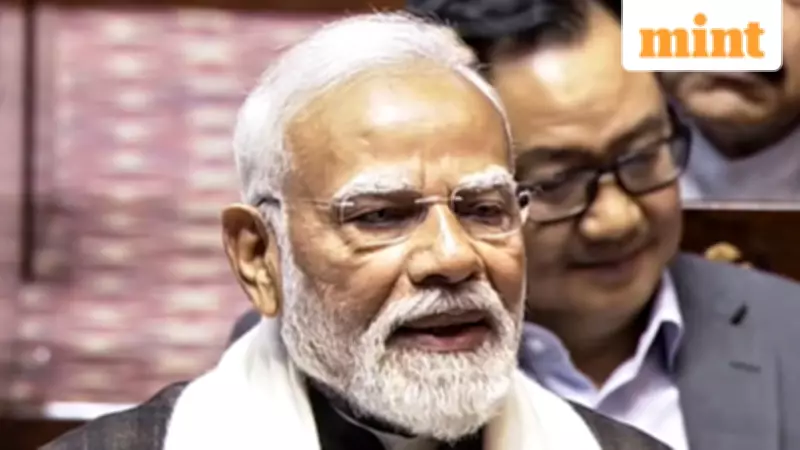
New Delhi: Prime Minister Narendra Modi asserted on Thursday that nations possessing a strong manufacturing ecosystem inevitably become magnets for global partnerships. Addressing the Rajya Sabha amid opposition uproar while replying to the motion of thanks on the President's address, Modi positioned India's recent trade advancements, including the landmark India–US agreement, as direct results of persistent economic reforms and a fortified manufacturing base.
From Fragile Five to Reform Express
"When you have a strong ecosystem for manufacturing, the world will want to deal with you," Modi declared, framing the current era as decisive for India's long-term trajectory. He emphasized that the second quarter of this century is crucial for building a Viksit Bharat (Developed India). The Prime Minister noted that India has decisively moved beyond the "Fragile Five" phase—a term coined by Morgan Stanley in 2013 to describe emerging markets like Brazil, India, Indonesia, South Africa, and Turkey that were vulnerable to capital outflows and external shocks.
"We have moved forward with the reform–perform–transform mantra, and today India has boarded the reform express," Modi stated, highlighting the nation's rapid progression toward becoming the world's third-largest economy, driven by comprehensive reforms, enhanced performance, and transformative policies.

Trade Momentum and Strategic Agreements
Linking external engagement with domestic stability, Modi explained that India's growing capability to finalize trade pacts with developed economies mirrors deeper structural changes at home. He revealed that India is negotiating future-ready trade agreements on more balanced terms, supported by policy stability, predictable regulation, and a cleaner financial system.
Referring specifically to negotiations with Europe, Modi described the proposed India–EU trade pact as the "mother of all trade deals," underlining its profound strategic importance. This statement gains substantial significance as India has signed or announced nine free trade agreements since 2014, including major pacts with the UK, EU, US, the four-nation European Free Trade Association (EFTA), Oman, and concluded talks with New Zealand, while also initiating negotiations with the Gulf Cooperation Council (GCC).
Banking Reforms and Credibility Boost
Modi pointed to banking sector reforms as a critical enabler, noting they have reduced the "mountain" of non-performing assets (NPAs) to their lowest level in decades—below 1%. According to a Lok Sabha reply by Minister of State for Finance Pankaj Chaudhary on 8 December 2025, gross NPAs in public sector banks declined from ₹6.16 trillion (9.11% of advances) in March 2021 to ₹2.84 trillion (2.58%) by March 2025, while private sector banks reduced NPAs from 4.94% to 1.75% over the same period.
"This clean-up has strengthened India's credibility with global partners and created the foundation for deeper trade and investment ties," Modi asserted, adding that the shift from ad-hoc decision-making to future-ready policymaking has helped rebuild trust in India's economic direction and correct its earlier tarnished image.
Unprecedented Opportunities and Forward Momentum
The Prime Minister further elaborated that the current phase presents unprecedented opportunities across manufacturing, services, and innovation-led sectors. India is actively securing critical minerals for future generations and placing renewed emphasis on quality and innovation, even in lower-margin areas, to enhance the global acceptance of Made-in-India products.
"Now, we are not stopping, nor are we going to look back. We will only look forward," Modi affirmed, stating that India's economic journey has reached an irreversible point. Under the evolving global order, India is advancing with speed and confidence as a stable, reliable economic partner in an increasingly fragmented world.

Renewed Trade Diplomacy and Immediate Developments
These remarks coincide with a renewed push on trade diplomacy. Earlier on Thursday, Union Commerce and Industry Minister Piyush Goyal indicated that the signing of the joint statement for the first tranche of the India–US bilateral trade agreement is expected shortly. Following this, the US is likely to issue an executive order reducing reciprocal tariffs on Indian goods to 18%, a move anticipated to provide relief to exporters and accelerate bilateral trade flows.
Modi's comprehensive address underscores a strategic vision where domestic manufacturing strength, banking stability, and forward-looking policies converge to position India as an attractive global partner, leveraging trade agreements to fuel sustainable economic growth and solidify its standing on the world stage.





