

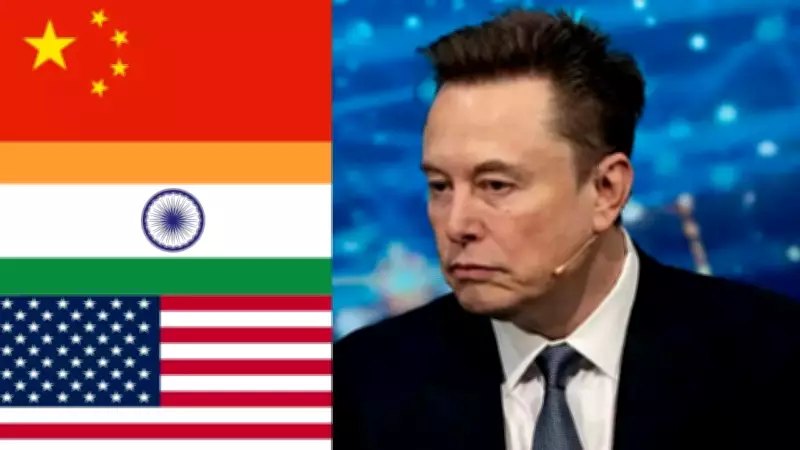
Elon Musk, the influential tech billionaire, recently shared a thought-provoking chart on his social media platform X with the simple yet powerful caption: "The balance of power is changing." The chart, which had been circulating previously, originated from World of Statistics and was based on projections from the International Monetary Fund. While the format was standard, the ordering of countries captured immediate attention and sparked widespread discussion about shifting global economic dynamics.
China and India Dominate Global Growth Projections
What made this particular chart stand out was the clear positioning of China and India at the very top of the list, significantly ahead of all other nations. According to the IMF projections for 2026, China is expected to contribute a substantial 26.6 percent of global real GDP growth, while India follows closely with an impressive 17.0 percent contribution. Together, these two Asian giants account for more than 43 percent of all additional economic output anticipated for this year, representing a remarkable concentration of global growth momentum.
The visual representation made the gap between these emerging economies and most advanced nations strikingly obvious without requiring any additional commentary. The chart effectively communicated how economic influence is gradually shifting toward Asia, with China and India emerging as the primary engines of global expansion.

United States and Other Emerging Markets Follow
The United States appeared in third position on the chart, with a projected contribution of 9.9 percent to global GDP growth in 2026. Further down the list were other emerging economies including Indonesia, Türkiye, and Nigeria, alongside various other developing markets. While the chart itself presented data without explicit statements, the emerging pattern was unmistakable: traditional economic power centers are being complemented and, in some respects, challenged by new growth hubs.
IMF's Global Growth Outlook and Supporting Factors
The International Monetary Fund expects global economic growth to maintain stability at 3.3 percent in 2026, with a slight easing to 3.2 percent projected for 2027. These figures represent marginal upward revisions from the October 2025 outlook, reflecting cautious optimism about the world economy's resilience.
Several interconnected factors support this relatively positive outlook. Continued investment in technology remains a significant driver, while policy support measures implemented during previous economic challenges have not completely unwound. Financial conditions remain relatively accommodating across many regions, and the private sector has demonstrated faster-than-expected adjustment capabilities. Although trade policy shifts continue to exist as background factors, they are not currently dominating the IMF's forecast considerations.
Potential Risks and Uncertainties
The IMF report acknowledges several potential risks that could affect global economic stability. A reassessment of expectations surrounding artificial intelligence could potentially cool investment enthusiasm and unsettle financial markets, particularly affecting technology-linked firms. Trade tensions could resurface unexpectedly, while political or geopolitical strains might interrupt global supply chains or shake investor confidence.
Additionally, high public debt levels and widening fiscal deficits in various countries could push long-term interest rates higher, thereby tightening financial conditions more broadly. However, the IMF also presents alternative scenarios where faster adoption of AI translates into real productivity gains, or where trade tensions ease rather than escalate, highlighting the inherent uncertainty in economic forecasting.
Inflation Trends and Policy Recommendations
Global inflation is expected to continue its downward trajectory, with the IMF projecting headline inflation at 3.8 percent in 2026, down from an estimated 4.1 percent in 2025. A further decline to 3.4 percent is anticipated for 2027, with these figures remaining largely unchanged from earlier projections. Notably, the United States stands out as an exception, with inflation expected to return to target levels more slowly than in other major economies.

The IMF's policy recommendations follow familiar patterns: rebuilding fiscal buffers where possible, maintaining price and financial system stability, reducing economic uncertainty, and advancing structural reforms. While these suggestions don't directly address the broader questions raised by the chart Elon Musk shared, they provide important context for understanding the global economic landscape in which these growth shifts are occurring.
The combination of Musk's social media amplification and the IMF's authoritative data has created a powerful narrative about changing global economic dynamics. As China and India continue to expand their contributions to world growth, traditional economic hierarchies are being reshaped, with implications for international relations, investment patterns, and global governance structures.





