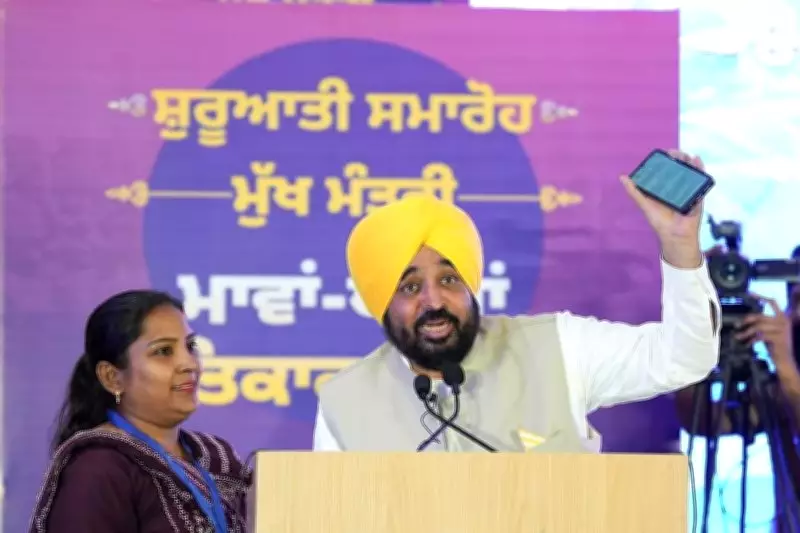
The rollout of the Mukh Mantri Mawan Dhiyan Satkar Yojana from July 1, 2026, expected to cost the state exchequer Rs 9,300 crore for roughly 50 lakh women in Punjab, has spotlighted the Aam Aadmi Party’s other freebies. Under the scheme, Dalit women receive Rs 1,500 per month, while others get Rs 1,000 per month.
History of Freebies in Punjab
The culture of 'gifting' in Punjab — from the state to the citizen — dates back to 1997 when then Chief Minister Parkash Singh Badal’s Cabinet decided to provide eight hours of free electricity to all Punjab farmers. AAP’s unabashed handouts also take a leaf from Prime Minister Narendra Modi’s support for giveaways, especially to women in states going to the polls — from Haryana (Deen Dayal Lado Lakshmi Yojana) to Maharashtra (Ladki Bahin Yojana) to Delhi (Mukhyamantri Mahila Samman Yojana).
In the southern states of Tamil Nadu and Andhra Pradesh, the freebie culture has persisted for decades, with people being gifted everything from gold chains to mixer-grinders and scooters. Still, freebie culture is unusual for Punjab.

Current Welfare Expenditure
AAP has allocated Rs 15,500 crore for free power to farmers and urban households (300 free units) and concessions to industrialists. An amount of Rs 6,150 crore is allocated for social security to 36.52 lakh special beneficiaries, such as the elderly, widows, destitute women and the disabled. Free bus facility for women costs another Rs 600 crore, while pilgrimage to religious sites costs Rs 312 crore.
The state has allocated Rs 900 crore for ‘Meri Rasoi’, affecting nearly 40 lakh blue ration card holder families, and another Rs 2,000 crore aimed at providing cashless treatment under the Mukh Mantri Sehat Yojna. All told, roughly Rs 34,762 crore, or as much as 13 per cent, has been allocated to “welfare activities” out of the total state budget of Rs 2.60 lakh crore.
Expert Warnings on Debt
“No government freebies are actually free. Money is generated from loans or diversion of funds from other departments. Punjab has fallen to the second lowest rank in the country in terms of debt-to-GSDP ratio. It has no roadmap for paying back its debts or allocating new expenditure for the revival of its economy,” leading economist Ashok Gulati told The Tribune.
Leading agricultural economist SS Johl said: “Certain social security measures are justified as part of government expenditure, but the right choices need to be made for the programmes. The exercise needs to be mapped in terms of generating money for repaying loans. Expenditure cannot be one-directional. The loans have to be returned. Till 1992-93, Punjab’s growth rate was above the national average. This was before former Chief Minister Parkash Singh Badal announced free electricity for farmers. And then other freebies followed.”
Political Norm or Economic Trap?
Jawaharlal Nehru University (School of Social Sciences) former Professor Surinder Singh Jodhka said: “I don’t blame Chief Minister Bhagwant Singh Mann. He is only doing what other states are doing. Freebies, currently, are the political norm. All states, near elections, are promising new freebies. This is being done to lure voters in the absence of any clear agenda for development to attract voters.”
Taking note of the situation in Tamil Nadu, the Supreme Court earlier this year pointed out that political parties across states were promoting a “freebie culture”, saying it hampered economic development, and observed that it was high time to revisit such policies.
Impact on Economy
Funding of freebies leads to cutting government expenditure on schools, hospitals, roads and important wings of public governance. Professor of Eminence in Economics at Guru Nanak Dev University, Ranjit Singh Ghuman, said: “The government needs to create systems for generating revenue to repay the loans taken in the name of public service. The so-called government freebies are actually funded by taxpayers. Governments find ways to raise funds by charging more in the name of offering services like registration of land or houses and constructing roads. If the government is so bothered about public welfare, why are teachers perched on water tanks? Why are sewer workers on the roads without their vests?”

The Reserve Bank of India has repeatedly warned that when investment is significantly lower than Gross State Domestic Product (GSDP), freebies act as a negative force. Johl, former Vice-Chancellor at Punjab Agricultural University, said: “Punjab needs to forget its prosperity of the Green Revolution days. The revolution is history. Change is the only way forward. The state needs to look for new investment. This is possible only if the state provides matching infrastructure and concessions to meet industry expectations and inputs.”
The Debt Spiral
In terms of plain economics, offering freebies means public funds are spent on projects that do not offer any returns. The government is left with no option other than borrowing money. More often than not, the state finds itself diverting resources from job-creating sectors, particularly infrastructure. The government is left with no other option but to delay payments, which is definitely no way out.
Politicians are very well aware of the unending debt trap their states are falling into because of freebies, but no one is backtracking from offering them, in order to gain voter support. Punjab is no different. Johl said: “Unless things are corrected immediately, we might very soon hear parties offering free alcohol to their voters.” Temporary relief is no way out towards quality education, healthcare, public services, and even good roads. Freebies more often than not lead to higher taxation. The resulting low productivity throws the state into a debt spiral. Ghuman said freebies were bad economics. Freebies would ruin Punjab, he noted. Dr Gulati said: “Give people jobs. They need industry.”