

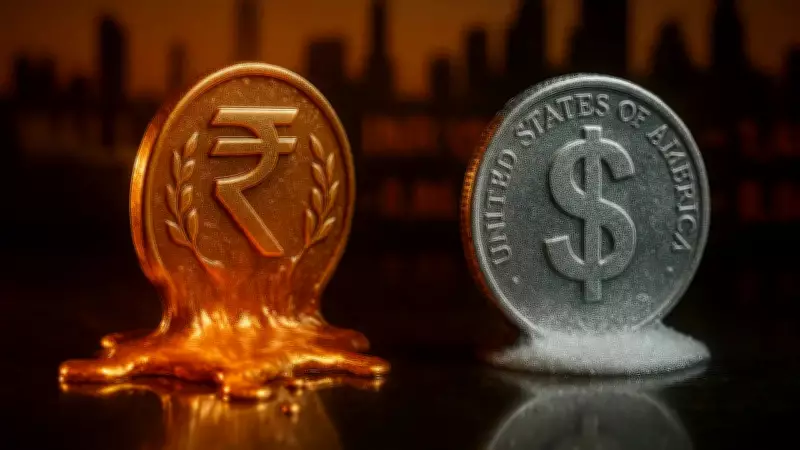
Indian Rupee Plunges Past 95 Against US Dollar, Marks Steepest Annual Decline in 14 Years
The Indian rupee experienced a historic downturn on Monday, breaching the critical 95 mark against the US dollar for the first time ever. This milestone underscores a dramatic depreciation trend, with the currency recording a staggering 9.88 percent decline in the current financial year—the most severe annual drop witnessed in over a decade and a half.
Intraday Volatility and Closing Figures
Despite opening on a stronger note and appreciating by 128 paise during morning trade, the rupee could not sustain its gains. It ultimately closed at 94.78 against the dollar, after hitting an intraday low of 95. This recovery occurred even as global crude oil prices continued to rise, a factor that typically exacerbates currency weakness by increasing import bills and inflating the current account deficit.
RBI's Intervention to Stabilize the Currency
In a decisive move to curb the rupee's slide, the Reserve Bank of India issued a circular on March 27, 2026, capping the overnight net open position that banks can maintain at $100 million. Banks are mandated to comply with this new limit by April 10, 2026, a significant reduction from the previous allowance of up to 25 percent of their net worth.

Amit Pabari, Managing Director of CR Forex Advisors, commented: "As banks begin adjusting their positions, they are likely to sell dollars in the market, which can temporarily support the rupee. This creates a phase of relief, driven by position unwinding, not by a major shift in fundamentals, but still meaningful in the near term."
This policy shift is expected to force several large institutions, which had built substantial long dollar exposures exceeding $1 billion in anticipation of further depreciation, to swiftly reduce their positions. Consequently, banks may incur losses and have approached the RBI seeking relaxations, though the central bank has maintained its stance.
Market Reactions and Analyst Perspectives
The RBI's action initially spurred a sharp appreciation in the rupee during early Monday trading. However, these gains were largely erased due to robust demand for US dollars from oil companies and other corporate entities. Forex traders reported significant volatility, with the USD/INR pair fluctuating within a wide range of 165 paise intraday.
Anil Kumar Bhansali, Head of Treasury at Finrex Treasury Advisors LLP, noted: "Rupee rose, but again fell due to some big corporate buying, squaring up of position in NDF, nationalised banks buying, and oil companies buying."
Analysts highlight that the rupee remains under pressure from multiple fronts:
- Persistent outflows by foreign investors
- Strengthening of the US dollar amid ongoing West Asia conflict uncertainties
- Inflation risks fueled by elevated energy prices
Sunal Sodhani, Head of Treasury at Shinhan Bank India, outlined the outlook: "Outlook depends on three variables: oil, flows, and global rates. The new normal is higher volatility plus gradual depreciation, not stability around a fixed band. In FY27, for the USD/INR pair, 92-97 remains the broader range play."
Historical Context and Future Measures
Prominent banker Uday Kotak described the RBI's step as "an unconventional policy action" reminiscent of measures taken during the 1998 Asian crisis under former RBI Governor Bimal Jalan. He speculated on the potential need for innovative schemes, such as a new version of the FCNR (B) program, if geopolitical conditions worsen.
However, some bankers express skepticism about the effectiveness of special measures aimed at attracting dollar inflows, noting that previous initiatives like offering assured returns to non-resident Indians may have limited appeal today. Alternative strategies, such as rupee-dollar swap mechanisms, could prove more cost-effective for the RBI in mobilizing foreign currency.

The rupee's depreciation has been accelerated since the onset of the US-Iran war, with market participants emphasizing that unless there is a meaningful correction in crude oil prices, the overall trend is likely to remain weak. The currency's performance will continue to be closely monitored as banks adjust to the new regulatory framework and global economic dynamics evolve.





