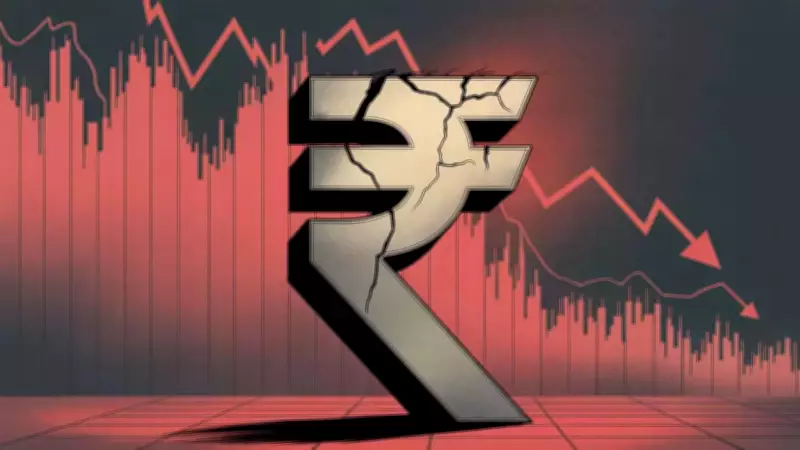
Indian Rupee Plunges to Historic Low Against US Dollar
The Indian rupee continued its downward trajectory on Monday, depreciating by 10 paise to close at a fresh record low of Rs 92.40 (provisional) against the US dollar. This decline marks another milestone in the currency's recent weakness, driven primarily by escalating crude oil prices and relentless foreign fund outflows triggered by ongoing geopolitical uncertainties in the Middle East.
Key Factors Driving the Rupee's Depreciation
Forex traders and analysts pointed to multiple headwinds battering the local currency. Surging crude oil prices have emerged as a critical pressure point, with Brent crude futures trading higher by 1.46% at USD 104.69 per barrel. This elevation forces Indian importers to purchase more dollars to pay for oil imports, thereby widening the country's trade deficit and creating what experts describe as a "material terms-of-trade shock."
Concurrently, foreign institutional investors (FIIs) have maintained their selling spree in Indian equities, offloading shares worth Rs 10,716.64 crore on a net basis just last Friday. This persistent capital flight, fueled by global risk aversion amid conflicts involving Israel, Iran, and the US, has further strained the rupee's position in the foreign exchange market.

Market Dynamics and Intervention Efforts
At the interbank foreign exchange market, the rupee opened at Rs 92.44 and touched its lowest-ever intra-day level of Rs 92.47 against the greenback during the session. It finally settled at Rs 92.40, down from the previous close of Rs 92.30. In the preceding session, the currency had already hit its weakest closing level at that time.
Anuj Choudhary, Research Analyst at Mirae Asset Sharekhan, noted that some softness in the US dollar index and hopes for the reopening of the Strait of Hormuz provided limited cushion against a steeper fall. Jigar Trivedi, Senior Research Analyst at IndusInd Securities, emphasized that "persistently high oil prices are forcing importers to purchase more dollars, widening India's trade deficit." He added that the Reserve Bank of India (RBI) has intervened in FX markets to stabilize the currency and prevent excessive volatility, though these efforts have only mitigated the decline rather than reversed it.
Domestic Equity Markets Defy Currency Weakness
Interestingly, while the rupee struggled, domestic equity markets staged a robust recovery. The Sensex surged 938.93 points, or 1.26%, to settle at 75,502.85, while the Nifty climbed 257.70 points, or 1.11%, to 23,408.80. This rally was partly fueled by optimism surrounding potential diplomatic resolutions that could ease tensions in the Middle East and facilitate the reopening of critical shipping routes like the Strait of Hormuz.
Trade Data and Global Economic Indicators
Government data released on Monday revealed that India's trade deficit narrowed to USD 27.1 billion in February compared to January. However, the underlying figures were mixed: merchandise exports dipped marginally by 0.81% to USD 36.61 billion, while imports rose sharply by 24.11% to USD 63.71 billion from USD 51.33 billion a year earlier. This import surge, largely driven by expensive oil, continues to exert pressure on the current account.
Globally, the dollar index, which gauges the greenback's strength against a basket of six currencies, was trading 0.13% lower at 99.97. Looking ahead, traders are closely monitoring key economic indicators and central bank decisions. Anuj Choudhary highlighted that "traders may take cues from the Empire State manufacturing index and industrial production data from the US. Investors will also watch out for the FOMC, ECB, Bank of Japan and Bank of England's monetary policy this week." He projected the USD-INR spot price to trade in the range of Rs 92.10 to Rs 92.75 in the near term.
The confluence of high oil prices, foreign fund outflows, and geopolitical risks suggests that the rupee may face continued volatility. Market participants will be keenly observing the RBI's interventions and global developments to gauge the currency's next moves.