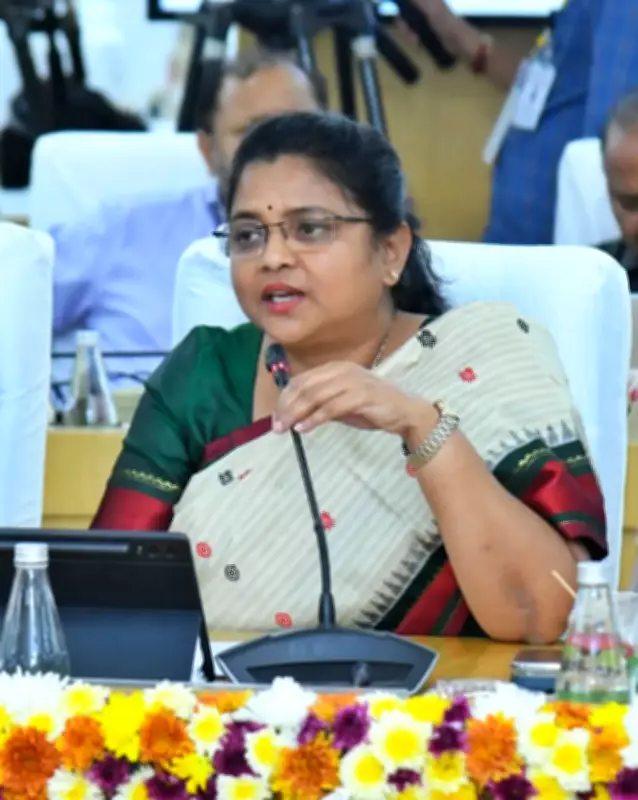
VIJAYAWADA: West Godavari district collector Chadalavada Nagarani's presentation on the 'Circular Economy Blueprint' at the district collectors' conference drew the attention of chief minister Chandrababu Naidu. The blueprint focuses on converting agricultural residue, seafood waste, and livestock manure into commercially viable products, generating employment and industrial growth in rural Andhra Pradesh.
Blueprint for Sustainable Industrialization
The district collector contended that the blueprint will help position the coastal district as a future hub for bio-products, green energy, and value-added rural industries. The presentation stood out at the conference for combining economic growth targets with sustainability-driven industrialization.
Nagarani explained that despite West Godavari's rapid rise in per capita income, the district still suffers from weak industrial expansion. According to the district collector, West Godavari's per capita income is projected to touch Rs 3.5 lakh in 2025-26, up from Rs 2.41 lakh in 2022-23, reflecting a sharp growth trajectory powered by agriculture, aquaculture, and services. However, the industrial sector's share in the district economy remains stagnant at around 15-16%, exposing what Nagarani described as a 'missing multiplier effect.'

'We are a naturally wealthy district, but we must convert that agricultural surplus into industrial growth and employment generation,' Nagarani said during the presentation.
Paddy as Industrial Raw Material
The collector highlighted that Andhra Pradesh produces nearly seven million tonnes of rice annually, creating enormous potential for secondary industries using rice husk, rice bran, and broken rice. Under the proposed circular economy model, rice milling waste can be converted into silica gel, biomass energy, rice bran oil, ethanol, and fortified rice kernels.
'Paddy should not be viewed merely as a food crop. It is an industrial raw material capable of supporting energy, nutrition, and manufacturing sectors simultaneously,' Nagarani observed.
She said that the district administration has already initiated industry mobilisation efforts through a conclave conducted in Bhimavaram, where over 500 rice millers reportedly expressed interest in diversifying into value-added sectors including silica-based products, biomass power, and edible oil extraction. The presentation noted that the initiative has already facilitated multiple industrial units and generated immediate employment opportunities.
Cocoa Ecosystem and Women-Led Enterprises
Nagarani also showcased the district's growing cocoa ecosystem. West Godavari currently has 5,880 acres under cocoa cultivation, producing around 1,700 metric tonnes annually. The presentation stressed that farmers currently receive nearly Rs 300 per kg locally despite global cocoa prices crossing Rs 395 per kg, underlining the need for local processing and branding. Successful local brands such as Choco Tales and The Slow Bean were presented as models of women-led rural industrialisation supported through SHGs, DRDA, and PMFME schemes.
Zero-Waste Seafood Processing Model
The blueprint further proposed a 'Zero-Waste Seafood Processing Model' for Bhimavaram's marine cluster. The district currently has 26 seafood MSMEs with an annual turnover of nearly Rs 67 crore and direct and indirect employment for about 2,468 people. However, nearly 30-40 tonnes of seafood waste generated daily currently yields no commercial value. Under the new model, shrimp shells, fish skin, and scales would be converted into collagen peptides, chitosan, and protein hydrolysates used in nutraceutical, pharmaceutical, and biomedical industries. The proposed project carries an estimated investment of nearly Rs 30 crore under the MSME-CDP framework.
Biogas from Livestock Waste
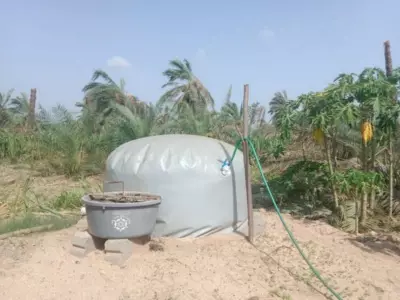
Nagarani also proposed large-scale biogas generation using livestock waste. The district currently has over 37.5 lakh livestock and poultry population capable of generating more than 31.5 lakh kg manure daily, enough to support 63,126 biogas plants.
The chief minister appreciated the district's focus on sustainable industrialisation, women-led enterprises, and rural value addition aligned with the Swarna Andhra 2047 vision.