

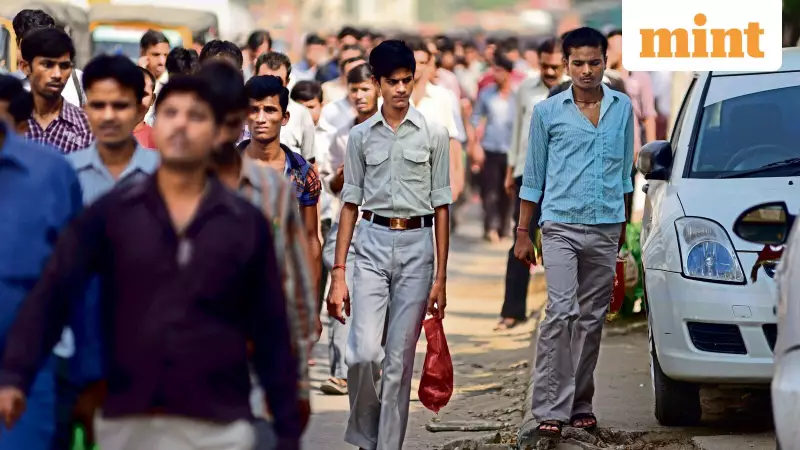
A new analysis reveals a stark economic divergence between the world's two most populous nations. While China has successfully cultivated one of the planet's largest middle classes, India's equivalent demographic has failed to achieve similar global prominence, raising critical questions about the nature of its growth story.
The Global Middle Class Gap
Back in 1980, both China and India had minimal presence in the global middle class, defined as those neither in the bottom half nor the top 10% of worldwide income distribution. Fast forward nearly half a century, and the picture has changed dramatically, but in opposite directions for the two Asian giants. China now commands a significant share of affluent middle-income earners, whereas India's relative importance has diminished.
This puzzling finding, highlighted in the annual World Inequality Report, contrasts with the common narrative. Both nations opened their economies post the Soviet Union's collapse, embracing capitalism—China as the "factory to the world" and India as its "back office." Yet, the outcomes for their citizens' prosperity are markedly different.

The Indian Pyramid: Extreme Ends and a Hollow Middle
The Indian economic structure is characterized by extreme bookends. At the apex sits what Mumbai's Marcellus Investment Managers calls the "Octopus Class"—approximately 1 million super-wealthy individuals whose lifestyles and disposable incomes rival first-world levels. This elite has prospered from financial markets and by serving global and domestic affluent clients as corporate leaders, bankers, and top professionals.
At the base, the situation is dire, especially since the pandemic, which forced 800 million people to rely on government-provided free food grains—a dependency that persists. The problematic space between these extremes of wealth and welfare is defined by work and wages.
Both nations saw surplus agricultural labor fuel industrialization. However, a critical divergence occurred in migration patterns. In China, young men and women moved to cities. In India, migration was predominantly male. Women from landless families often found only seasonal work at brick kilns or construction sites, leaving India with one of the worst female labour force participation rates in the developing world. Post-pandemic gains in this ratio are largely due to increased, low-paying farm work and self-employment.
Barriers to Mobility: Caste, Education, and Informal Work
For men who migrated to cities, opportunities were frequently circumscribed by caste, the birth-based social hierarchy unique to South Asia. While some upward mobility has occurred, it remains severely restricted. Scarce government jobs, which once offered affirmative action, are now rare. Consequently, as noted in the State of Working India 2023 report by Azim Premji University's Amit Basole, a majority of male workers remain trapped in low-productivity roles like guards, chauffeurs, and handymen.
The report argues India missed the crucial shift of labour from subsistence work to profit-led activity. Three out of four nonfarm workers are stuck in the informal sector. This stunted transition directly contributes to a stunted middle class. The wealthy see the masses as a market mainly for basics like utilities, soap, and personal loans, while those at the bottom lack the education and skills to manufacture for domestic or global elites.
The rise of the gig economy offers youth work like quick-commerce deliveries, but it is no stepping stone to a middle-class life. Alarmingly, the World Inequality Report indicates the return on an additional year of schooling in India is lower than not only China's but also Sub-Saharan Africa's.

An Unambitious Elite and the Stalled Ascent
The analysis points to a lack of ambition at the top. India's business dynasties, often legacies of pre-1947 mercantile interests, focus on short-term returns. Instead of emulating China's aggressive tech investments, a key strategy has been lobbying for relaxed labour laws to enable 12-hour workdays. The top 1% of Indians own 40% of the nation's personal wealth, but Gen-Z billionaires are more inclined to park fortunes in family offices than launch new enterprises.
This combination—an elite spoiled by finance and a working class held back by inadequate education, caste, and gender inequities—is stifling the emergence of a robust, globally significant Indian middle class. The profound social change needed to bridge this gap appears nowhere on the horizon, cementing a growth model of extreme inequality.





