

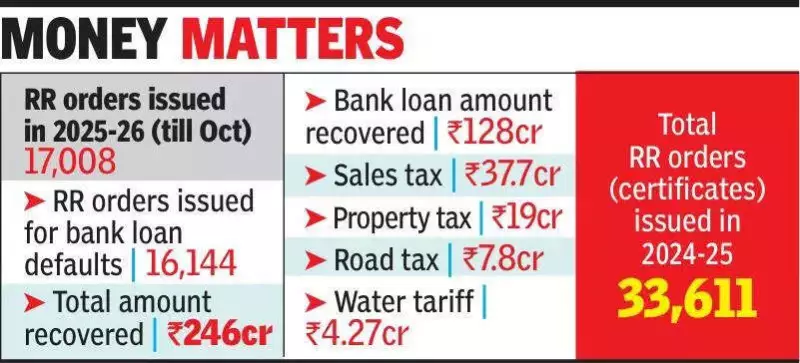
The district administration in Kochi is initiating a staggering number of revenue recovery proceedings against residents, with thousands facing legal action annually for failing to clear financial dues. The primary triggers are defaults on bank loans and non-payment of various government taxes and tariffs.
Alarming Scale of Recovery Proceedings
Data reveals the massive scale of this enforcement drive. In the last financial year, authorities issued a total of 33,611 revenue recovery (RR) orders. For the current fiscal year, until October, the number already stands at 17,008 orders. This translates to the district administration issuing an average of 92 RR orders every single day to recover public revenue arrears.
These orders empower officials to attach and sell properties if individuals persistently fail to settle their outstanding amounts. A district administration officer explained that RR orders are issued following formal requests from the authorities to whom the money is owed.

Breaking Down the Defaults: Loans and Taxes
An analysis of the total RR orders shows a near-even split between two major categories. Nearly half of all proceedings stem from defaults in bank loan repayments. The remaining half are initiated for the failure to remit various government levies, including road tax, property tax, water tariffs, and others.
Within the bank loan defaults, housing loans and credit availed by self-help groups for business purposes are the most common. "When a group defaults on repayment, the RR order is issued to each person in the group to recover the amount," the officer stated. The competitive, performance-oriented banking sector is also a factor. Banks now swiftly approach the district administration when a borrower misses just two or three monthly installments.
"As banks do not want to show any shortage in their quarterly performances, they immediately write to the collector seeking RR proceedings," a Kochi revenue recovery official noted. Often, the threat of proceedings itself prompts a settlement.
Property Tax and Other Arrears Pile Up
On the taxation front, property tax is a significant contributor to arrears. Kochi has a high number of buildings, including commercial ones, and many remain shut for long periods. Owners of such properties frequently fail to remit property tax, leading to piled-up arrears and eventual RR certificates issued at the request of local bodies.
In some cases, the amounts sought through the formal RR process are surprisingly small, as low as Rs 2,000-3,000, which could potentially be collected at the department level. Regarding road tax, a common issue arises when vehicle owners sell their cars or bikes without completing the documentation process, including tax transfer. The arrears accumulate, and once an RR notice is issued, the original owner often tries to shift the liability to the new buyer.
The official also pointed out a trend where some commercial establishments simply refuse to pay taxes, claiming they have become paupers. Furthermore, builders who fail to complete construction projects and hand over apartments can also face RR actions following intervention by the Kerala Real Estate Regulatory Authority (RERA).






