

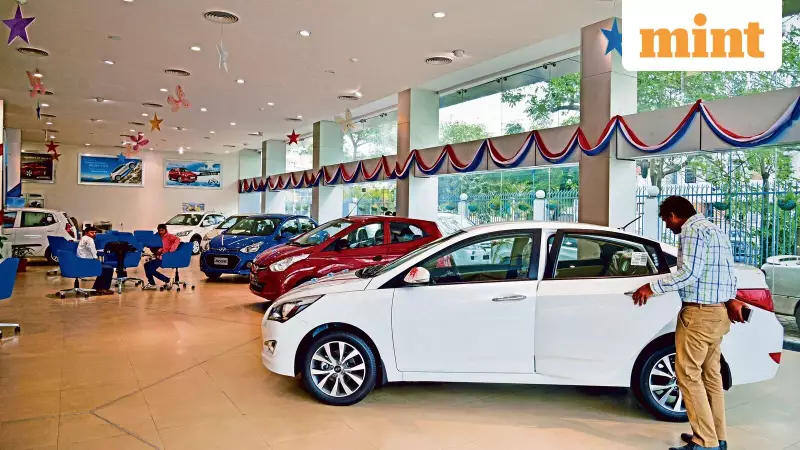
The recent reduction in Goods and Services Tax (GST) rates, while a boon for automobile manufacturers and a trigger for stock market rallies, has cast a long shadow over the country's car dealership network. A complex transition involving the discontinuation of a compensation cess has left dealers grappling with massive financial exposure, eroding profits, and waning investor confidence, pushing the industry to seek legal recourse from the Supreme Court.
The Profit Pinch: Discounts Erode Dealer Margins
On the surface, the numbers tell a story of success. The passenger vehicle market witnessed a robust 17% growth, selling 754,574 units in October-November 2025. The Nifty Auto index raced ahead by 8% over three months, buoyed by the demand surge. However, this sales boom has not translated into prosperity for the crucial last-mile sellers—the dealers.
Three major listed dealerships—Landmark Cars Ltd, Popular Vehicles and Services Ltd, and Competent Automobiles Co. Ltd—have seen their share prices decline by 20%, 4%, and 1%, respectively, since 3 September 2025, when the GST cuts were announced. The core issue is the government's decision to discontinue the compensation cess on automobiles from 22 September 2025.

Dealers typically hold an inventory of 30-50 days. When the cess was scrapped, they were stuck with vehicles for which they had already paid the cess to manufacturers but could no longer collect it from customers. To clear this stock before the new regime took effect, dealers launched aggressive discounting schemes between 3 and 21 September. This fire sale, compounded by customers delaying purchases to wait for lower post-cess prices, severely compressed margins.
The financial damage is stark. Landmark Cars saw its operating profit margin drop from 5.73% in September 2024 to 4.48% in September 2025. Popular Vehicles reported a profit plunge from ₹7.57 crore to a mere ₹0.57 crore year-on-year for the same quarter, with margins falling from 3.54% to 2.96%. Competent Automobiles suffered a 58% profit decline to ₹1.5 crore.
A ₹2,500 Crore Sticky Problem and Legal Battle
The scale of the trapped capital is enormous. Industry estimates suggest the entire auto dealer network in India is sitting on approximately ₹2,500 crore of compensation cess that has become unusable. Previously, dealers could use the cess paid to manufacturers to offset their cess liability to the government, effectively passing the cost to the end consumer. The sudden removal of the cess broke this chain, leaving the amount stranded.
This unresolved issue is the primary reason for the puzzling slump in investor interest towards dealership stocks, even during a festive sales period. "Who is supposed to reimburse them remains a matter of discussion," noted Ashim Sharma, Senior Partner at Nomura Research Institute, acknowledging the dealers' legitimate need for government relief.
With no clarity from authorities, the Federation of Automobile Dealers Associations (FADA) has filed a writ petition in the Supreme Court, which issued a notice to the government last week. Dealers are hopeful, citing historical precedent. Naveen Philip, Managing Director of Popular Vehicles, referenced past instances where states refunded removed cesses following High Court orders.
In anticipation, companies have made financial provisions. Popular Vehicles set aside ₹3.6 crore for the potential loss on compensation cess. The management of these firms has openly discussed the "ambiguity" and "temporary pressure on gross margins" caused by the tax transition during recent earnings calls.

Key Takeaways and the Road Ahead
The situation presents a clear dichotomy: while automakers thrive, their primary sales channel is under severe stress. The listed dealership trio, with a combined revenue of ₹11,693 crore and market capitalisation of ₹3,109 crore, represents just a fraction of a vast, largely privately-held industry now facing a unified challenge.
The core outcomes are:
- Dealer operating margins have contracted by 100-150 basis points due to forced discounting.
- Investors are shunning dealer stocks despite industry-wide sales growth, spooked by the unresolved tax liability.
- The industry's legal fight hinges on the principle of fair transition and past precedents for tax refunds.
- The standard inventory cycle, usually a business staple, became a trap during the mid-month tax change.
The Supreme Court's decision will be pivotal. It will determine whether the government must provide a mechanism to credit or refund the stranded ₹2,500 crore, offering relief to a key segment that drives automotive retail and employment across the nation.





