

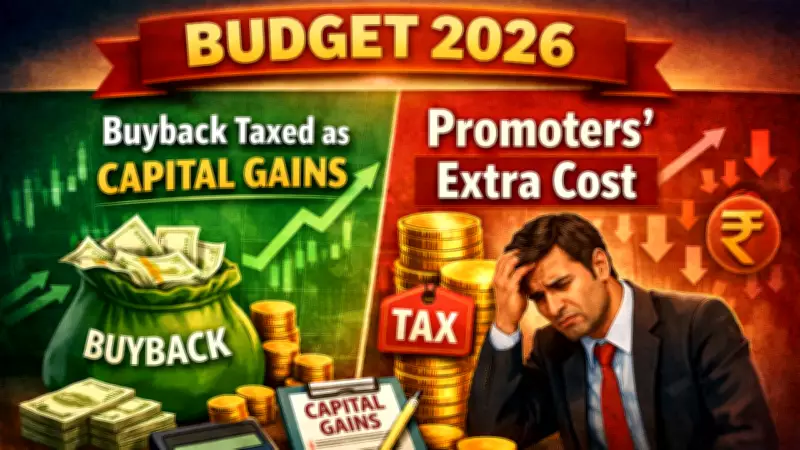
Budget 2026 Proposes Major Taxation Overhaul for Share Buybacks
The Union Budget 2026-27 has announced a significant transformation in how share buybacks are taxed, shifting them from the dividend taxation framework to the capital gains regime. This move aims to rationalize the tax treatment while imposing higher effective taxes on promoters to prevent misuse of this corporate route.
From Dividend to Capital Gains: A Fundamental Shift
Under the budget proposal, consideration received by shareholders during buyback transactions will no longer be treated as dividend income. Instead, it will be taxed as capital gains, effectively aligning buybacks with the treatment of regular share sales in the market. Finance Minister Nirmala Sitharaman emphasized in her budget speech that this change is designed to protect minority shareholders' interests while discouraging tax arbitrage opportunities.
"In the interest of minority shareholders, I propose to tax buyback for all types of shareholders as capital gains. However, to disincentivise misuse of tax arbitrage, promoters will pay an additional buyback tax," the Finance Minister stated during her parliamentary address.

The Current Taxation Mechanism and Its Challenges
Currently, shareholders face a two-part taxation mechanism for buyback transactions introduced through a 2024 amendment. First, the entire buyback consideration is taxed as "deemed dividend" under section 2(22)(f). Second, the original cost of shares becomes a capital loss under section 46A, which can only be adjusted against other capital gains either in the same financial year or carried forward for up to eight subsequent years.
This system created a situation where taxpayers paid high taxes immediately but received relief only later—and only if they had sufficient capital gains to offset the losses. For shareholders in the top tax bracket, this translated to an effective tax rate of approximately 35.88% on the deemed dividend component, including surcharge and cess.
Benefits for Retail and Minority Shareholders
The proposed changes promise substantial benefits for retail and minority shareholders. Under the new capital gains framework:
- Long-term capital gains tax on listed shares held for more than 12 months will be 12.5% without indexation
- Long-term capital gains up to ₹1.25 lakh from listed shares or equity mutual funds remain exempt from tax
- Short-term capital gains tax for shares held less than 12 months will be 20%
Gautam Nayak, tax partner at CNK & Associates, explains: "This was unfair to shareholders other than promoters, particularly domestic retail shareholders of listed companies, where often it was more beneficial to sell the shares on the market at a lower price and pay capital gains tax, rather than paying the higher dividend tax. Now, the law is being rationalised for buybacks completed on or after April 1, 2026."
Higher Tax Burden for Promoters
While retail shareholders stand to benefit, promoters face increased tax liabilities under the new proposal. The explanatory memorandum clarifies that due to their distinct position and influence in corporate decision-making, particularly regarding buyback transactions, promoters will face an effective tax liability of thirty percent.
This comprises tax payable at applicable rates plus an additional tax component. For promoter companies specifically, the effective tax liability will be 22%. The definition of "promoter" extends beyond traditional classifications to include any shareholder holding more than 10% shareholding (directly or indirectly) in a company.
Historical Context and Evolution
Prior to the 2024 amendment, buyback proceeds were exempt in shareholders' hands, with only the company undertaking the buyback paying tax under section 115QA. This tax amounted to 20% (plus surcharge and cess) on the difference between the buyback price and the issue price of shares.
The 2024 changes introduced the two-part mechanism that the current budget seeks to replace. The consistent objective across these policy shifts has been to curb misuse of buybacks while ensuring fair taxation across different shareholder categories.

Practical Implications and Examples
To illustrate the impact, consider a shareholder who purchased 100 shares at ₹40 each in 2020. If 20 shares are bought back at ₹60 each in 2027 under the proposed regime:
- Long-term capital gains would be ₹400 [(60-40) × 20]
- Tax at 12.5% would be ₹50
- However, since long-term capital gains up to ₹1.25 lakh are exempt, no tax would be payable in this scenario
This demonstrates how many small shareholders may incur zero tax liability on buybacks under the new system, representing a significant improvement over the current regime where the same transaction would attract ₹360 in dividend tax plus create an ₹800 capital loss that could only be set off against future capital gains.
Implementation Timeline and Broader Context
The proposed changes will apply to buybacks completed on or after April 1, 2026, once legislated. This taxation overhaul occurs alongside other budget announcements that have drawn mixed reactions, including criticism from West Bengal Chief Minister Mamata Banerjee who described the budget as having "nothing for the common man" and labeled it a "Humpty Dumpty" budget.
The budget also includes revised income tax slabs for FY 2026-27 and changes to what gets cheaper versus costlier across various sectors, though the buyback taxation changes represent one of the most significant structural reforms in corporate taxation proposed this fiscal year.





