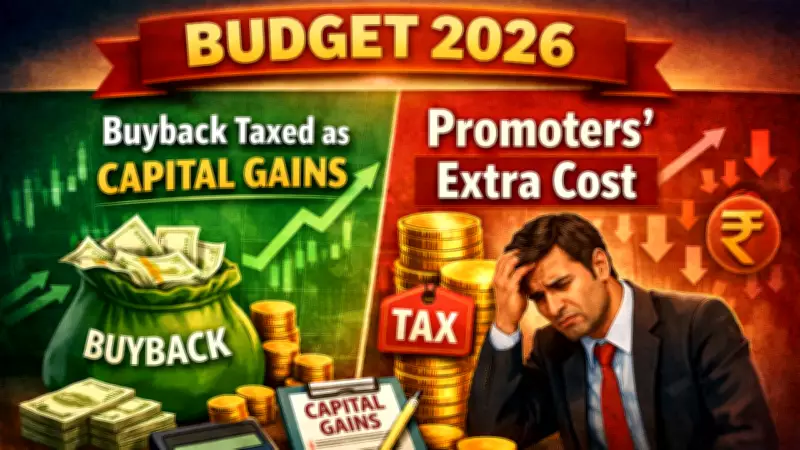
Budget 2026 Introduces Major Taxation Overhaul for Share Buybacks
The Union Budget 2026-27 has announced a significant transformation in the taxation framework for share buybacks, fundamentally altering how these corporate actions are treated for tax purposes. In a move aimed at rationalizing the system and protecting minority shareholders, the government has shifted buyback taxation from the dividend framework to the capital gains regime.
From Dividend to Capital Gains: A Fundamental Shift
Under the new budget proposals, consideration received by shareholders during buyback transactions will no longer be treated as dividend income. Instead, it will be taxed as capital gains, effectively aligning buyback treatment with regular share sales in the market. This change represents a substantial departure from the existing system and addresses long-standing concerns about fairness in taxation.
Finance Minister Nirmala Sitharaman emphasized the rationale behind this change during her budget speech, stating: "In the interest of minority shareholders, I propose to tax buyback for all types of shareholders as capital gains. However, to disincentivise misuse of tax arbitrage, promoters will pay an additional buyback tax."

Tax Implications for Different Shareholder Categories
The new taxation framework creates distinct implications for various categories of shareholders:
For Regular Shareholders:- Long-term capital gains tax on listed shares held for more than 12 months will be 12.5% without indexation
- Long-term capital gains up to ₹1.25 lakh from listed shares or equity mutual funds remain exempt from tax
- Short-term capital gains tax for shares held less than 12 months remains at 20%
- Face an additional buyback tax to prevent misuse of tax arbitrage opportunities
- Higher effective tax burden designed to curb potential exploitation of the buyback route
Comparison with Previous Taxation Regime
The previous taxation system treated buyback proceeds as dividend income, creating significant disadvantages for many shareholders. Under that regime:
- Shareholders in the top tax bracket paid 30% tax on the deemed dividend component
- Additional surcharge and cess brought the effective tax rate to approximately 35.88%
- Only the cost of shares was allowed as capital loss, creating an unfair burden
Gautam Nayak, tax partner at CNK& Associates, explains the significance of this change: "In case of buyback of shares, both listed as well as unlisted, the shareholder was subjected to tax on the entire buyback proceeds as dividends, with cost of the shares being allowed as a capital loss. This was unfair to shareholders other than promoters, particularly domestic retail shareholders of listed companies, where often it was more beneficial to sell the shares on the market at a lower price and pay capital gains tax, rather than paying the higher dividend tax."
Implementation Timeline and Rationalization
The new taxation framework will apply to buybacks completed on or after April 1, 2026, once the necessary legislation is passed. This rationalization addresses several key issues:
- Creates a more equitable system for minority and retail shareholders
- Aligns buyback taxation with market transactions
- Reduces tax burden for many shareholders who may now face lower or even nil tax liability
- Prevents misuse by promoters through additional taxation measures
The budget's approach to share buyback taxation represents a balanced effort to protect investor interests while maintaining fiscal discipline and preventing tax avoidance strategies. By moving to a capital gains framework, the government aims to create a more transparent and fair system for all market participants.