

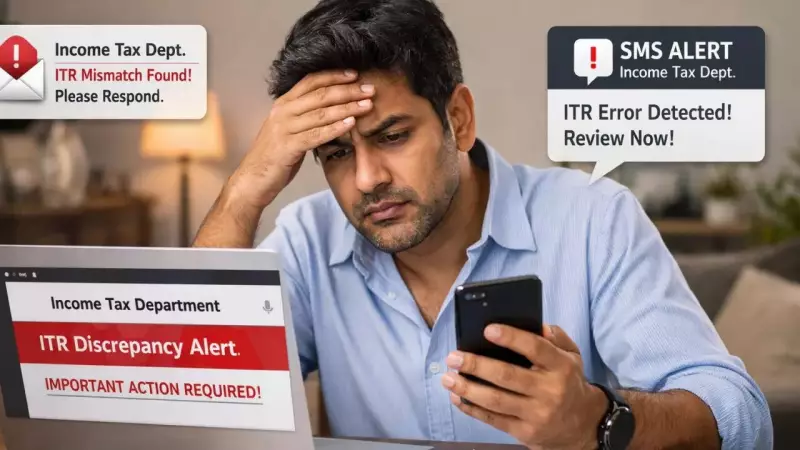
In a year-end move that has caused significant unease among taxpayers, the Income Tax Department has begun dispatching blunt emails and SMS alerts. These communications highlight apparent mismatches in deduction and exemption claims filed in Income Tax Returns (ITRs), effectively putting the processing of returns and the release of refunds on hold for the affected individuals.
Who is Receiving These Tax Alerts?
The department's digital nudge is primarily targeting two specific groups of taxpayers. The first category comprises salaried individuals whose claims for deductions are not reflected in their Form 16, the consolidated statement of salary and TDS provided by employers. The second group includes wealthy individuals who have reported charitable donations running into lakhs of rupees.
According to an ET report, these "do not reply" emails have landed unexpectedly in inboxes, creating confusion about the necessary next steps. Recipients are uncertain whether to ignore the messages or to retract their claimed benefits and file revised returns before the critical December 31 deadline.

Reasons Cited by the Income Tax Department
The department's automated risk assessment systems have flagged returns for several specific reasons. For donations, alerts are triggered by incorrect Permanent Account Numbers (PANs) of recipient charities, or donations to organisations not registered under Section 80G of the Income Tax Act. In other cases, refund claims under the old tax regime appear disproportionately high compared to the declared gross salary.
Other red flags include Leave Travel Allowance (LTA) claims significantly exceeding the amount in Form 16, capital gains declarations that don't align with the Annual Information Statement (AIS), unusually high House Rent Allowance (HRA) claims, and donations reported above the permissible deduction threshold. Notably, these emails are not formal notices and do not appear on the official income tax portal.
Confusion and Criticism from Tax Experts
Tax professionals have pointed out a major flaw: many alerts have been sent even when all details submitted by taxpayers are correct and legitimate. This has led to unnecessary stress for compliant citizens.
Mohit Bang, partner at Trivedi & Bang, a Hyderabad-based CA firm, told ET that the policy's good intentions are undermined by ineffective communication. "The use of charged terms such as 'false claims' for donations flagged by risk systems has rattled taxpayers who have followed the rules," he said. Bang emphasized that when contributions are made via traceable banking channels to government-approved institutions, calling them "potentially false" reflects a deeper mismatch. He urged the department to fine-tune its data analytics to minimize false positives so that automated communications guide rather than intimidate.
Ashish Karundia, founder of Ashish Karundia & Co., highlighted another concern: the timing. He noted that refunds are being delayed for over four months, while these issue-highlighting notices are being issued barely a week before the filing revision deadline. "Even though the objective may be constructive, the release of these communications toward the end of the year has unsettled many compliant taxpayers," Karundia stated. He suggested a better approach would have been earlier engagement during the filing season, allowing for orderly reconciliation.
Karundia also clarified a key point for salaried taxpayers: while employers may set internal deadlines for investment declarations (often around November-December), there is no legal bar on claiming genuine deductions that were not communicated to employers within those internal timelines. Differences between Form 16 and the ITR often arise simply because investment details could not be submitted to the employer in time.
The department, in a December 23 release, described this exercise as one meant to assist assessees and encourage voluntary compliance. However, the sharp wording and the looming deadline have left a cloud of uncertainty over the timeline for tax refunds, even for those confident in the accuracy of their returns.






