Finance Minister Nirmala Sitharaman has declared a comprehensive simplification of India's customs framework as the government's next major reform priority. This announcement, made ahead of the Union Budget for 2026, signals a significant push to make customs procedures more transparent and less cumbersome for businesses and individuals.
Cleaning Up the Customs Regime
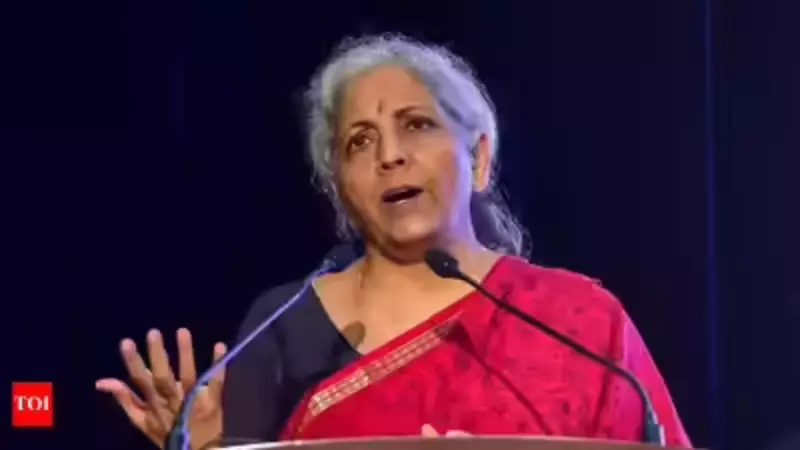
Speaking at the HT Leadership Summit on Saturday, Sitharaman stated that the government intends to undertake a complete overhaul of the customs system. She emphasized the need to simplify processes so that compliance feels less burdensome. The finance minister drew a parallel to the rationalisation efforts already seen in income tax and the Goods and Services Tax (GST), reforms designed to boost consumption by leaving more money in the hands of consumers.
"We need to have customs simplified for people to feel that it is not cumbersome to comply… we need to make it more transparent," Sitharaman said, as reported by PTI. She added that the proposed changes would include bringing the virtues of transparency and ease from the income-tax reforms to the customs regime, alongside a further rationalisation of customs duty rates.

Rationalisation of Duty Slabs and Budget Timeline
Sitharaman indicated that specific announcements regarding these reforms could be made in the upcoming Union Budget, which is likely to be presented on February 1, 2026. She noted that the government has steadily reduced customs duties over the past two years but acknowledged that some items still have rates considered above the optimal level.
"Customs is my next big cleaning-up assignment," she declared. This follows recent actions where the government, in this year's Budget, eliminated seven additional customs tariff rates on industrial goods. This came after the removal of seven tariff slabs in the 2023-24 period. These consecutive moves have successfully reduced the total number of customs tariff slabs to eight, which includes a zero rate.
Economic Context: Rupee and Growth Outlook
Addressing other economic matters, the Finance Minister commented on the Indian rupee's recent depreciation. The currency has weakened by approximately 5 per cent against the US dollar during the calendar year 2025. Earlier in the week, it breached the 90-per-dollar mark for the first time, settling at a provisional all-time low of 90.21. Sitharaman stated that the rupee would find its "natural level," attributing the movement to sustained foreign fund outflows and elevated crude oil prices.
On a positive note, Sitharaman expressed strong confidence in India's economic growth trajectory. She expects India's GDP expansion to remain at 7 per cent or above in the current financial year. This optimism is backed by robust performance data: the Indian economy grew at a six-quarter high of 8.2 per cent in the July-September quarter. This surge was aided by stronger factory output and a robust services sector, which offset a slowdown in farm output.
Growth stood at 7.8 per cent in the preceding April-June quarter and 5.6 per cent in the same quarter a year earlier. For the first half of the financial year ended September, India clocked an impressive GDP growth of 8 per cent.