

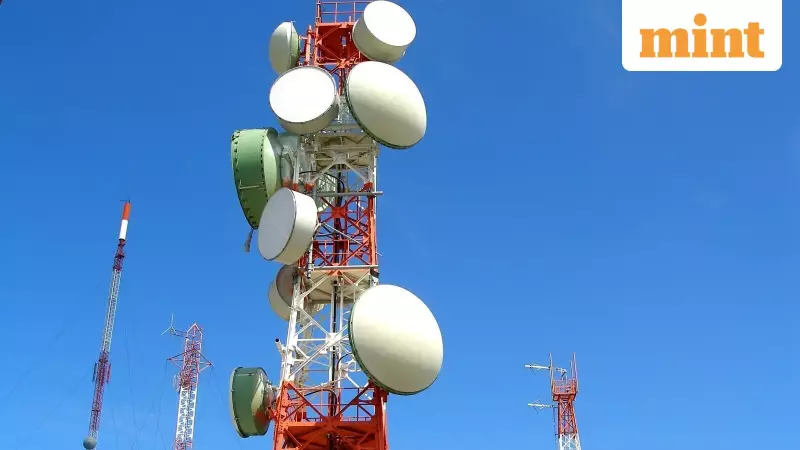
As India steps into 2026, its telecommunications sector is poised for a transformative year marked by high-stakes corporate turnarounds, crucial spectrum decisions, and the potential arrival of new satellite broadband players. The outcomes will directly impact market competition, network quality, and ultimately, consumer bills.
Vodafone Idea's Make-or-Break Year
The spotlight in 2026 will be firmly on Vodafone Idea Ltd (Vi), as it fights for survival in a market dominated by Reliance Jio and Bharti Airtel, which together command a 75% market share. The telco's fate is intricately linked to the government's decision on providing relief for its massive Adjusted Gross Revenue (AGR) dues.
Following a Supreme Court order, the government is reviewing Vi's AGR liabilities. As of September 2025, the company's AGR dues alone stand at a staggering ₹78,500 crore, out of total dues of around ₹2 trillion. An urgent resolution is critical.

"AGR relief itself should be a very meaningful shot in the arm, and it should result in Vodafone being able to raise bank funding as well," said Vivekanand Subbaraman, lead telecom analyst at Ambit Capital. He expects government relief by March 2026, followed by fundraising by June and network deployment by September.
This relief is the key to unlocking ₹25,000 crore of pending bank debt and enabling Vi's planned ₹50,000-55,000 crore capital expenditure (capex) for network expansion. Without relief, the company faces an annual outgo of ₹18,000 crore starting March 2026 for statutory dues.
Analysts believe a competitive three-player market is in everyone's interest. "The primary concern is that if the telecom market really shrinks to only two players, the government would adopt a very heavy-handed stance with respect to tariffs and regulations," Subbaraman added.
Spectrum Auctions: A Muted Affair on the Horizon?
While AGR relief would ease cash flow for Vi, the broader industry's focus in 2026 will also be on the upcoming spectrum auctions. However, analysts predict a "muted affair" with limited participation.
The reason is significant unutilized capacity with existing operators. For instance, spectrum in the critical 26GHz band remains largely unused due to a lack of a device ecosystem. "Operator participation is expected to align closely with renewal obligations, existing spectrum utilization and cash-flow priorities," explained Vinish Bawa, Partner and Telecom Leader at PwC India.
The Telecom Regulatory Authority of India (TRAI) is considering auctioning spectrum across multiple bands, including 800MHz, 900MHz, 3300MHz, and 26GHz, totaling over 12,000 MHz of unsold airwaves. Telcos have called for lower base prices and an extension of the usage period from 20 to 40 years.
This cautious approach follows the June 2024 auction, where only ₹11,341 crore worth of spectrum was sold against an offer of ₹96,238.45 crore, as operators focus on monetizing the ₹1.5 trillion worth of 5G spectrum bought in 2022.
Starlink's Entry and New Regulatory Challenges
2026 is also the year when satellite-based broadband is expected to finally reach Indian consumers. Starlink, along with Bharti-backed Eutelsat OneWeb and Jio Satellite, awaits spectrum and security clearances for a commercial rollout.
While traditional telcos worry about competition, analysts see satellite internet primarily expanding the market to unconnected or poorly served areas. "SatCom is positioned more as an incremental layer of connectivity than a substitute for nationwide mobile networks," Bawa noted.
Pricing will be key. Starlink briefly listed a price of ₹8,600 per month with a ₹34,000 hardware fee in December 2025 before calling it a technical glitch. Ambit's Subbaraman suggests even ₹2,500 per month may be too high for retail users, making enterprise clients the initial target.

A regulatory tussle is brewing between the Department of Telecommunications (DoT) and TRAI over the spectrum usage charge (SUC) for satellite companies. TRAI recommends a 4% of AGR fee, while DoT proposes 5%. Industry seeks a simple, predictable SUC structure for long-term planning.
Another significant regulatory change slated for 2026 is the mandatory SIM binding for using communication apps like WhatsApp, Signal, and Telegram. This means a phone without an active SIM card would block access to these apps, a move supported by telcos to curb cyber fraud but questioned by tech companies seeking wider consultation.
In conclusion, 2026 will be a defining year for Indian telecom. The sector's trajectory will be shaped by Vodafone Idea's struggle for revival, the industry's appetite for new spectrum, the disruptive potential of satellite broadband, and evolving regulations that will collectively determine the future of connectivity and costs for millions of Indians.





