

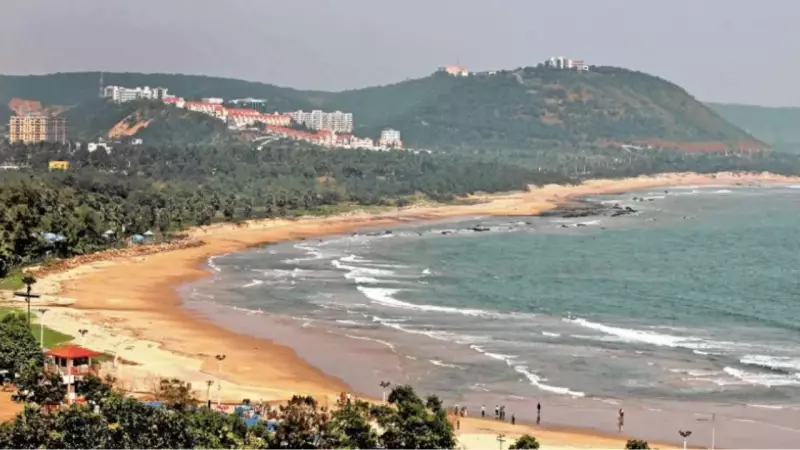
Stretching over 974 kilometers from Srikakulam to Nellore, the coastline of Andhra Pradesh is hiding a treasure far more valuable than its scenic beauty. Beneath its dark sands lies a colossal reserve of rare earth minerals, a geological asset poised to power India's ambitions in clean energy, defence, and semiconductor technology.
A Shoreline of Strategic Wealth
These coastal sands are rich with heavy minerals like ilmenite, rutile, zircon, garnet, and sillimanite. But the crown jewel is monazite, the primary source of Rare Earth Elements (REEs) and thorium. What makes Andhra's deposits exceptional is their quality. The monazite here contains 55-60% rare earth oxides, ranking among the highest grades globally, and 8-10% thorium, a potential fuel for advanced nuclear reactors.
The belt forms a near-continuous corridor with significant deposits identified at Bhimunipatnam, Kalingapatnam, Kakinada, Narsapur, Machilipatnam, Chirala, Vodarevu, Ramayapatnam, and Dugarajapatnam. Nationally, India holds over 300 million tonnes of heavy mineral sands, with 12-15 million tonnes of monazite. Andhra Pradesh is estimated to possess a substantial 30-35% of India's total monazite reserves.

From Mining to Value Addition: APMDC's Aggressive Push
For years, these resources were underutilized due to atomic regulations and processing challenges. Now, with global supply chains shifting away from China's dominance (which controls 85% of REE processing), Andhra is seizing the moment. The Andhra Pradesh Mineral Development Corporation (APMDC) has received 16,000 hectares of beach sand-mining leases from the Centre.
Of this, 1,000 hectares have operational clearance and have been allotted to a private developer. The state is seeking approval for another 4,000 hectares, with plans to fast-track activities across the remaining 11,000 hectares. The focus has sharply moved from just extraction to domestic value addition.
"We are concentrating on downstream processing facilities to make the country self-reliant," stated APMDC's Managing Director, Pravin Kumar. "Exporting raw minerals forces us to import finished rare earth magnets, chips and components at a high premium. The Centre's PLI (Production-Linked Incentive) will be a game changer."
Currently, monazite processing is handled solely by the central PSU, Indian Rare Earths Limited (IREL). To boost capacity, IREL is setting up a 10,000-tonne-per-annum monazite processing plant in Gudur, Nellore, slated for commissioning in 2026.
Policy Tailwinds and Pilot Projects
The Ministry of Mines has launched a major initiative under the National Critical Mineral Mission (NCMM) to recover critical minerals, including REEs, from waste like mining tailings, red mud, and fly ash. Funding of up to Rs 100 crore from the National Mineral Exploration and Development Trust (NMEDT) is earmarked for R&D and pilot projects.
"These guidelines mark a pivotal step towards converting waste into wealth," said Geetika Sharma, Director (Projects) at NMEDT. Pilot studies may receive 90% central funding, fostering partnerships between PSUs, academia, and private firms.
This policy is a boon for Andhra, where decades of mineral sand processing have left tailings containing recoverable REEs. The state already has a foundation: a private REE plant operates in Anantapur, and IREL runs a separation plant in Visakhapatnam. Officials believe reprocessing these tailings alone could unlock an annual Rs 5,000-crore opportunity.
The state government is preparing proposals to extract REEs from fly ash at thermal plants in Nellore and Krishnapatnam, exploring collaborations with institutes like IIT-Hyderabad. Experts suggest modern technology could achieve over 80% extraction efficiency from existing tailings.
As DAR Subramanyam, a retired economics professor, noted, rapid scaling under the NCMM could slash India's REE import dependence from 95% to nearly 50% within five years. With global demand projected to grow tenfold by 2030, Andhra Pradesh's coastline is transforming from a scenic marvel into the strategic frontier of India's critical mineral independence.






