

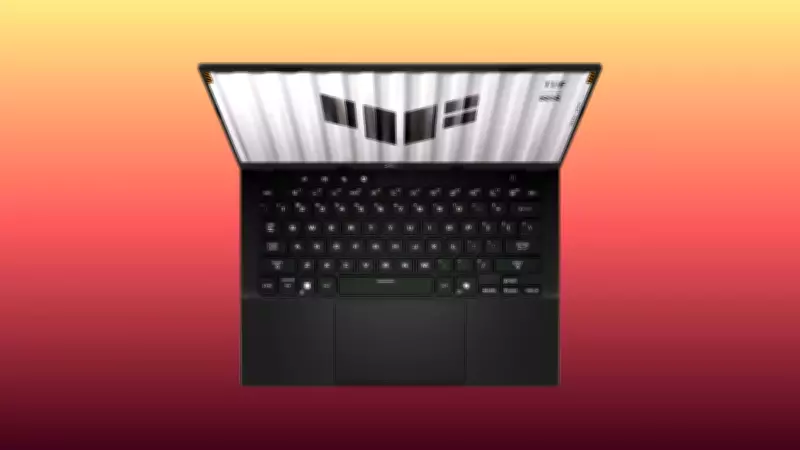
ROG turned 20 this year. Asus marked the milestone with a quieter but more material announcement—a shift in how it builds gaming laptops for India, the company's biggest market in Asia Pacific and its third-biggest worldwide. The TUF Gaming line, the mainstream tier of Asus's gaming portfolio, has begun coming off a Chennai assembly floor this year, with the company targeting 20 to 30 percent of TUF production through that line by the close of FY26.
That work runs alongside a market position Asus has already built. The company leads India's gaming PC segment with around 30 percent share, and is gaining ground in the wider consumer notebook category, where it has set itself a target of taking the top slot this year.
Asus is operating inside a manufacturing ecosystem still in its early years. India's laptop manufacturing scaffolding is two to three years into its build-up, against a mobile ecosystem that has had a decade to mature, and even there, deep manufacturing of displays, memory and silicon still happens elsewhere. The revamped production-linked incentive scheme for IT hardware, and the more recent ECMS 2.0 framework covering display modules, camera modules and other component categories, are designed to make it commercially sensible for a domestic supplier base to grow. The categories ECMS targets typically take three to five years to mature from policy notification to functioning supplier output. As that base grows, the depth of what Made in India means for a gaming laptop will grow with it.

Inside the Chennai facility, surface-mount lines populate motherboards, populated boards become assembled hardware, and hardware becomes finished notebooks. It's the same model the global PC industry runs on—brand-owned assembly drawing on worldwide supplier bases for the silicon, displays and memory inside each machine. "Right now it's not completely fully produced here in India. Obviously some parts come from outside India," said Paramjeet Singh Mehta, head of product and marketing for the consumer and gaming business at Asus India, at the ROG anniversary roundtable. "To achieve that is, in fact, a complicated subject."
Local production carries a premium Asus is willing to absorb. The Indian line costs more to run than its overseas counterparts because the capacity is smaller and the supplier base is still maturing. "For the first few years, local production cost will be much higher than our current production, because the capacity we run overseas is much higher than any capacity we have here," Mehta said. Asus is taking that gap onto its global manufacturing scale rather than passing it through to Indian price tags. "You'll see our prices stay competitive enough to meet customer expectations."
That choice also explains why Asus has moved by series rather than by price tier. Vivobook opened the local floor last year, a mainstream line that let a new surface-mount operation train without the margin sensitivity of higher-end builds. TUF Gaming followed this year. The PCBA work behind a gaming notebook needs the line to have run simpler builds first. ROG Strix and ROG Zephyrus, the brand's higher-end gaming lines, sit further out in the sequence. "We are going by series right now," Mehta said. "It's not about pricing."
The broader picture is moving faster. The locally-assembled share of Asus's India laptop business has climbed from roughly 10 percent in FY25 to between 30 and 35 percent in the current fiscal. Mehta put a soft horizon on full localisation, suggesting "the next three, four years."






