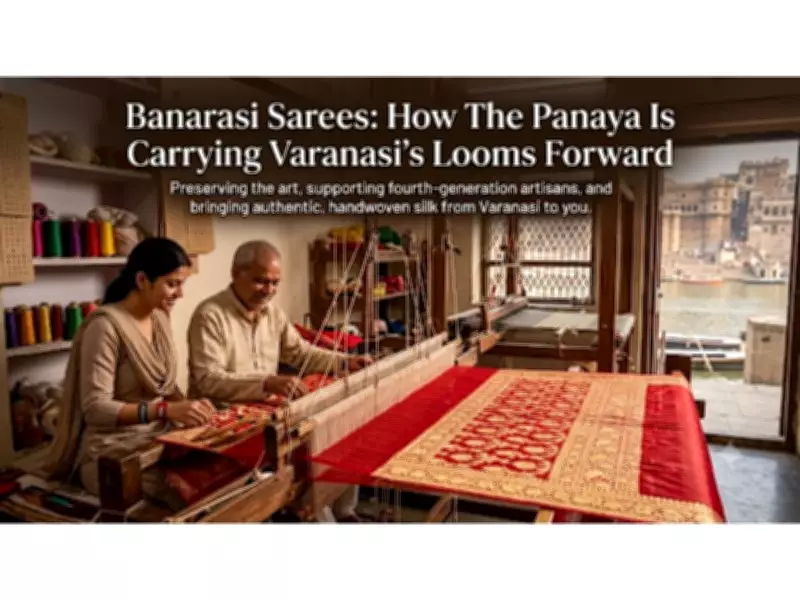
For over five centuries, the narrow lanes of Varanasi have resonated with the rhythmic clatter of handlooms. In small homes and family workshops along the Ganges, weavers dedicate days or weeks to transforming silk and gold thread into patterns passed down through generations. The result is the Banarasi saree, one of India's most celebrated textiles. Few brands have remained as closely tied to this traditional process as The Panaya, which collaborates directly with weaving families rather than mass-market suppliers.
The Craft Behind a Banarasi Saree
Creating a single Banarasi saree can take anywhere from fifteen days to six months, depending on the intricacy of its design. This painstaking process involves multiple stages, from dyeing the yarn to threading the final motif. The Panaya works with fourth-generation artisans whose workshops are often run from their homes, with looms set up in courtyards or front rooms. Entire households contribute to a single saree, ensuring each piece reflects generations of expertise.
Historical Roots of Banarasi Weaving
Banarasi weaving traces its origins to the Mughal era, when Persian motifs such as paisley, floral vines, and intricate borders merged with local Indian craftsmanship. Varanasi, a historic centre of trade and culture, became the natural home for this fusion. Over time, the city's weavers refined techniques passed down through generations, making "Banarasi" synonymous with a standard of silk weaving that The Panaya continues to uphold.

What Makes a Genuine Banarasi Saree
The term "Banarasi" is often used loosely in the market. The Panaya's weavers and quality checks focus on several key elements to ensure authenticity:
- Real zari: Traditional Banarasi sarees use zari—thread wrapped in fine metal, historically silver dipped in gold. The Panaya sources tested, durable metallic thread rather than plastic-coated imitation, even as pure zari has become rarer and more expensive.
- Silk base: Authentic pieces are woven on a silk base, most commonly Katan (fine, twisted mulberry silk), Kora (raw, lightweight silk with a slight sheen), Tissue (silk woven with metallic thread for a shimmering finish), or Organza (crisp, sheer, and structured).
- Handloom technique: Motifs are not printed. Techniques like Kadwa (each motif woven individually, with thread cut and tied off) and Jaal (a continuous net-like pattern across the saree) require the weaver to work the design by hand, thread by thread.
- Asymmetry and small flaws: Because each saree is handwoven, tiny irregularities—a slightly uneven motif or a thread catching light differently—are common. The Panaya treats these as signs of authenticity, not defects.
GI Certification and Its Importance
In 2009, Banarasi sarees received a Geographical Indication (GI) tag, legally recognizing that the term "Banarasi" can only be used for sarees woven in and around Varanasi using traditional methods. This step protected both the craft's identity and the livelihoods of thousands of artisan families. The Panaya ensures its sarees are GI-certified and Silk Mark guaranteed, giving buyers a reliable way to confirm a saree is genuinely handwoven in Varanasi rather than a power-loom copy produced elsewhere.
A Day in the Life of a Weaver
Before weaving begins, the design is plotted on graph paper and translated into a punch-card system for the loom. Silk yarn is dyed in small batches to achieve the exact shade required. For heavily patterned sarees, two or sometimes three weavers work on a single loom, communicating with small gestures as they pass the shuttle back and forth. This is the rhythm behind every piece that reaches The Panaya's collection. The work is slow and physically demanding, often done in natural light because artificial lighting can distort colors. A weaver's skill is measured not just in speed but in consistency—maintaining even tension across a six-metre length of silk so the final piece drapes correctly.
Caring for a Banarasi Saree
To preserve a Banarasi saree from The Panaya, follow these guidelines:

- Store it folded in a soft cotton or muslin cloth, away from direct sunlight, and refold along different lines every few months to prevent permanent creasing.
- Avoid hanging a heavily zari-worked saree for long periods, as the weight of the embroidery can strain the silk threads.
- Dry clean only, and choose a cleaner experienced with zari and silk weaves, since metallic thread can tarnish if handled incorrectly.
- Keep it away from perfume and deodorant sprays, which can react with the metallic zari over time.
The Panaya's Role in Preserving a Craft
Mass production has made inexpensive imitations of traditional textiles widely available, and Banarasi weaving is no exception. However, what a machine cannot replicate is the slow, considered judgment of a weaver who has spent a lifetime learning how silk behaves, how zari catches light, and how a motif should sit against the body when the saree is worn. Brands working directly with Varanasi's weaving families help keep that knowledge alive by ensuring the craft remains commercially viable for the next generation. The Panaya has built its business around this idea, collaborating with fourth-generation weavers to bring GI-certified, handwoven pieces to a wider audience while preserving traditional processes.