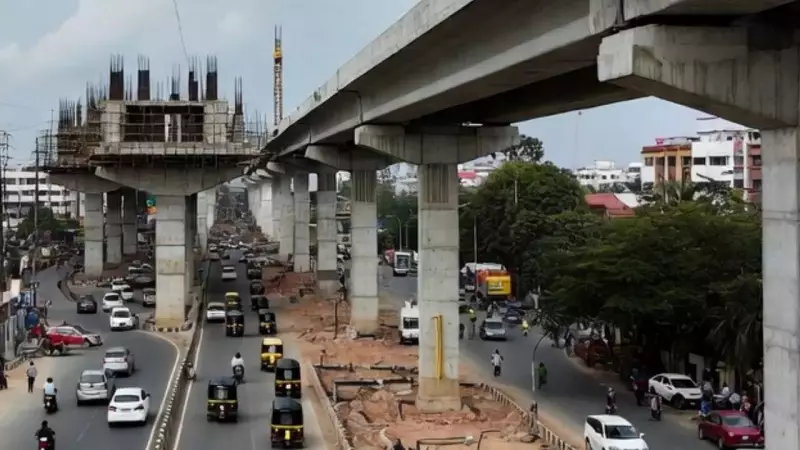
Bengaluru's Longest Double-Decker Flyover Takes Shape to Redraw City Travel
The Bangalore Metro Rail Corporation Limited (BMRCL) has launched tenders for Bengaluru's longest double-decker flyover project. This ambitious initiative forms part of Phase III of Namma Metro. It aims to tackle the city's notorious traffic congestion while expanding public transport options across key growth corridors.
Project Scope and Key Corridors
Phase III spans a total of 44.6 kilometers across two major corridors. The first corridor stretches 32.1 kilometers from JP Nagar 4th Phase to Kempapura via the Outer Ring Road. The second corridor covers 12.5 kilometers from Hosahalli to Kadabagere along Magadi Road.
The double-decker design uniquely combines a Metro viaduct with a road flyover. This integrated approach seeks to maximize infrastructure efficiency and address Bengaluru's pressing mobility challenges.

Detailed Tender Packages and Costs
BMRCL has floated multiple tender packages for the project. The first package covers a 6.5-kilometer double-decker stretch from JP Nagar 4th Phase to Kamakya Junction. This section includes road-cum-Metro structures, ramps, and stations at four busy residential locations. To accommodate the new construction, the existing flyover at Dollars Colony (Delmia) will be demolished. The estimated cost for this package alone stands at ₹1,375 crore.
The second tender involves a 5-kilometer double-decker flyover extending up to Nagarabhavi Circle. It will feature Metro stations at Hosakerehalli, Dwaraka Nagar, Mysuru Road, and Nagarabhavi. This package is projected to cost approximately ₹1,396 crore.
A third package includes a 6.6-kilometer Metro stretch up to Sunkadakatte. Stations at Vinayaka Layout, Papareddy Palya, and BDA Complex Nagar are planned, along with depot connectivity ramps. The cost for this segment is around ₹1,415 crore.
BMRCL has indicated that additional tenders will be issued soon. These will cover the remaining double-decker corridor from Sunkadakatte to Kempapura and the sections along Magadi Road. This will complete the full Phase III alignment.
Government Approvals and Funding
The central government granted approval for the Orange Line in August 2024. Following this, the state government proposed the double-decker structure specifically to alleviate traffic on the Outer Ring Road. The state cabinet later cleared a substantial ₹9,700 crore for the road flyover portion of the project.
Last year, BMRCL proposed some alignment tweaks. These include shifting a Metro station from Peenya to Goraguntepalya, which trims the alignment by 300 meters. Officials expect these changes to be finalized and reflected in the upcoming tenders.
Expert Opinions and Concerns
While the project is designed to ease congestion, some mobility experts have raised concerns. They warn that adding road flyovers alongside Metro corridors might inadvertently encourage greater private vehicle use. This could potentially dilute the long-term benefits of the significant public transport investment.
Despite these concerns, the project represents a major step forward for Bengaluru's infrastructure. It promises to reshape the city's travel patterns and provide much-needed relief from daily gridlock.