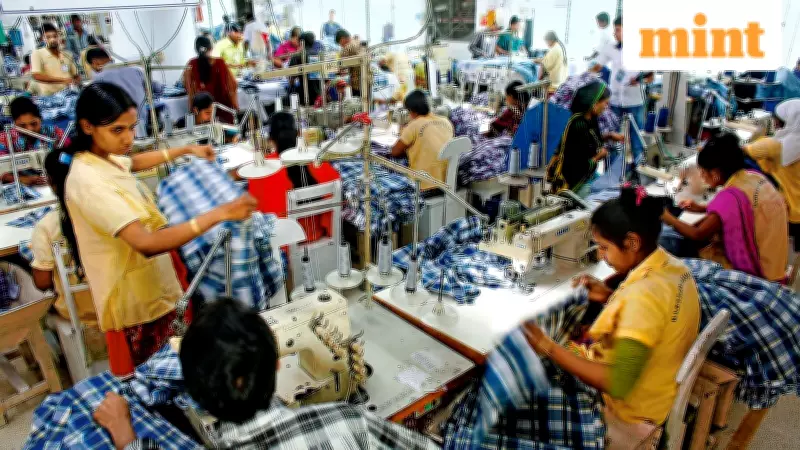
New Delhi: The Union Budget for fiscal year 2027 has strategically positioned the textile industry at the very core of India's manufacturing blueprint for labor-intensive sectors. Finance Minister Nirmala Sitharaman, while presenting the budget in Parliament on Sunday, unveiled an ambitious integrated program designed to significantly boost exports, modernize traditional clusters, and fortify India's standing in the global apparel and technical textile markets.
Comprehensive Five-Part Textile Program Announced
The centerpiece of this strategic push is a five-part integrated textile initiative. This comprehensive program encompasses critical areas including fibre security, technology and machinery upgrades, promotion of technical textiles, support for handlooms and handicrafts, sustainable production practices, and extensive skilling efforts. Alongside this, the government plans to establish mission-mode Mega Textile Parks through a challenge-based approach to create world-class manufacturing ecosystems.
Mahatma Gandhi Gram Swaraj Initiative for Traditional Crafts
One of the most significant announcements was the launch of the Mahatma Gandhi Gram Swaraj initiative, specifically aimed at strengthening khadi, handloom, and handicraft sectors. "This will help in global market linkage and branding. It will streamline and support training, skilling, quality of processes and production," Sitharaman stated, outlining the government's vision to transform the sector into a global sourcing hub. "This will benefit our weavers, village industries, the 'one district–one product' initiative and rural youth."

National Fibre Scheme to Reduce Import Dependence
The proposed National Fibre Scheme represents a strategic move to decrease import reliance by promoting diverse fibre sources. The scheme will focus on natural fibres such as cotton, silk, wool, and jute, alongside man-made and new-age fibres. This initiative aims to ensure stable supply chains and enhance price competitiveness in global markets. Complementing this effort, the Textile Expansion and Employment Scheme will provide crucial capital support for machinery modernization, technology upgrades, and establishing common testing facilities within traditional textile clusters.
Modernizing Skilling with Samarth 2.0
Recognizing the need for a skilled workforce, the budget also announced 'Samarth 2.0', a renewed initiative to modernize the textile skilling ecosystem through strategic partnerships with industry leaders and academic institutions. This program aims to create a future-ready workforce capable of meeting evolving global demands.
Sector's Economic Significance and Employment Impact
The textile sector holds immense importance as a major foreign exchange earner and employment generator for India. Recent data shows the country exported textiles and apparel worth $36.60 billion in FY25, highlighting its critical role in the economy. The industry stands as the country's second-largest employer after agriculture, providing direct employment to over 45 million people. Furthermore, it supports millions of additional jobs across allied activities, with a substantial share concentrated among women and rural populations.
Strategic Timing Amid Global Supply Chain Shifts
These announcements for the labor-intensive sector gain particular significance as geopolitical shifts continue to reshape global supply chains. "The big-ticket announcements for labour-intensive sectors are being seen as a clear push to strengthen domestic industry and improve global competitiveness, especially at a time when new opportunities are opening up through the free trade agreements India has already signed and those currently under negotiation," observed Abhash Kumar, a noted trade economist.
Industry Experts Welcome Holistic Approach
Industry leaders have welcomed the budget's comprehensive approach. "Competitiveness in textiles begins with raw material security and competitive pricing. The budget's proposal for a National Fibre Mission, covering the full fibre spectrum will help ensure supply stability, price competitiveness and stronger global positioning of India's finished textile and apparel products," said Prabhu Dhamodharan, convenor at the Indian Texpreneurs Federation.

Experts emphasize that textile clusters and scale will be crucial in determining how effectively India captures opportunities arising from free trade agreements. With clusters forming the backbone of exports, states like Tamil Nadu—which contributes over 40% of India's apparel exports—are expected to be key beneficiaries. "The budget's push for technology upgradation in clusters and mission-mode mega textile parks will enable faster scaling, higher productivity and the creation of globally competitive supply chains," Dhamodharan added.
Budget Allocations and Continued Support
In alignment with the broader manufacturing push outlined in the budget, the textile sector receives backing through a mix of new initiatives and continued funding support. The Budget has provided a total allocation of ₹5,279 crore for the textile ministry, with sharp focus on fibre security, cluster development, skilling, and value addition across the textile value chain. This allocation is marginally lower than the revised estimate of ₹5,766.68 crore for FY26, but broadly in line with the budget estimate of ₹5,272 crore for the previous fiscal year.
Integrated Textile Programme Receives Substantial Funding
A key highlight is the Integrated Textile Programme, which has been allocated ₹1,500 crore. This program brings together five sub-components:
- The National Fibre Mission
- Textile Expansion and Employment Scheme
- Tex-Eco Mission for sustainable textiles
- Samarth 2.0 for skilling
- Initiatives focused on handmade textiles and human capital excellence
Continued Support for Infrastructure and Traditional Segments
The government has maintained support for large-scale infrastructure through the PM MITRA scheme, with an allocation of ₹300 crore, aimed at creating integrated textile parks and end-to-end manufacturing ecosystems. The allocation for the production linked incentive (PLI) scheme for textiles remains at ₹405 crore, reflecting continued emphasis on man-made fibre apparel, fabrics, and technical textiles.
Support for traditional segments such as handlooms, handicraft, jute, silk, and wool has also been maintained, alongside higher allocations for skill development and technical textiles.
Industry Leaders Optimistic About Future Prospects
"The continued focus on Samarth 2.0, Tex-Eco and mega textile parks, particularly with an emphasis on technical textiles, signals strong intent to future-proof the sector," said Rajeev Gupta, joint managing director of Bhilwara Group yarn manufacturer RSWM Ltd. "With effective implementation, these measures can significantly strengthen India's position as a globally competitive, sustainable and resilient textile manufacturing hub."
Rahul Kakkad, tax partner for consumer products and retail sector at EY India, noted that the budget firmly positions textiles as a growth and employment engine for India. "Through initiatives such as the National Fibre Scheme, cluster modernization, Samarth 2.0 skilling, and sustainability-led TEX-ECO, the budget addresses the sector holistically—from raw materials and technology to skills and green manufacturing. Support for khadi and handlooms further strengthens inclusive growth," he explained. "Collectively, these measures are expected to enhance global competitiveness, boost exports, and generate large-scale employment across the textile value chain."