

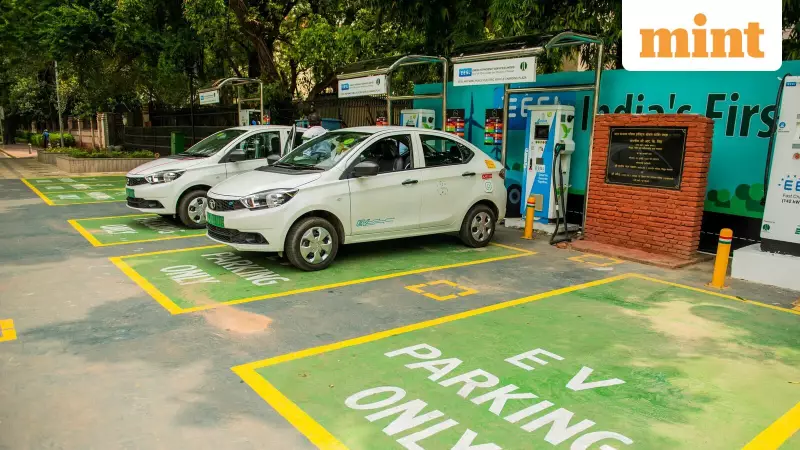
India's electric vehicle (EV) ambition is hitting a familiar roadblock: the fear of running out of power. While the market is growing, the lack of widespread charging stations continues to deter mass adoption. The government is now launching a massive counteroffensive with a plan to install over 72,000 public chargers by the 2027-28 financial year under the PM E-Drive scheme, backed by a ₹2,000 crore budget. This push raises a critical question: can this infrastructure surge finally keep pace with accelerating EV demand?
The Current Charging Gap and EV Penetration Reality
As of August this year, India had just over 29,000 public EV charging stations, according to official data. This sparse network contrasts sharply with the accelerating global shift to electric mobility. In 2024, global EV penetration reached 16.48%, while India lagged at 7.66%. The disparity is even more pronounced in specific segments. An August Niti Aayog report highlighted that while over half of India's three-wheelers are electric, other categories struggle.
In 2025, only about 6% of two-wheelers and 5% of cars sold were electric. The figures were similarly modest for buses (5%) and negligible for medium- and heavy-duty trucks (less than 1%). Experts like Ashim Sharma of Nomura Research Institute emphasize that making charging infrastructure widespread is the key to unlocking higher adoption, a sentiment echoed in the government's new strategy focusing on urban areas and highways.

Understanding the Charger Ecosystem and Government's Plan
Public charging is vital to combat 'range anxiety'—the fear of a depleted battery mid-journey—which remains a primary bottleneck for buyers, especially for cars and long-distance travel. Chargers are broadly of two types: slow AC chargers and fast DC chargers. India has standardized the Combined Charging System Type 2 (CCS2), aligning with European standards, for all public stations. Urban DC chargers typically operate at 30–60 kW, while highway units are more powerful, ranging from 60–180 kW.
The PM E-Drive scheme outlines a clear public-private partnership model for the 72,000 new chargers. The government will largely cover the upstream infrastructure costs (grid connection), while charge point operators or other stakeholders cover the downstream EVSE (vehicle charging equipment). The subsidy structure is tiered:
- 100% of both upstream and EVSE costs for government-owned locations.
- 80% of upstream and 70% of EVSE costs for public-use spots like airports.
- 80% of upstream costs for other public locations like city roads.
State governments and central public sector undertakings, including two state-run oil marketing companies, must submit detailed plans for vetting and approval by the Ministry of Heavy Industries.
The Long Road Ahead: Costs, Viability, and Future Demand
Setting up a charging station involves significant costs, primarily for the EVSE equipment (around ₹8-10 lakh) and variable upstream infrastructure expenses, heavily influenced by distance from the grid and land acquisition. Despite the government's push, the projected need is staggering. A 2023 CII study estimated that India will require 1.32 million EV chargers by 2030 to meet future demand.
The market potential is enormous. According to Mordor Intelligence, India's EV charging station market, currently valued at about $46 billion, is projected to grow at a compound annual growth rate (CAGR) of 21.57% to reach $122 billion by 2030. The success of the PM E-Drive scheme in deploying 72,000 chargers will be a crucial first step in bridging the current confidence gap. It represents a foundational investment to convince hesitant consumers that reliable power is just around the corner, paving the way for India's electric mobility ambitions to finally shift into high gear.






