

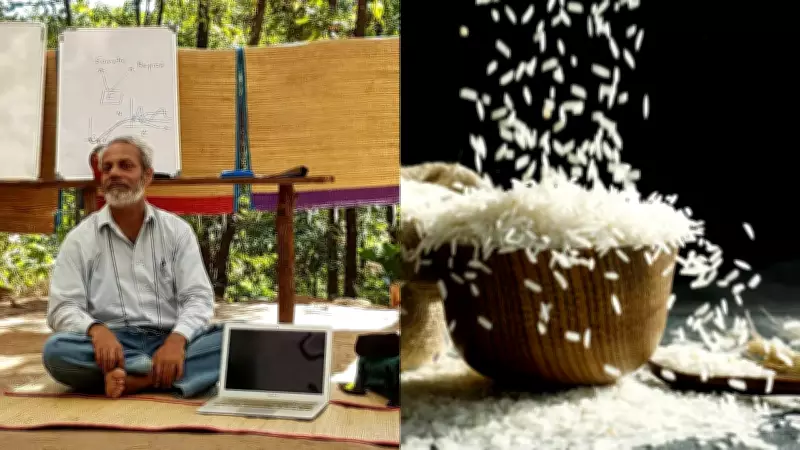
The Seed Warrior of Odisha: Preserving India's Agricultural Heritage
In the agricultural landscape of Odisha, where farming discussions typically revolve around yield metrics, input costs, and market prices, Debal Deb has dedicated his life to cultivating something far more profound: agricultural memory. What began as simple exchanges of grains between farmers has evolved under his stewardship into a comprehensive conservation movement, transforming individual seeds into living archives of climate adaptation, cultural taste, survival strategies, and generational inheritance.
From Modest Exchange to Monumental Conservation
Debal Deb did not commence his journey with a meticulously crafted conservation blueprint. According to multiple interviews and profiles spanning from 2022 to 2024, his mission took root in the 1990s when he observed the rapid displacement of indigenous rice varieties by Green Revolution crops. This transition carried significant implications because these traditional landraces represented more than mere agricultural relics. Many were uniquely adapted to local environmental conditions, and their disappearance signaled a dangerous erosion of genetic diversity precisely when farming systems were becoming increasingly vulnerable to climate-induced stresses.
In 1997, Deb established Vrihi as India's first non-governmental rice seed bank specifically designed for farmers. He later developed Basudha in Odisha as a functional farm where these precious seeds could be cultivated in situ rather than preserved as static museum specimens. This distinction proves crucial: Deb's initiative focuses not on freezing seeds in time but on maintaining their vitality in active agricultural fields where they can continue evolving and adapting.

The Urgency of Agricultural Biodiversity Preservation
The magnitude of genetic loss provides compelling context for Deb's conservation efforts. In a 2022 interview, he revealed that India once boasted approximately 110,000 distinct rice varieties, with nearly 90 percent of this genetic diversity having vanished from farmers' fields. These landraces developed over centuries with inherent resilience to floods, droughts, pests, and diseases—precisely the attributes modern farmers desperately need amid increasingly unpredictable weather patterns.
This practical relevance has attracted attention extending well beyond environmental circles. The World Economic Forum recognized Deb as the "Seed Warrior" in 2019, noting that his seed bank protected more than 1,410 endangered varieties. Subsequent profiles in 2024 documented his safeguarding of 1,442 rice varieties distributed between Basudha and Vrihi, all acquired directly from farmers and all adapted to specific local conditions. While exact counts fluctuate as the collection expands, the trajectory remains unmistakably upward.
A Living Network Rather Than a Static Repository
The revolutionary aspect of Deb's model lies in its dynamic circulation system. Vrihi operates on principles of non-commercial exchange, with seeds shared among farmers under the agreement that recipients will cultivate them and return portions of their harvest to the community. IndiaSpend reported that Deb has distributed seeds freely to nearly 8,000 farmers, creating conservation with built-in circulation where rice varieties are not merely preserved but actively redistributed to maintain their cultivation across villages.
This living system explains the critical importance of Basudha farm in Rayagada district. Rather than serving as a decorative research plot or private collection, it functions as a working agricultural center where rare rice varieties regenerate under authentic growing conditions. Since initiating regular in situ cultivation in 2001, Basudha has evolved into a compact yet highly active hub for ecological farming practices, farmer knowledge exchange, and seed revival initiatives.

The Political Dimensions of Agricultural Preservation
Debal Deb's work carries significant implications for agricultural policy and practice. He consistently challenges the notion that agricultural modernity must equate with genetic uniformity, warning that dependence on narrow sets of high-yield varieties exposes farmers to debt cycles, fertilizer dependency, and heightened climate vulnerability. His argument presents a simple yet profound logic: uniform farming systems become inherently fragile systems. His diverse rice collection, by contrast, represents a powerful argument for biodiversity as agricultural insurance.
The resulting body of work occupies the intersection of ecology, agriculture, and culture. Specific varieties demonstrate exceptional flood tolerance, others exhibit remarkable drought resistance, some offer superior nutritional profiles, while many survive in environments where modern cultivars consistently fail. Collectively, they constitute a tangible record of agricultural wisdom that predates contemporary climate resilience terminology by centuries.
The Practical Legacy of Preservation
Debal Deb's mission proves compelling precisely because of its practical orientation. He has not preserved seeds for nostalgic purposes but has constructed a functional system where seeds continue working for farmers. This represents the deeper lesson of his life's work: biodiversity transcends abstract environmental virtue to become a concrete survival tool. In capable hands, genetic diversity maintains food system flexibility when weather patterns, market dynamics, and policy frameworks become increasingly unpredictable. In this fundamental sense, every rice variety he has saved represents more than a grain—it embodies possibility, resilience, and hope for sustainable agricultural futures.





