

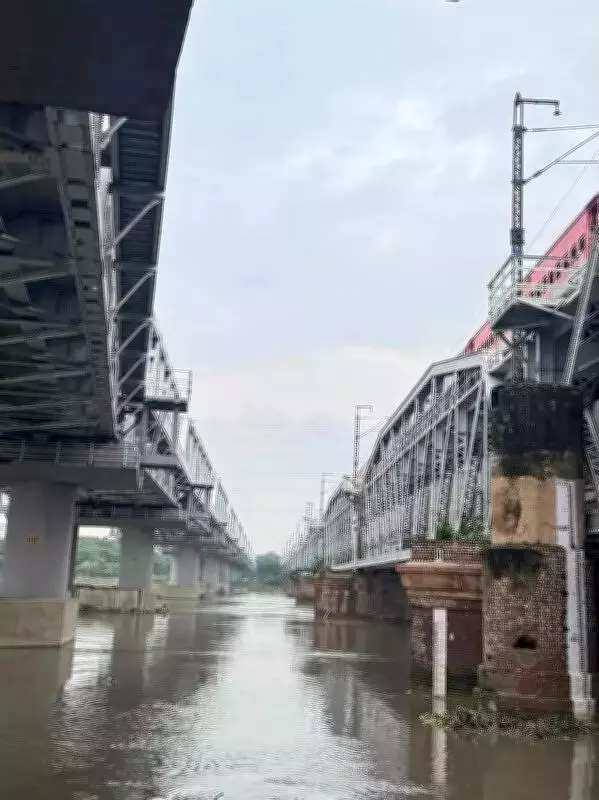
Delhi's New Loha Pul Rail Bridge Finally Operational After Decade-Long Delays
After a decade of persistent delays, missed deadlines, and numerous challenges, the new rail bridge constructed alongside Delhi's historic Loha Pul is now fully prepared for train operations. A senior Northern Railway official confirmed that the project has received the crucial clearance from the Commissioner of Railway Safety (CRS) following a successful trial run.
Operational Status and Technical Details
Train services have already commenced in one direction—specifically from Delhi towards the Delhi-Shahdara section—with operations for trains entering Delhi expected to begin shortly. Officials indicate that full bidirectional operations are imminent, pending only final technical formalities.
The official elaborated, "Non-interlocking work is currently underway in certain sections, which involves connecting the bridge to signaling systems. Once this critical process is completed, the formal inauguration will follow." The inauguration ceremony is anticipated to occur later this month or in early next month.

The CRS inspection was successfully conducted, granting authorization for the cut-and-connection process to initiate traffic movement. This 865-meter-long engineering marvel, constructed at a cost of Rs 227 crore, is projected to significantly alleviate rail traffic congestion in the region.
Advanced Design and Engineering Features
Unlike the aging Loha Pul structure, the new bridge imposes absolutely no speed restrictions on electric multiple unit (EMU) trains. It has been strategically built at a higher elevation over the Yamuna River to guarantee uninterrupted operations even during periods of high flooding.
Designed with modern steel girders and bolted connections, the bridge features:
- A double rail line configuration
- Construction to a 25-tonne loading standard
- Successful completion of static load testing
Officials reported that the bridge "performed satisfactorily" during rigorous testing procedures, confirming its structural integrity and readiness for heavy rail traffic.
Historical Context and Project Challenges
The existing Yamuna bridge, popularly known as Loha Pul, dates back to 1867 and has far exceeded its intended lifespan. This two-deck structure accommodates road traffic on the lower deck while trains operate on the upper deck. Due to its advanced age, trains crossing this historic bridge are subject to a strict speed restriction of 30 kmph.
The new bridge has been developed exclusively for train movement, while the old bridge will continue serving road traffic needs. However, the construction journey has been fraught with significant obstacles.
The project was originally approved in 1997-98, with construction commencing in 2003 and an initial completion target of 2007. One major challenge stemmed from its proximity to Salimgarh Fort, a protected monument. According to a senior railway official, the bridge alignment required alteration as part of the construction needed land within the fort premises.
In 2007, the Archaeological Survey of India (ASI) withdrew permission, citing potential irreversible damage to the monument. Later, in 2011, based on recommendations from the Cultural Impact Assessment Committee, the alignment was revised to completely avoid the fort area. Fresh approval was granted by the ASI in 2012, allowing work to resume.
Future Implications
With all major hurdles now resolved, this long-pending infrastructure project is finally set to become fully operational. The new bridge represents a significant upgrade in Delhi's transportation network, promising enhanced efficiency, safety, and capacity for the city's rail systems.
The successful completion of this project demonstrates how persistent engineering challenges can be overcome through careful planning, regulatory compliance, and technical innovation, ultimately benefiting urban mobility and infrastructure development.






