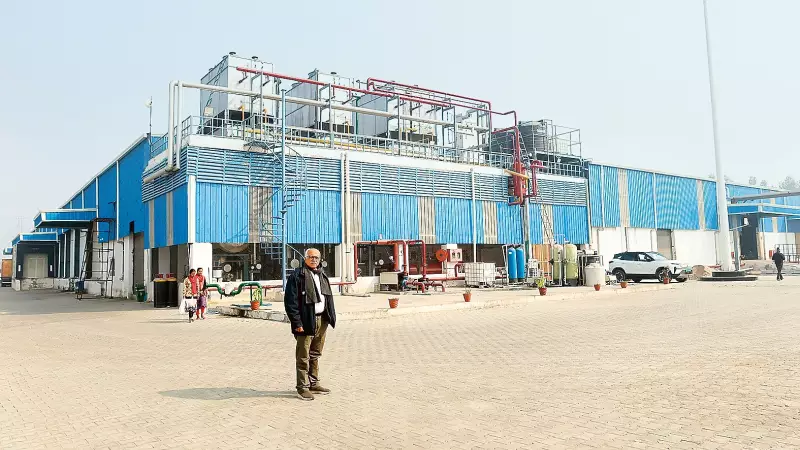
From Army Officer to Carrot King: How Subhash Deswal Transformed Sikandrabad into UP's Gajar Hub
In the fertile lands of Bulandshahr district, a quiet agricultural revolution has been unfolding over the past two decades. Sikandrabad, once an ordinary town in Uttar Pradesh, has emerged as a major carrot cultivation belt, with the vibrant orange crop now grown across an estimated 5,000 acres. At the heart of this transformation stands Subhash Chander Deswal, a former Army officer whose vision and determination have rewritten the rules of farming in this region.
The Genesis of an Agricultural Visionary
Subhash Chander Deswal's journey from military service to agricultural entrepreneurship is nothing short of remarkable. Commissioned into the 12th Battalion of the Mechanised Infantry Regiment in 1984, Deswal served with distinction before taking premature retirement as a Lieutenant Colonel in 2006. His agricultural journey, however, began much earlier during visits to Sikandrabad, where his elder brother operated an Indian Oil Corporation wholesale dealership.
It was during these visits that Deswal met Lal Krishan Yadav, a local pesticide dealer with shared agricultural aspirations. In 1998, the two partners took 250 bigha (approximately 50 acres) on lease in Sikandrabad Dehat, initially cultivating potato, onion, and wheat. For four challenging years, they faced consistent losses, but their perseverance would soon bear fruit in an unexpected form.

The Carrot Experiment That Changed Everything
In 2002-03, Deswal and Yadav made a pivotal decision to experiment with carrot cultivation on just two acres. The results proved so encouraging that they expanded to 20 acres the following season. Crucially, they shifted from traditional desi Asiatic red carrots to the deep orange, cylindrical French Nantes variety, marking the beginning of their quality-focused approach.
Deswal quickly learned the harsh realities of small-scale farming. "We were farming carrots the old way," he recalls, "sowing seeds through broadcasting by hand and cleaning harvested produce in water tubs using our feet." Despite their meticulous grading and packaging efforts, they found themselves at the mercy of Delhi's Azadpur wholesale market arhatiyas (middlemen), who dictated prices and deducted substantial commissions.
Breaking Free from the Middleman System
The turning point came when Deswal decided he would no longer accept this exploitative system. "Under this system that prevails even now," he explains, "the farmer could never negotiate a rate and had to accept whatever the arhatiya gave, just enough to keep him alive." This sense of outrage fueled his determination to become "the biggest carrot grower and seller" on his own terms.
By 2004-05, Deswal and Yadav were cultivating carrots across 100 acres while embracing modern agricultural practices. Their visit to the Indian Agricultural Research Institute in New Delhi proved transformative, where they discovered the Agricola Italiana pneumatic precision seed drill. Despite its Rs 8.5 lakh price tag, Deswal imported the Italian machine, which dramatically improved germination rates and reduced seed requirements from over 3 kg to just 800 grams per acre.
Technological Innovation and Yield Transformation
The partners implemented a comprehensive technological overhaul:
- Laser levelling of fields for uniform water and fertilizer distribution
- Development of raised beds with furrows for optimal irrigation
- Creation of custom harvesting equipment to reduce labor intensity
- Installation of drum-washer machines for efficient cleaning
These innovations, combined with their shift to hybrid carrot varieties from leading French seed company HM.Clause, resulted in yields skyrocketing from 8-10 tonnes to 30-35 tonnes per acre. By 2004-05, they recorded their first substantial profit of approximately Rs 75 lakh.

Building an Integrated Agricultural Enterprise
On October 13, 2009, Deswal and Yadav incorporated Sunshine Vegetables Private Limited, marking their formal entry into agricultural entrepreneurship. Their vision extended beyond cultivation to establishing control over the entire value chain. The company's initial focus was developing cold storage and processing facilities to extend carrot shelf life and enable year-round sales.
After navigating regulatory challenges with the Bulandshahr Development Authority, they secured necessary approvals with support from then UP Chief Minister Akhilesh Yadav. In February 2015, the foundation stone was laid for their 6,500-tonne cold store, financed through a Rs 5-crore Punjab National Bank loan with Rs 1.7 crore subsidy from the National Horticulture Board.
Expansion and Economic Impact
Today, Deswal and Yadav's operations span approximately 1,500 acres through a combination of owned land and contract farming with 517 growers across Sikandrabad and surrounding villages. Their annual handling capacity has reached nearly 45,000 tonnes of produce, with cultivation proving highly profitable at Rs 1.25-1.4 lakh per acre.
The enterprise has continued to grow with significant government support. In October 2024, UP Chief Secretary Manoj Kumar Singh inaugurated their Rs 40-crore integrated cold chain project, partially funded by an Rs 8.5-crore subsidy under the Pradhan Mantri Kisan Sampada Yojana. This expansion includes:
- Cold storage with 6,000-tonne capacity at 0°C and 4,000 tonnes at -20°C
- 5 tonne/hour automatic vegetable processing unit
- 3 tonne/hour Individual Quick Freezing line
- Ten 9-tonne refrigerated trucks
A Model for Agricultural Transformation
With annual turnover exceeding Rs 50 crore and distribution networks spanning from Delhi-NCR to Mumbai, Hyderabad, Bengaluru, Chennai, and beyond, Sunshine Vegetables represents a new paradigm in Indian agriculture. Deswal's journey demonstrates how strategic investments in technology, combined with effective utilization of government schemes, can create sustainable agricultural enterprises.
Most importantly, this story represents a fundamental shift in farmer empowerment – from being price takers at the mercy of middlemen to becoming price setters who control their own destiny. As Deswal himself puts it: "If you become big and produce both good quantity and quality, the arhatiya will himself come. You can then be a price setter."
The Sikandrabad carrot revolution stands as testament to what determined farmers can achieve when they combine traditional knowledge with modern technology, entrepreneurial spirit with agricultural expertise, and personal vision with community development.