

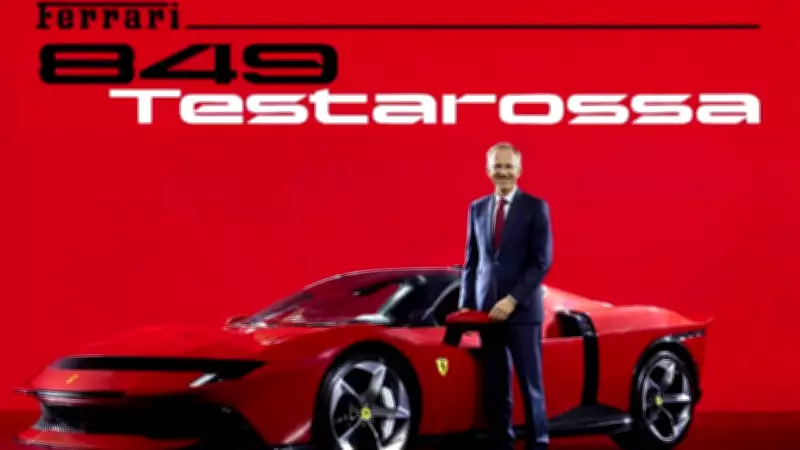
From Semiconductors to Supercars: The Journey of Ferrari's CEO
Long before he assumed the high-profile role of steering one of the world's most iconic luxury car brands, Benedetto Vigna – the global CEO of Ferrari – cultivated a distinguished career in the realms of semiconductors and subnuclear physics. A graduate in subnuclear physics from the University of Pisa, Vigna dedicated over twenty years to European semiconductor giant STMicroelectronics, where he emerged as a pivotal innovator, filing more than 200 patents in micromachining. In September 2021, at the height of the Covid-19 pandemic, he transitioned to the high-octane world of Ferrari, taking the helm of the legendary automaker.
A Spiritual Connection: Varanasi and Ferrari's First Electric Car
During a recent visit to India – marking his fiftieth trip over the past two-and-a-half decades – Vigna traveled to Varanasi to engage with students at IIT before proceeding to Mumbai for Ferrari's inaugural brand event in the country. He was captivated by Varanasi's ancient and spiritual name, Kashi, and was thrilled to discover that it translates to 'City of Light.' This revelation resonated deeply with him, drawing a direct parallel to Ferrari's first electric vehicle, the Luce (pronounced 'Loo-cheh'), which also means 'light.'
"It was particularly interesting for me because this year we are launching our electric car, Ferrari Luce. Luce also means light. Everything was like a sign," Vigna remarked, reflecting on the serendipitous connection.

India: A Market of Passion and Exclusivity
While India represents a relatively small market in terms of Ferrari sales, the brand places a premium on exclusivity over volume. Vigna expressed his admiration for the country, describing it as "very 'sparkling'" and noting that "people here dare more." He drew a parallel to the Hindi phrase "Hoga Kaise Nahi" (How will it not happen? It has to happen), which he sees as emblematic of both Ferrari's ethos and the Indian spirit.
"India is a special place for me because it is now more than 25 years that I have been coming here. What I like when I come here is that you have a peaceful approach, kindness, and a spiritual approach," Vigna shared. He highlighted the growing domestic wealth and the younger demographic as key factors that make India an important and fertile market for Ferrari's future growth.
Navigating Global Uncertainty: The Luxury Market Perspective
In the face of global economic and geopolitical tensions, including wars and market volatility, Vigna remains confident in the resilience of the luxury automotive sector. He attributes this stability to Ferrari's limited production – only 14,000 cars annually – and its diversified client base. However, he emphasizes the importance of humility, agility, and cohesion in navigating these challenges.
"We cannot pretend to manage uncertainty; you cope with it. You take it as a fixed condition and see how to cope," Vigna stated. He underscored the value of spiritual journeys, like his visit to Varanasi, in reinforcing the need for humility and collaboration during turbulent times.
The Future of Driving: Emotion in the Age of EVs and AI
As the automotive industry shifts towards electric vehicles (EVs) and autonomous driving, Vigna asserts that Ferrari's core mission – delivering unique driving emotions – remains unchanged. He argues that technology, when humanized, can preserve the thrill of driving, regardless of the powertrain.
"If you use technology starting from the emotion that you want to deliver, we are able to do something unique," Vigna explained. He addressed common misconceptions about EVs, noting that electric motors are not silent and that Ferrari's Luce model incorporates features like paddle shifts to maintain engagement.
Vigna passionately declared, "Emotion cannot be outsourced." He believes that while technology may augment certain functions, the emotional connection between driver and car is irreplaceable and fundamental to the Ferrari experience.

Collaboration with Jony Ive: Embracing Open Innovation
Vigna addressed the polarized reactions to Ferrari's collaboration with former Apple designer Jony Ive on the Luce. He clarified that Ive's team worked alongside Ferrari's internal designers, fostering a synergy of diverse perspectives.
"If you want to do something new, you need to put together people with different points of view, and that’s what we did," Vigna said. He highlighted the benefits of this partnership, such as the incorporation of new materials like anodized aluminum and advanced glass, which enriched the car's design language.
Vigna emphasized that open innovation is crucial for sustainable growth, allowing Ferrari to blend tradition with cutting-edge advancements while staying true to its heritage.
Exclusivity and Growth: Ferrari's Strategic Vision
Ferrari's commitment to exclusivity remains unwavering. Vigna outlined the brand's strategy of focusing on quality over quantity, with growth driven by personalization, innovation, and client intimacy rather than mass production.
"Exclusivity is one of our fundamental values. We value quality over quantity. To be exclusive means that if I have a car, you cannot have that same one," Vigna affirmed. He detailed plans to expand Ferrari's presence in India through enhanced client engagement and tailored experiences, leveraging the country's growing economy and favorable trade agreements.
In conclusion, Benedetto Vigna's insights reveal a leader deeply attuned to the intersection of tradition and innovation, spirituality and commerce. His vision for Ferrari is one that honors its storied past while boldly embracing the future, ensuring that the emotion of driving remains at the heart of the brand's journey.





