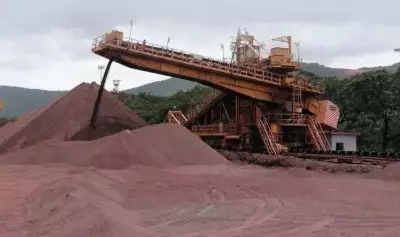
India's vast potential in critical minerals, essential for modern technologies and green energy, remains largely untapped due to significant policy and regulatory hurdles. Addressing these gaps could propel the sector to a valuation of $30 billion, according to industry leaders. The call for reform comes as global competition for these strategic resources intensifies.
The Need for Streamlined Policy and Clearance
Vikrant Singh, Chief Operating Officer of Novasensus Advisors LLP, a prominent strategy and management consulting firm, has highlighted the fragmented regulatory landscape as a major bottleneck. He emphasizes that the current system, involving multiple ministries and lengthy approval processes, discourages investment and delays project execution. A single-window clearance mechanism is cited as a crucial reform needed to unlock the sector's growth.
Singh points out that while India has taken positive steps like amending the Mines and Minerals (Development and Regulation) Act and identifying 30 critical minerals, the on-ground implementation remains challenging. The absence of a stable, long-term policy framework creates uncertainty for both domestic and international investors looking to commit capital to high-risk exploration and mining projects.

Harnessing Domestic Reserves and Global Partnerships
The recent discovery of 5.9 million tonnes of lithium reserves in Jammu & Kashmir's Reasi district is a landmark development for India's ambitions. This find positions the country to reduce its heavy dependence on imports for a mineral vital to electric vehicle batteries and energy storage. However, simply having the resource is not enough.
Experts argue that to fully capitalize on such discoveries, India must develop a robust value chain—from exploration and mining to processing, refining, and manufacturing. This requires not just policy fixes but also technology transfer and strategic partnerships. Collaborations with resource-rich countries under government-to-government agreements and acquiring overseas mining assets are seen as key strategies to secure a steady supply of minerals not abundantly available domestically.
Economic and Strategic Imperatives
The push for critical minerals is driven by dual objectives: economic growth and national security. As the world transitions to renewable energy and electric mobility, demand for minerals like lithium, cobalt, nickel, and rare earth elements is skyrocketing. India's own goals for electric vehicle adoption and renewable energy capacity are directly tied to the availability of these materials.
A thriving domestic critical minerals sector would create jobs, spur technological innovation, and strengthen India's position in global supply chains. More importantly, it would reduce strategic vulnerabilities. Over-reliance on imports, particularly from a single country or region, exposes India to geopolitical risks and supply disruptions. Developing a self-reliant, or at least diversified, supply base is therefore a strategic necessity.
In conclusion, the consensus from industry leaders is clear. India possesses the geological potential to become a significant player in the global critical minerals market. Realizing this potential, however, hinges on the government's ability to enact swift and decisive policy reforms. Creating a transparent, efficient, and investor-friendly regulatory environment is the critical first step to transforming this potential into a $30 billion economic opportunity and securing the nation's industrial future.