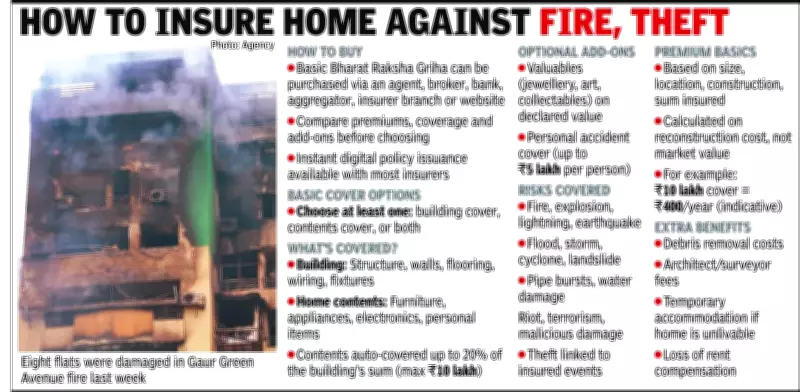
Ghaziabad: The Raghavs of Tower D were only able to save their wallets and phones on April 29 when a fire swept through eight flats at Gaur Green Avenue in Indirapuram. "Everything is finished. We are only left with the clothes that we were wearing when we left the house," said Raghav, sitting in a room at Country Inn hotel in Sahibabad. "My children's books, laptops and toys, our degrees, property documents and appliances were destroyed. We had nearly Rs 25 lakh cash at home and jewellery worth Rs 30 lakh - everything has been charred."
The fire has laid bare a costly oversight. In a housing complex where flats cost crores, almost nobody thought to insure them. Among all the affected families, only one homeowner - a government official - had an insurance policy covering fire-related damage.
The RWA has been raising funds for affected families. However, the incident has exposed a widespread misconception among apartment owners that society-level insurance protects individual homes. RWA president Rajeev Wadhawan said the society has a Rs 300 crore insurance cover, which protects it from structural damage in case of an earthquake, flood or any other such calamity. "Fire accidents do not structurally damage a building, hence it is not covered in this insurance," he said.

Moreover, society insurance only protects common areas. Individual flats, interiors and personal belongings remain the responsibility of homeowners. This distinction often becomes clear only after a disaster. Raghav moved into the flat barely a year ago after purchasing it for around Rs 2.5 crore. Today, he estimates the total damage to the house and valuables at more than Rs 1.5 crore. When asked the reason for not buying home insurance, Raghav retorted, "Who thinks that their house will get burned down one day?"
Understanding Home Insurance
Home insurance in India is a property insurance product designed to protect a residential unit and its contents against damage from fire and other unexpected events. It is different from life insurance and is also not the same as home loan insurance. The latter safeguards repayment obligations in the event of a borrower's death or disability, but home insurance is concerned purely with protecting the physical house and the belongings inside it.
The most common standard product available for residential property owners is Bharat Griha Raksha, a fire and allied perils policy offered by general insurance companies. The policy can insure the house's structure, household contents or both. The cover protects the walls, flooring, electrical wiring, plumbing and attached fixtures. In addition to the main residential unit, it can be extended to garages, verandahs, compound walls, retaining walls, parking areas, solar panels, water tanks, internal roads and fixed fittings within the property. The policy also reimburses certain related expenses that arise after damage, including professional fees paid to architects, surveyors or consulting engineers, generally up to 5% of the claim amount, and debris removal costs of up to 2% of the claim.
Damages caused by fire, explosion, lightning, earthquake, storm, flood, landslide, riot, malicious damage, terrorism, overflowing water tanks, sprinkler leakage and theft are covered by the policy. In situations where the house becomes temporarily uninhabitable due to any of the issues mentioned above, the policy may also compensate for loss of rental income or cover rent for alternative accommodation.
Common Misconceptions
One of the biggest misconceptions among apartment owners is that insurance must match the resale price of a flat, say experts. "Insurance does not cover the market value of the apartment," Alox Dixit, a chartered insurer and a fellow of Insurance Institute of India, said. "Barely 1%-2% of homeowners in India buy an insurance policy thinking it would be expensive. But in reality, a flat worth Rs 2 crore might just need Rs 40-70 lakh in rebuilding costs."
The building coverage under home insurance is based on how much it would cost to rebuild the physical structure. This calculation depends on carpet area, construction cost per square metre, permanent fixtures and any additional structures declared by the owner. The contents cover protects household belongings such as furniture, appliances, clothing, electronics and personal items kept within the home and declared by the owner.

Premium Costs
According to the Insurance Regulatory and Development Authority of India, premiums for home insurance depend on the insured amount, type of construction, risk profile of the building, location and insurer pricing approved by the Authority. For example, if the reconstruction cost of a home is Rs 10 lakh and the insurer charges a premium rate of 0.40 per Rs 1,000 of cover, the annual premium would be around Rs 400. Further, the premium for general contents of this home on the basis of 20% of the building sum insured will be Rs 2 lakh, for which a premium of Rs 80 will be charged at the same rate.
Premium rates are subject to regulatory guidelines. The actual cost of insuring a flat is often far lower than what many homeowners assume, particularly when compared to the financial burden of replacing furniture, electronics, appliances and valuables after a fire. Where building cover is taken, contents are automatically insured up to 20% of the building sum insured, capped at Rs 10 lakh, unless homeowners opt for higher declared coverage.
Additional Coverage Options
Homeowners can also purchase additional coverage for valuables such as jewellery, silverware, paintings and artwork. The policy also offers a personal accident clause under which compensation may be paid if an insured event results in the death of the policyholder or spouse.
Some insurers also provide add-on benefits beyond repair costs. Certain home insurance products, for example THE Home Shield Insurance Policy by HDFC Ergo, offer Rs 25 lakh coverage for house content safeguard without a specified list.
To buy home insurance, one can contact any insurer. Dixit advised insurance buyers to check if their housing complexes have a fire NOC to avoid their claim being rejected by the insurance company.