

Gujarat Electric Vehicle Sales Surge 75.5% in March Amid Policy Push and Fuel Concerns
In a remarkable development, Gujarat witnessed a dramatic 75.5% year-on-year increase in electric vehicle sales during March, driven by a combination of expiring tax incentives and growing apprehensions over potential fuel shortages. This surge highlights a significant shift in consumer behavior towards sustainable mobility solutions in the state.
Record-Breaking Registrations and Pure EV Dominance
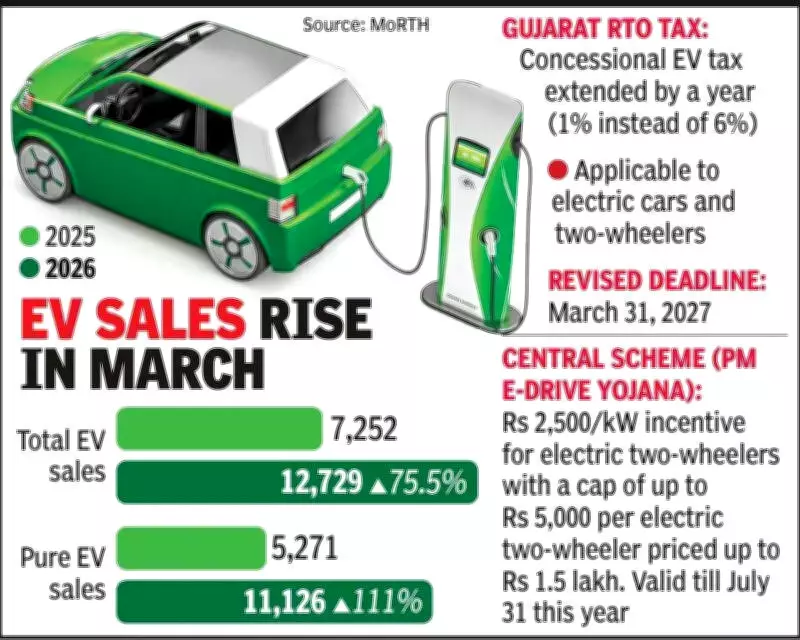
According to data from the Ministry of Road Transport and Highways, Gujarat recorded a total of 12,729 EV sales in March 2026, encompassing battery-operated vehicles, pure electric vehicles, petrol hybrids, and diesel hybrids. This figure marks a substantial rise from the 7,252 units sold in March 2025. Notably, pure electric vehicles accounted for 11,126 of these sales, more than doubling from 5,271 units in the previous year, reflecting a staggering 111% year-on-year growth.
This exponential increase underscores the strengthening affordability of EVs, sustained policy support from both state and central governments, and a palpable shift in consumer sentiment towards greener alternatives. The trend is particularly pronounced in urban centers like Ahmedabad, where awareness and infrastructure are rapidly evolving.

Extension of Tax Incentives Provides Major Boost
In a strategic move to sustain this momentum, the Gujarat government has extended its RTO-linked tax incentives for electric vehicles until March 31, 2027. This decision, formalized through a notification issued on March 30, amends the previous deadline from March 31, 2026, and is expected to further elevate demand by ensuring lower upfront costs for buyers.
Pranav Shah, Gujarat Chairperson of the Federation of Automobile Dealers Associations (FADA), emphasized the impact of this extension. "The extension of tax incentives under the Gujarat Motor Vehicles Tax Act ensures that buyers continue to benefit from lower upfront costs, a key trigger in a price-sensitive market," he stated. He added that inquiries for electric vehicles have doubled in both two-wheeler and four-wheeler segments, driven largely by concerns over possible fuel shortages and a desire to safeguard personal mobility.
Market Dynamics and Consumer Behavior
FADA data reveals that EV sales are growing by 30-40% across both two-wheeler and four-wheeler categories, with some areas experiencing demand surges of 50-100%. On a month-on-month basis, March sales nearly doubled, indicating a peak in purchasing activity ahead of the original incentive deadline.
Ravish Shah, an EV dealer from Ahmedabad, noted the sharp uptick in demand. "Customers were well aware of the impending changes ahead of the March-end deadline. From around March 12, we saw a sizeable uptick in demand, as buyers rushed to avoid a potential Rs 11,000 increase due to subsidy withdrawal and RTO cost revisions," he explained. He further highlighted that daily commuters and professionals are increasingly preferring at least one EV for office use, especially those with rooftop solar installations aiming to optimize running costs amidst fuel shortage concerns.
Policy Support and Future Outlook
Although Gujarat ended its direct subsidy in 2024, which offered up to Rs 20,000 for electric two-wheelers and Rs 2 lakh for electric cars, a combination of central support and local incentives continues to bolster adoption. Central schemes like the PM e-Drive Yojana provide incentives of around Rs 2,500 per kW for electric two-wheelers priced up to Rs 1.5 lakh, while municipal tax rebates add to the appeal.
Electric two-wheelers dominate sales volumes due to their affordability and suitability for daily commuting. However, the passenger vehicle segment is gaining traction, particularly among upper-income buyers and fleet operators seeking to offset fuel price volatility. Rahul Shah, an industrialist who recently purchased an EV, shared his perspective: "I am taking measures at both business and household levels to ensure that dependence on gas and conventional fuels is less. The idea is to safeguard my mobility and ensure continuity of operations."

With the extended tax incentives and ongoing concerns over fuel availability, Gujarat's electric vehicle market is poised for sustained growth, reinforcing the state's position as a leader in India's transition to sustainable transportation.





