

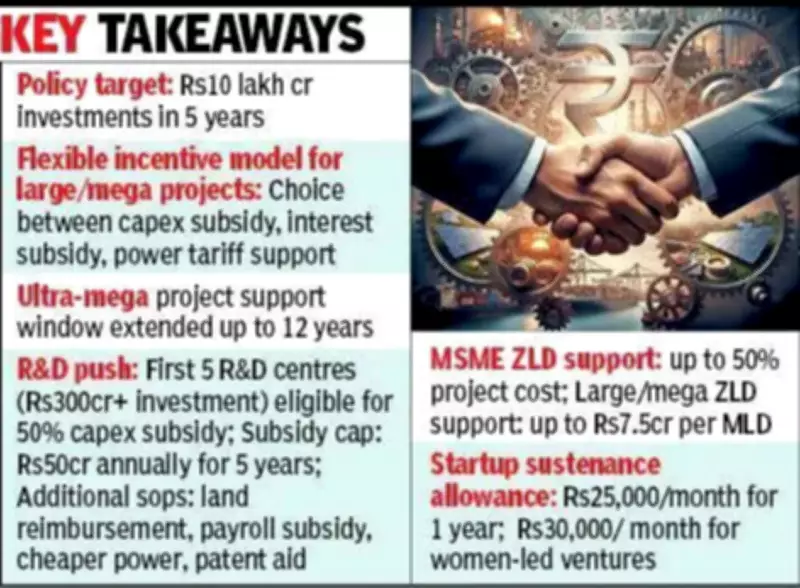
The Gujarat government on Monday unveiled the 'Viksit Gujarat Industrial Policy 2026', positioning the state as a global hub for semiconductors, clean energy, and advanced manufacturing. Launched in Gandhinagar by Chief Minister Bhupendra Patel and Deputy CM Harsh Sanghavi, the policy aims to attract investments worth Rs 10 lakh crore over the next five years, officials said.
Policy Duration and Flexibility
Valid for five years from June 1, 2026, the policy for the first time offers large and mega units the flexibility to choose from a mix of capital, interest, and power subsidies aligned with their project structures and financial viability.
Ultra-Mega Category Introduced
The policy introduces an ultra-mega category for projects in thrust sectors worth Rs 10,000 crore and above that generate over 3,000 jobs. The government has identified 21 thrust sectors, including aerospace and space-related manufacturing, semiconductors, semiconductor ancillary industries such as ultra-high-purity chemicals and gases, green hydrogen, battery storage, drones, and robotics.

Special Provisions for Select Sectors
Special provisions have been made for selected thrust sectors including drones, robots, toys, footwear, and sports goods manufacturing. Units in these sectors can avail incentives up to 50% of eligible fixed capital investment (eFCI) in Category-A talukas and 45% in Category-B talukas.
Project THRIVE for Decongestion
Under 'Project THRIVE', industrial units relocating outside congested city limits will receive wage support, worker housing assistance, and relaxations in transfer fees and land conversion norms. This initiative aims to decongest urban centres.
Startup Support
The policy offers a sustenance allowance of Rs 25,000 per month for startups for one year, with women-led startups eligible for enhanced support of Rs 30,000 per month.
Incentives for MSMEs and Large Units
MSMEs in Category-A talukas (largely backward regions) can avail incentive ceilings of up to 45% of eFCI, while units in Category-B talukas can avail up to 35% of eFCI. Large units in thrust sectors can avail combined incentives up to 35% of eFCI in Category-A talukas and 25% in Category-B talukas. For ultra-mega projects, the ceiling rises to 40% and 35%, respectively, over a support period extending up to 12 years.
R&D and Infrastructure Incentives
The policy introduces a dedicated incentive framework for R&D centres, including capital subsidy, payroll support, and patent assistance. It also backs anchor institutes, specialised skill centres, and captive industry training facilities. Incentives have been announced for private industrial parks, green industrial estates, labour hostels, and working women's hostels near industrial hubs. Support for wastewater recycling, zero liquid discharge systems, and cleaner production technologies is also included.






