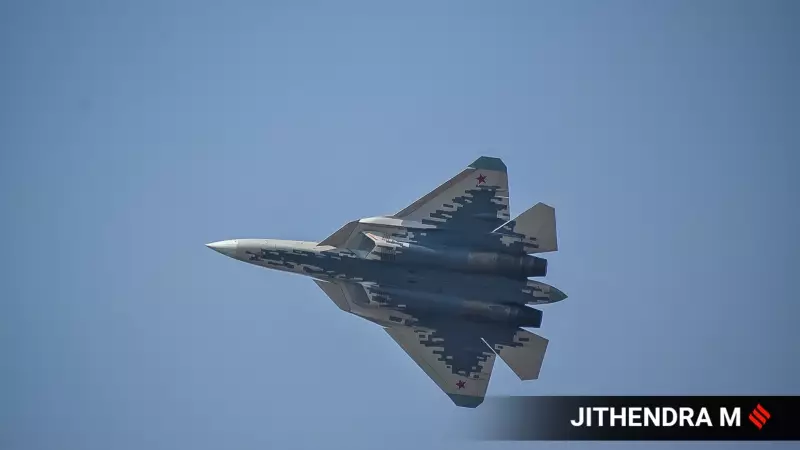
Hindustan Aeronautics Limited (HAL) has not yet made a decision regarding the Su-57 stealth fighter aircraft. The company currently awaits a detailed report from a Russian team. This report will outline the overall costs involved in potentially manufacturing these advanced jets in India.
Cost Report Expected This Month
The Russian team is expected to submit its comprehensive cost analysis this month. This document will provide a clear financial picture for HAL. It will detail the quantum of expenditure required for local production.
The report will cover several critical areas. These include the integration of advanced technologies, human resource development, necessary infrastructure upgrades, and supply chain establishment. A clear cost structure is essential for HAL to proceed with any future plans.

Existing HAL Infrastructure Provides Advantage
The Russian assessment team, which includes members from the Sukhoi Design Bureau, previously sent a preliminary report to HAL. This earlier document highlighted a significant advantage for the Indian company.
According to sources, HAL already possesses approximately half of the required infrastructure to produce a fifth-generation fighter. This existing capability stems from HAL's long-standing production of the Su-30MKI aircraft.
An Inter-Governmental Agreement for the licensed production of the Su-30MKI was signed back in December 2000. This decades-long experience has built a substantial industrial base.
Key HAL Facilities Involved
Several HAL divisions across India contribute to this existing capability. The Nashik division houses the final assembly line for Su-30MKI fighters. The Koraput division manages the licensed production and overhaul of the AL-31FP turbofan engines.
Furthermore, the Strategic Electronics Factory (SEF) located in Kasaragod, Kerala, manufactures crucial avionics components for the Su-30MKIs. This distributed manufacturing ecosystem forms a strong foundation for more advanced projects.
Government Yet to Decide on Foreign Fighter Acquisition
Officials have clarified that the Indian government has not taken a final decision. The question remains about which fifth-generation fighter jet might be acquired from a global defence major.
This potential acquisition would serve as a stopgap measure. It would fill a capability gap in the Indian Air Force's fighter squadron strength. The gap exists until India's indigenous Advanced Medium Combat Aircraft (AMCA) is inducted, which is expected in the next decade.
Air Marshal Ashutosh Dixit, Chief of Integrated Defence Staff, recently addressed this issue. He stated there is a gap of about eight to ten years before India acquires its own fifth-generation aircraft.
"We are thinking right now how that gap can be filled. There are various options. I can't list the platform. We are still working that out," he said. He added that fifth-generation capability is currently under active deliberation.
Potential Options for India
If India decides to procure a limited number of foreign fifth-generation fighters, two key options are on the table. The primary candidates are the Russian Su-57E and the American F-35 stealth aircraft.
Both aircraft were prominently showcased at the Aero India 2025 exhibition in Bengaluru. The choice involves significant strategic and technological considerations.
In October last year, Russian Ambassador Denis Alipov indicated Moscow's willingness to support India's AMCA programme. This support could potentially include local production of the Su-57 as part of a broader collaboration. However, there has been no official confirmation if this topic was discussed during Russian President Vladimir Putin's visit to India in December 2025.
The current exercise by HAL is primarily an internal initiative. It aims to obtain a realistic estimate of the required investments and to assess the company's production capacity. This feasibility study is a crucial step before any formal project proposal can be developed for government consideration.