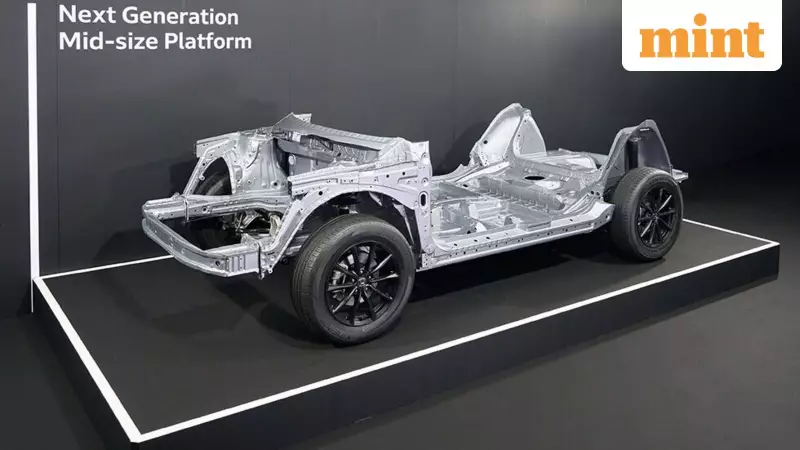
In a major strategic push, Japanese automaker Honda is preparing to significantly intensify its product offensive in the Indian market and globally. The company has laid out an ambitious roadmap that includes the launch of at least 10 new SUVs, featuring a sub-compact model and electric vehicles (EVs). Central to this aggressive plan is the development of a next-generation hybrid vehicle platform, with a slew of new hybrid cars slated to hit the roads starting in 2027.
The PF2 Platform: Lighter, Stronger, and More Efficient
The heart of Honda's future hybrid lineup will be its new architecture, internally codenamed PF2. This modular platform has been designed specifically to support hybrid powertrains and will form the base for small and medium-sized passenger vehicles, including those destined for the Indian market.
A key highlight of this new platform is its significant weight reduction. Honda claims the next-generation midsize hybrid platform will be an impressive 90 kg lighter than its current hybrid architecture. This reduction in body weight is a critical factor in achieving higher fuel efficiency, a benefit the automaker explicitly promises for its upcoming models. Furthermore, the platform is engineered to be more rigid, enhancing both safety and driving dynamics.

Engineering a Superior Driving Experience
Honda is not just focusing on efficiency; it aims to redefine the driving experience with its new hybrids. The company plans to integrate advanced technologies to ensure superior handling and stability.
These will include a sophisticated Motion Management System that uses robotics-based posture control. An Agile Handling Assist feature will be incorporated to enhance driving dynamics. Additionally, a body rigidity management system will intelligently adjust load distribution across the tyres, providing better stability, especially during cornering. Collectively, these innovations are designed to offer a more engaging and confident drive.
A Modular Strategy for Faster Development
Embracing a strategy common among modern automakers, Honda's new platform will heavily focus on modularity. The company has revealed that its midsize hybrid car platform will boast a 60% component sharing capability.
This means that a majority of parts will be common across a wide range of vehicles built on this architecture. This approach is expected to drastically improve both development speed and production efficiency, allowing Honda to bring new models to market more quickly and cost-effectively.
This comprehensive hybrid initiative is a pivotal part of Honda's broader global objective to achieve complete carbon neutrality by 2050. By launching a plethora of hybrid cars from 2027 onwards, Honda is making a clear statement that hybrid technology will be a cornerstone of its transition towards a fully sustainable future.