India Achieves 20% Ethanol Blending Milestone, Saving Billions in Foreign Exchange
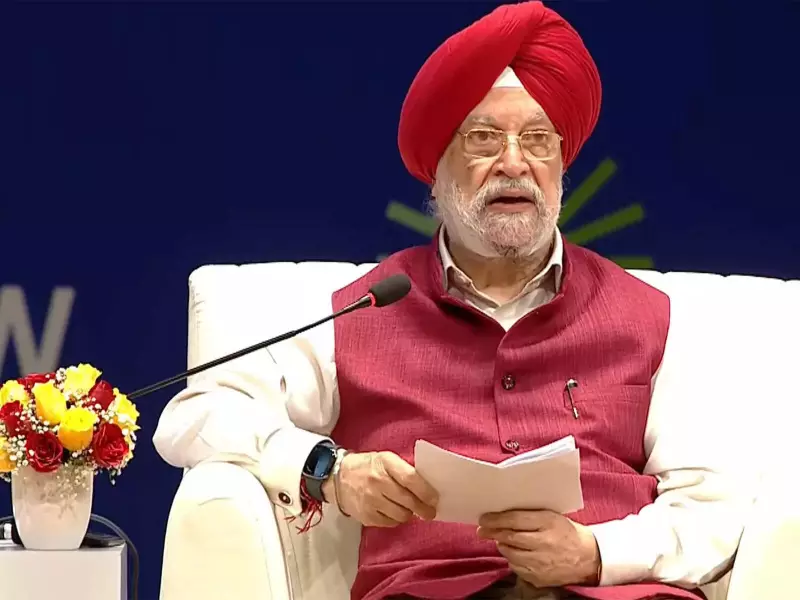
India has successfully achieved nearly 20% ethanol blending in the Ethanol Supply Year (ESY) 2025, marking a significant milestone in its biofuel strategy. Union Minister for Petroleum and Natural Gas, Hardeep Singh Puri, announced this achievement on Tuesday, highlighting its substantial economic benefits.
Economic Impact and Farmer Benefits
The enhanced ethanol blending program has resulted in foreign exchange savings of approximately USD 19.3 billion for the nation. Over the last decade, this initiative has facilitated direct payments exceeding USD 15 billion to farmers, providing crucial financial support to the agricultural sector.
Minister Puri made these announcements during his address at the inaugural ceremony of the 4th India Energy Week (IEW) 2026 in Goa. He emphasized that India's energy strategy carefully balances the transition to cleaner energy sources with maintaining economic security.

Balancing Renewable and Conventional Energy
The Minister detailed India's comprehensive approach to energy development, noting that while renewable energy sources have grown from "one-fifth to nearly one-third" of global electricity generation, conventional energy remains essential to meet rising demand. "The history of energy has never been about replacement alone. It has been about addition," Puri stated, adding that "while renewable and alternative energy sources are expanding at pace, conventional energy will remain essential."
India remains firmly on track to meet its compressed biogas targets as part of a broader push into bioenergy development. This forms a crucial component of the nation's diversified energy portfolio.
Projected Energy Demand and Nuclear Expansion
Addressing future energy requirements, Puri projected that "by 2050, India's share of global energy demand is projected to rise by nearly 30-35%, reaching around 10 percent of the total global energy demand." To meet this substantial increase, the government is expanding capacity across the full energy spectrum.
This includes raising nuclear energy ambitions to 100 GW by 2047, supported by the Atomic Energy Bill 2025 SHANTI, which modernizes the nation's nuclear legal framework and facilitates this expansion.
Upstream Sector Reforms and Price Stability
Significant reforms in the upstream sector include the Oilfields (Regulation and Development) Amendment Act, 2025, which introduced single petroleum leases and long-term stability measures. Preliminary assessments from recently concluded exploration rounds in deep-water acreages show promising results, leading to select drilling efforts.
Minister Puri highlighted India's remarkable price stability in the energy sector: "While fuel prices rose significantly in many major economies after 2021, prices in Delhi in 2025 remained lower than in 2021. For over 100 million PMUY beneficiaries, LPG prices have been maintained at around 5.5 - 6 US dollars per cylinder, among the lowest globally."
Trade Volume and Investment Opportunities
The petroleum sector now accounts for 28 percent of India's trade volume by weight at ports, demonstrating its crucial role in the national economy. With an USD 8 billion government package for shipbuilding, the Minister identified a near-term investment opportunity of USD 5 billion for approximately 60 vessels required for the oil and gas trade.
Global Capability Centres Growth
India's Global Capability Centres (GCCs) are experiencing remarkable growth, projected to reach a revenue of USD 105 billion by 2030, supported by nearly 2,400 centers. "In just five years, their combined revenue has jumped from USD 40.4 billion in FY19 to USD 64.6 billion in FY24, with growth rate of 9.8% annually," Puri noted. "The sector is projected to reach USD 105 billion by 2030, supported by nearly 2,400 GCCs employing over 2.8 million professionals."
Concluding his address, Puri expressed hope that "May India Energy Week serve as a catalyst for collective progress and a forum where solutions are shaped for the benefit of the world."

Earlier in the day, Minister Puri held meetings with Pramod Sawant, Chief Minister of Goa, and H.E. Sultan Al Jaber, Minister of Industry and Advanced Technology and ADNOC MD and Group CEO from the United Arab Emirates, strengthening international energy partnerships.