Government Introduces Strict Testing Norms for Electric Quadricycles
In a significant move, the Indian government has for the first time notified dedicated testing and performance standards for electric quadricycles. This development comes under the ambitious ₹25,938-crore production-linked incentive scheme for automobiles and auto components. The new norms tighten eligibility by directly linking testing standards with local value-addition requirements.
Enhanced Standards Under PLI-Auto Scheme
Through a notification dated 13 January, the Ministry of Heavy Industries upgraded testing norms for electric vehicles under the PLI-Auto scheme. These updated standards now connect with local value-addition requirements under the PM E-Drive scheme. The PM E-Drive programme has replaced the earlier Faster Adoption and Manufacturing of Electric Vehicles initiative.
The government has clearly defined performance criteria for electric quadricycles. Vehicles must achieve a minimum range of 80 kilometers on a full charge. They must also maintain maximum energy consumption under 12 kilowatt-hours per 100 kilometers. Range refers to the distance an electric vehicle can cover on a single charge. Lower energy consumption indicates more energy-efficient vehicles.

Quality Assurance Through Testing Agencies
Government testing agencies will use these parameters to determine model eligibility for incentives. The Automotive Research Association of India and the International Centre for Automotive Technology will conduct the evaluations.
Sharif Qamar, associate director of transport and urban governance at The Energy and Resources Institute, emphasized the importance of these standards. "Performance criteria for battery and vehicle is critical to ensure quality of products that are rolled out in the market," Qamar stated. "This is particularly important given the past experience of sub-par vehicles being launched."
Understanding Quadricycles and Their Export Potential
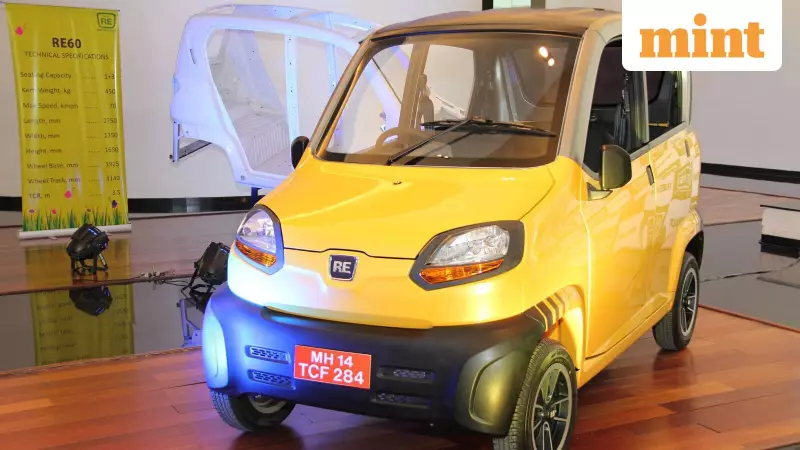
Quadricycles are small four-wheelers used for passenger and goods transport. They fall under the L7M and L7N vehicle categories. L7M classifies quadricycles for passenger transport, while L7N covers goods transport. These vehicles are primarily manufactured in India and exported globally.
Data from the Society of Indian Automobile Manufacturers reveals significant export activity. More than 4,900 units of the 5,090 quadricycles made in India during calendar year 2025 were exported. This represents nearly 98 percent of total production.
Qamar highlighted the international competitive advantage these standards create. "The performance criteria under the PLI gives an opportunity to OEMs and component manufacturers to compete in the international market," he explained. "Quadricycles, which are mainly export-oriented products, would give an edge to Indian manufacturers especially in African, South Asian and Latin American markets."
Current Market Landscape and Manufacturer Activity
Sales of battery-operated electric quadricycles qualify for incentives under the PLI-Auto scheme. These 'microcars' are classified as advanced automotive technology according to publicly-available eligibility norms.
However, Vahan data shows no electric quadricycle sales in India over the past two years. Most units sold in this vehicle segment currently run on CNG. Pune-based Bajaj Auto Ltd has sold the most quadricycles in India during this period—340 units according to Vahan.
Other manufacturers have shown minimal activity. Hyundai Motor India Ltd, Mahindra & Mahindra Ltd, and Mercedes Benz AG each sold one unit in the same period. Maruti Suzuki India Ltd sold two units.
Manufacturer Responses and Future Developments
Queries sent to the Ministry of Heavy Industries and several automakers on 15 January remained unanswered at the time of reporting. However, Bajaj Auto executive director Rakesh Sharma provided insights during a Q4FY24 earnings call.

"Yes, we are investing behind the Qute platform," Sharma confirmed. "When the BS-IV, BS-VI transitions took place, there was such a lot of work in our R&D that we deprioritized Qute only because of volumes. But we are now looking at an upgrade, which will provide the customer with a tech condition in Qute. We already have a CNG-based Qute, and we will be working on an electric Qute as well." Sharma made these comments in April 2024.
Implementation Challenges and Industry Demands
Despite four years of the PLI-Auto scheme, no manufacturer has applied for testing electric quadricycles at ARAI, the country's top testing agency. This information came to light in August 2024.
The PLI-Auto scheme mandates 50 percent localization. This means all vehicles must source half their components from India. In an August 2024 report, government think tank Niti Aayog noted specific manufacturer demands related to last-mile mobility.
Manufacturers called for a 'single-till' approach between two critical electric mobility government schemes. They want vehicles qualifying for incentives under PLI-Auto to also qualify under PM E-drive. This alignment would simplify compliance and boost adoption.
The new testing norms represent a strategic push to enhance electric vehicle quality while supporting domestic manufacturing. By linking performance standards with local value addition, the government aims to create globally competitive products. The focus on quadricycles acknowledges their export potential and addresses quality concerns from previous vehicle launches.