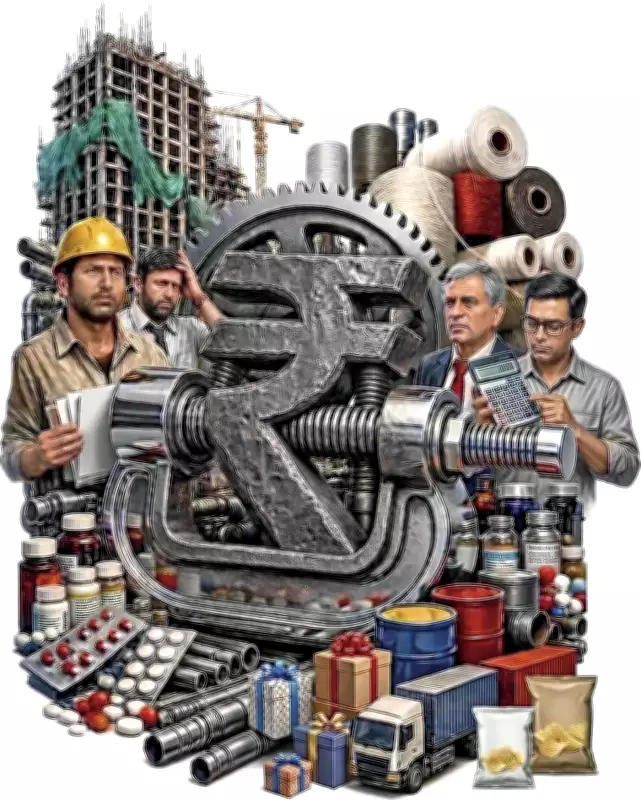
For many businesspersons in Gujarat's manufacturing industries, a large part of the workday these days is no longer spent discussing expansion plans or chasing new orders, but negotiating raw material prices that only seem to escalate. Textile manufacturers, chemical makers, pharmaceutical companies and real estate developers say escalating input costs and weak demand are making it increasingly difficult to protect margins or plan production cycles. While some companies have initiated calibrated price increases, many MSMEs say they are unable to fully pass on higher costs to customers, raising concerns of delayed projects, reduced production and fresh inflationary pressure across industrial value chains.
Rising Input Costs Thin Textile Makers' Margins
The textiles industry is facing mounting cost pressures as rising cotton yarn prices, expensive crude-linked chemicals and higher fuel costs push up production expenses across the value chain. Industry players said the impact has deepened over the past six weeks, with fabric prices rising by Rs 10 to Rs 25 per metre amid tighter yarn availability and higher processing charges. Manufacturers said strong export demand from China has sharply increased cotton yarn prices, while the West Asia conflict has triggered a fresh rise in crude oil-linked inputs used in dyeing and processing. Several powerloom operators have also curtailed production due to yarn shortages, further tightening supply in the market.
Nitin Thaker, MD of a textiles export unit, said, "The industry is under pressure from multiple sides. Prices of chemical raw materials have increased sharply, fuel costs linked to coal remain elevated and there is also unavailability of some key inputs. At the same time, the industry is facing a cash crunch, but manufacturers are unable to fully pass on the higher costs to consumers because demand is weak. Grey fabric prices have risen due to strong export demand from China, while Gulf markets remain largely shut. Despite the rupee's depreciation, textile exporters are not getting expected export realization because sea freight has increased proportionately and even customers ask for discounts."

Gujarat Chamber of Commerce and Industry textile taskforce co-chairman Rahul Shah said strong demand from China has pushed cotton yarn prices to Rs 310 per kg, the highest in nearly four years, impacting the entire textiles value chain. Industry representatives said rising fuel and chemical costs have increased processing expenses, with fabric prices climbing Rs 10 to Rs 25 per metre over the past six weeks. Maskati Kapad Market Mahajan president Gaurang Bhagat said the increase is reflecting in retail prices of garments and fabrics. The sector has renewed its demand for removal of the 11% cotton import duty, arguing that rising raw material costs are hurting export competitiveness. Powerloom Development and Export Promotion Council former chairman Bharat Chhajer said high crude-linked processing costs and uncertainty have weakened buying sentiment and forced several powerloom units to halt production despite confirmed orders.
Developers Struggle to Absorb Rising Project Costs
Ahmedabad's real estate sector is beginning to feel the impact of rising raw material prices, with developers warning that escalating construction costs and supply disruptions are straining project execution and financial viability. Even as input costs continue to climb, Credai-Ahmedabad has said its members will hold property prices steady till June 30 to avoid passing on the immediate burden to homebuyers. The developers' body said the ongoing conflict in West Asia has disrupted the supply of crude-linked construction materials, triggering steep price increases across essential inputs used in residential and redevelopment projects. Industry members said suppliers have raised prices by 30% to 60% for several materials, while irregular deliveries have further delayed construction.

According to developers, prices of cement, steel, tiles, aluminium, PVC pipes, paints, ready-mix concrete, cement blocks and waterproofing materials have all risen sharply in recent weeks. The association estimates that overall project costs have increased by 10% to 20%, upsetting original budgeting and cash flow calculations made at the time of project registration. Ankur Desai, secretary, Credai-Ahmedabad, said developers are faced with rising costs as well as procurement challenges. "Developers are dealing with an exceptional cost shock. Essential materials are not only becoming more expensive but are also harder to procure on time. This is putting severe pressure on project execution and financial viability," he said. The body has sought a six-month extension to project completion timelines from the Gujarat Real Estate Regulatory Authority, arguing that supply disruptions and higher costs are making timely delivery increasingly difficult. Developers also say labour shortage during the summer has added to execution challenges, particularly for large housing and redevelopment projects.
Kartik Soni, who is involved in redevelopment projects, said the changing cost structure is already affecting project negotiations and feasibility assessments. "Redevelopment projects are under serious stress. Cost assumptions made earlier are no longer workable, and builders are being forced to recalculate project viability. This will inevitably make new homes in redevelopment schemes more expensive," he said.
Chemical Makers Face Production Cuts Amid Raw Material Volatility
Gujarat's chemical industry is witnessing severe disruption as sharp increases in prices of sulphur, sulphuric acid and other basic raw materials squeeze margins and force several units to cut production. Industry representatives said volatility linked to the West Asia conflict, supply shortages and currency fluctuations have made business planning increasingly difficult, especially for exporters and manufacturers dependent on imported inputs. Manufacturers said prices of key raw materials such as sulphur, sulphuric acid, aniline and other intermediates have risen 150% to 400% in recent months, affecting sectors including dyes, pharmaceuticals, agrochemicals and fertilisers. Several factories in the dyes and intermediates segment are currently operating below 50% capacity due to weak demand and elevated input costs.
Chemexcil Gujarat region chairperson Bhupendra Patel said, "The combination of a stronger dollar, rising diesel costs and raw material inflation has created deep uncertainty in the market. Predictability in business has not remained. We are unable to plan imports for the next two to three months because prices and currency movements are fluctuating continuously." Patel added that weak downstream demand is worsening the situation. "Yarn prices have increased; fabric demand is weak and therefore dyes are not in demand. Pigment usage has also reduced because plastic pellet prices have gone up significantly," he said. Chemexcil vice-chairman Ankit Shah said industrial production in several chemical segments has dropped below 50% as customers are unwilling to absorb steep price increases triggered by shortages and export restrictions in some countries.
Drugmakers Prepare for Price Hikes
Gujarat's pharmaceutical sector is preparing for another round of price increases in non-scheduled medicines as rising active pharmaceutical ingredients (API) and packaging costs begin filtering through the supply chain. Industry representatives said prices of various APIs and bulk drugs have risen 30% to 50% since February following disruptions linked to the West Asia conflict. The increase has prompted several pharmaceutical companies to raise prices of non-scheduled medicines by up to 10% during April and May. The revised rates are expected to reflect at retail pharmacies from July or August as newly priced batches enter the market. Medicines likely to be affected include painkillers, antibiotics, vitamin supplements, dermatology products, respiratory medicines and psychotropic drugs.
Indian Drug Manufacturers' Association national spokesperson Viranchi Shah said the industry is discussing temporary relief measures with the government under the Drug Price Control Order (DPCO). The Drug Marketing and Manufacturing Association president Amit Thakkar said companies are using the annual revision window for non-scheduled medicines to offset rising raw material costs, adding that packaging materials have also become costlier. Federation of Gujarat State Chemists and Druggists Associations president Jashvant Patel said consumers are likely to feel the impact from July-August once existing inventories are exhausted.
Product Packaging No Longer A Fancy Business
FMCG companies banking on flashy, feel-good or innovative packaging to attract consumers are bracing for higher costs as Gujarat's now-organized packaging industry grapples with a sharp spike in raw material prices. From premium snack pouches to perfumes and designer cartons to custom retail boxes, packaging manufacturers say the cost of almost every major input has surged in recent weeks, severely squeezing margins. Petroleum-linked raw materials used extensively in snack food and FMCG packaging have witnessed a steep rise, while paper-based packaging materials too have become steadily costlier. Packaging-grade paper that cost around Rs 67 per kg barely a month ago has now climbed to nearly Rs 74 per kg — an increase of almost 15%. Prices of inks, washes, alcohol-based solutions and alkaline chemicals used to maintain ink-water balance in printing the boxes have reportedly jumped by nearly 35%.
"This is a unique situation. Costs of chemicals used in printing are escalating faster than almost every other input," said a packaging manufacturer. Industry players said the sudden escalation has left margins turning razor-thin. The pressure is especially acute for firms supplying to FMCG brands, where packaging prices are often locked through contracts, making revisions difficult despite rapidly changing input costs. Over the last two decades, Gujarat's packaging industry has transformed dramatically from a largely unorganized sector dominated by small family-run units into a professionally managed manufacturing ecosystem. Sources said in 2007, there were barely five professionally managed packaging companies in Gujarat. Today, there are over 100 organized players capable of serving multinational corporations.
Experts weigh in as Gujarat's manufacturers face thinning margins amid US-Iran war. You can also check: Gold Rate in Ahmedabad, Silver Rate in Ahmedabad, Bank Holidays in Ahmedabad, Public Holidays in Ahmedabad, Ahmedabad AQI, Weather in Ahmedabad, Petrol Price in Ahmedabad, Diesel Price in Ahmedabad, CNG Price in Ahmedabad, LPG Price in Ahmedabad.