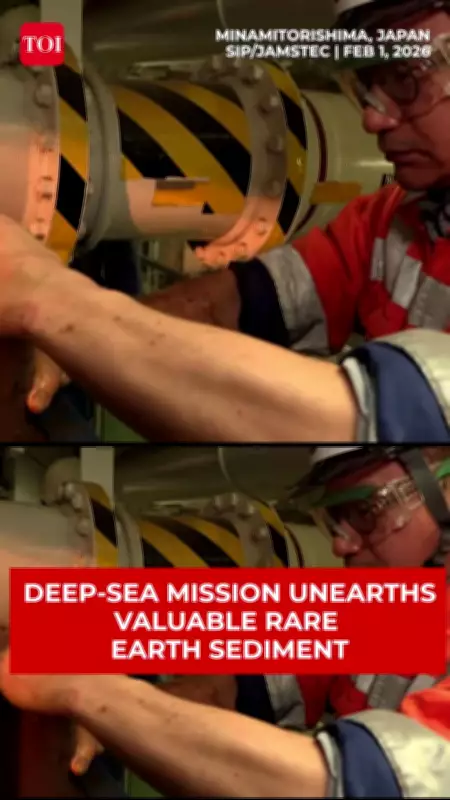
Japan Achieves Major Deep-Sea Mining Breakthrough With Rare Earth Extraction
In a significant technological and strategic advancement, Japan has successfully retrieved rare earth minerals from the extreme depths of the Pacific Ocean, reaching approximately 6,000 meters below the surface. This landmark achievement represents a crucial step forward in the nation's efforts to secure a stable supply of critical minerals essential for modern technologies.
Strategic Importance of the Deep-Sea Mining Operation
The extraction of rare earth sediment from such profound depths is not merely a technical feat but a strategic maneuver in the global competition for critical resources. Rare earth elements are vital components in the manufacturing of high-tech devices, including smartphones, electric vehicles, renewable energy systems, and advanced defense equipment. Historically, the global supply chain for these minerals has been dominated by a few countries, leading to concerns over dependency and geopolitical vulnerabilities.
By pioneering deep-sea mining capabilities, Japan aims to reduce its reliance on traditional land-based sources, which are often concentrated in politically sensitive regions. This breakthrough could potentially diversify the global supply of rare earths, enhancing economic security and technological independence for Japan and its allies.

Technical Challenges and Innovations in Deep-Sea Exploration
Mining at depths of 6,000 meters presents formidable technical challenges, including extreme pressure, low temperatures, and complex logistics. Japan's success in this endeavor highlights significant innovations in underwater robotics, remote-operated vehicles, and sediment extraction technologies. The operation likely involved specialized equipment designed to withstand harsh deep-sea conditions while efficiently collecting mineral-rich sediments from the ocean floor.
This achievement builds upon years of research and development in marine geology and deep-sea engineering, positioning Japan as a leader in underwater resource exploration. The ability to access minerals from such depths opens up new frontiers for resource extraction, potentially unlocking vast untapped reserves in the world's oceans.
Global Implications and Future Prospects
The successful extraction of rare earths from the Pacific seabed has broader implications for the global economy and environmental policies. As nations worldwide seek to transition to green technologies and digital economies, the demand for rare earth minerals is expected to surge. Japan's breakthrough could inspire other countries to invest in deep-sea mining research, potentially leading to a new era of ocean-based resource exploitation.
However, this development also raises important questions about environmental sustainability and the ecological impact of deep-sea mining. International regulations and careful assessment will be necessary to balance resource extraction with the preservation of marine ecosystems. Looking ahead, Japan's achievement may pave the way for collaborative efforts in sustainable deep-sea mining practices, ensuring that the pursuit of critical minerals does not come at the expense of ocean health.
In summary, Japan's retrieval of rare earth minerals from 6,000-meter depths marks a pivotal moment in the quest for resource security. This deep-sea breakthrough not only showcases technological prowess but also underscores the strategic importance of diversifying mineral supplies in an increasingly competitive global landscape.