

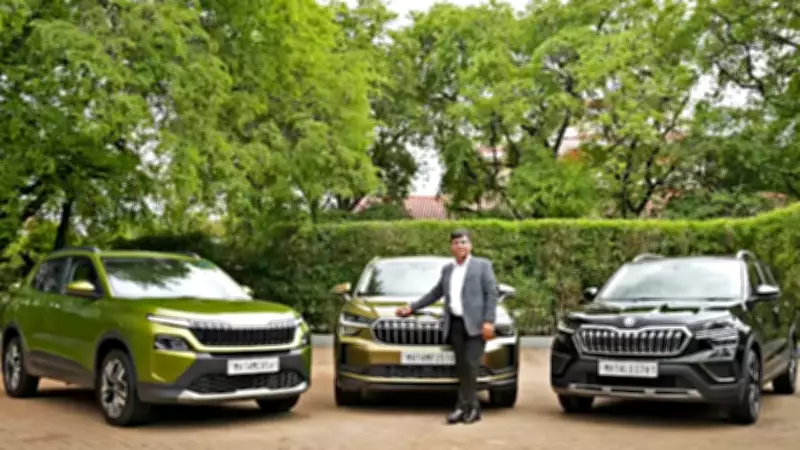
Škoda India Highlights Regulatory Push Over Consumer Demand in EV Adoption
Ashish Gupta, Brand Director of Škoda India, has emphasized that the current adoption of electric vehicles (EVs) in India is largely driven by regulatory requirements rather than robust consumer demand. He projected that by 2030, green vehicles are anticipated to constitute approximately 18% of total vehicle sales, with the overwhelming majority still expected to come from internal combustion engine (ICE) cars.
Škoda's EV Plans and Market Assessment
Gupta confirmed that Škoda is actively planning to introduce EVs in the Indian market, although he declined to provide a specific timeline. "We are definitely working on it. It’s too early to give a specific date, but we intend to stay a relevant player in India, and to do that, you have to get into electrification. It’s in an advanced stage of planning," he stated in an interview with Times Internet.
This announcement comes as Škoda experiences significant growth in India, with car sales surging over 100% in 2025, largely fueled by the popularity of the Kylaq mini SUV. The company sold a total of 72,665 units last year, up from 35,166 units in 2024, with the Kylaq accounting for around 45,000 of those sales.

Slow EV Growth and Regulatory Influence
During the launch of the next-generation Kushaq SUV, which features a petrol engine, Gupta noted that while Škoda is evaluating the EV market, signs of strong organic demand remain elusive. He pointed out that initial forecasts predicted EVs would capture 10% of the car market by now, but actual figures hover around 4-4.5%.
"With the GST changes, we see that the big push for electrification has also died down a bit. Electrification at one time was trending at about 6% of the market. But last year, it also ended at around 4.5%. So, electrics are definitely not playing out the way everybody forecasted it to be," Gupta explained.
However, he highlighted that regulatory frameworks, such as the proposed Corporate Average Fuel Efficiency (CAFÉ) norms, are likely to compel automakers to introduce new EV models. "... the regulatory framework will eventually force the move toward electrification. Currently, I feel electrification in India is more regulatory-driven than consumer-demand driven," he added.
ICE Dominance and Strategic Approach
Gupta underscored the continued strength of the ICE car market, estimating that by 2030, total vehicle sales in India could reach between 5.5 million and 6 million units. Even with EVs potentially achieving 18% penetration, ICE vehicles would still dominate 82% of the market.
"To be relevant, you have to be present in that large 82% while having a foothold in the 18% EV segment. That’s the game plan. You cannot bucket yourself into one corner, but (have to) be present across powertrains," he asserted, outlining Škoda's strategy to balance both segments.
India-EU FTA Opportunities and Localization Focus
Discussing the India-European Union Free Trade Agreement (FTA), Gupta expressed optimism about bilateral trade opportunities. He believes the agreement, which may take over a year to implement, could facilitate lower-duty imports of European cars to India and create export avenues for India-made vehicles.
"While everybody's talking about how India will open up to global products, I see trade happening both ways. I see it as an opportunity for us to use India as a base to export back to Europe. That is another opportunity that will open up," he said.
Gupta specifically mentioned the Kylaq as a potential export model to Europe post-FTA implementation. "The EU FTA could open doors for products like the Kylaq. There are naturally markets in Europe which are conducive to these kinds of cars. So, those are opportunities which I think will open up," he noted.
Addressing concerns that the FTA might reduce Škoda's investment in India due to cheaper imports, Gupta emphasized the necessity of localization for success. "The only way you can succeed in India is by producing locally. The FBUs (fully-built unit imports) will not change the game for any manufacturer in that regard," he explained, citing safeguards like minimum import prices that keep local production a priority.

Geopolitical Tensions and Supply Chain Impact
On the topic of geopolitical tensions, particularly involving Iran, Gupta reported minimal immediate impact on Škoda's business demand in India. "... in terms of how the business is going regarding inquiries and bookings — we do not see that much impact yet. But you can feel it in your bones that there’s a little bit of uncertainty. How much of a long-term impact it will have is anybody’s guess, but uncertainty is never good for business," he remarked.
Regarding supply chain disruptions, he assured that production schedules are currently manageable. "The disruption is definitely there, but it is not leading to disruptions in production. It can lead to delays, but so far we are unaffected. However, if this situation prolongs, we will start having effects. For now, we have enough supplies and stocks to manage our production," Gupta concluded.





