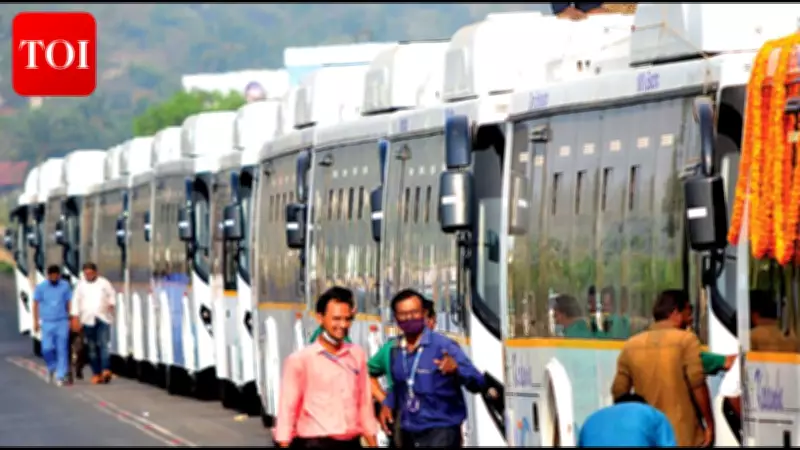
Kadamba Transport Corporation Launches Major Digital Overhaul with Unified Depot Management System
The Kadamba Transport Corporation Limited (KTC) in Panaji, Goa, has announced a transformative modernization initiative that will revolutionize its operational framework through a comprehensive Depot Management System (DMS). This ambitious digital integration project aims to unify multiple internal departments—including stores, maintenance, preventive maintenance, finance, personnel, and procurement—under a single, cohesive digital platform.
Centralized Monitoring and Inventory Management
KTC Managing Director Rohan Kaskar emphasized that the new system will bring all operational modules, from spare parts management to ticketing, to a unified level. "This means all modules, from spare parts to ticketing, will be at a single level," Kaskar stated. The DMS will enable centralized monitoring of spare parts and inventory across all KTC depots, allowing officials to instantly check stock availability and reallocate surplus inventory efficiently.
For instance, if a depot in Madgaon or Porvorim requires a specific spare part, the system will provide real-time visibility into stock levels at other depots, facilitating swift transfers. KTC General Manager Mahendra Pednekar highlighted the current manual processes, noting, "At present, some requests are made manually. With this system, we can immediately see which depot has surplus stock and arrange transfers efficiently."

Complete Lifecycle Tracking and Advanced Fleet Monitoring
The DMS will digitally record the entire lifecycle of each bus from the moment it enters a depot. This includes tracking arrival times, inspections conducted, spare parts issued, maintenance activities, washing durations, and dispatch times. Additionally, the system will monitor how long vehicles remain in maintenance and identify reasons for any delays, thereby enhancing operational efficiency.
Furthermore, the software will monitor the lifespan of spare parts and generate detailed data on route-wise earnings. The proposed system will incorporate advanced tracking features similar to those already available in KTC's recently procured electric buses, which monitor vehicle speed, gear usage, driving patterns, and halt points.
Pednekar explained that these monitoring capabilities will be extended across the entire fleet. "We will be able to track driving behavior, identify rough driving, monitor stoppages, and analyze operational inefficiencies," he said.
Integration of Standalone Modules and Tyre Management
The DMS will integrate existing standalone modules such as purchase, finance, personnel, ticketing, and tyre management into a unified system. Kaskar pointed out the significant annual expenditure on tyre procurement, stating, "KTC spends a lot of money annually on tyre procurement. Under the new system, each tyre will be digitally tracked, allowing us to monitor which vehicle it is fitted on, usage patterns, and replacement schedules."
Implementation Timeline and Funding
KTC plans to operationalize the full-fledged DMS by the financial year 2026–27. The integration process will involve installing compatible systems in individual buses, with the project being funded by the state government. In addition to the DMS, KTC is also planning to establish a centralized CCTV surveillance system with a command and control center at the Panaji bus stand.
This surveillance network will cover depots, bus stands, workshops, and offices, enabling authorities to review bus interiors and depot activity in real time. Officials believe this will help address passenger complaints more effectively. Funding proposals for both the DMS and the CCTV command center have been submitted to the state government for approval.