

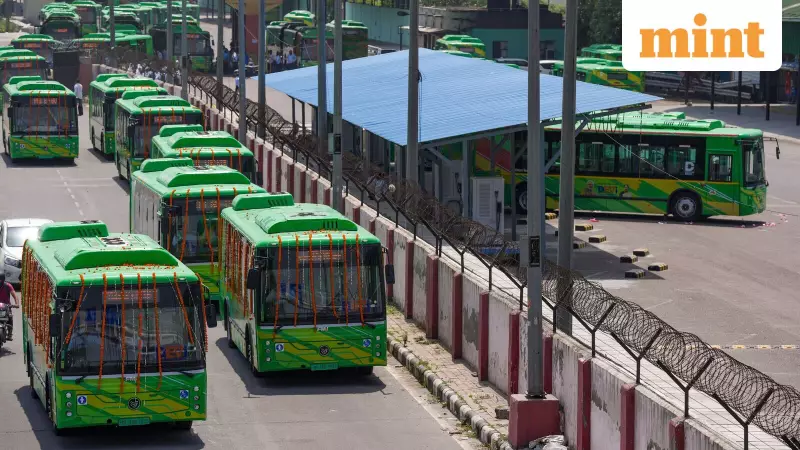
Electric bus sales in Maharashtra jumped dramatically in 2025. The state recorded a remarkable increase of over 60%. This surge helped Maharashtra overtake New Delhi as India's largest electric bus market. States across the country are actively pushing to expand green public transport networks. Their goal is to cut harmful carbon emissions significantly.
Sales Figures Show Clear Shift
According to data from the central government's Vahan portal, Maharashtra sold 1,442 e-buses in the 2025 calendar year. The portal keeps a detailed record of all vehicle registrations. Delhi, in comparison, sold 1,382 units during the same period. This marks a significant change from the previous year.
In 2024, Delhi was the clear leader with 1,036 e-bus sales. Maharashtra followed with 880 units. The national market for emission-free public transport is growing steadily. Total e-bus sales across India rose to about 4,400 units in 2025. The previous year saw sales of just over 3,600 units. These figures include buses bought by state transport agencies and privately-operated fleets.

State-by-State Performance Varies Widely
Tamil Nadu experienced a dramatic surge in e-bus adoption. Sales skyrocketed from a mere 5 units in 2024 to just under 400 units in 2025. This represents one of the most impressive growth rates in the country.
However, not all states followed this upward trend. Gujarat and Karnataka saw their e-bus sales fall considerably. Karnataka sold only 445 e-buses in 2025, down from over 800 the year before. Gujarat's sales dropped to 116 units from 329 units in the previous year.
Government Policy Drives Growth
The central government is actively accelerating the electric bus rollout. It is using massive clean mobility programmes to achieve this goal. Key schemes include the ₹10,900-crore PM E-Drive initiative and the ₹25,938-crore PLI-Auto scheme.
Experts directly link the sales surge to these incentive programmes. Amit Bhatt, India managing director of the International Council on Clean Transportation (ICCT), explained the impact. "The growth in annual e-bus sales is largely driven by strong policy support from the Government of India," he said. He mentioned schemes like PM E-Drive, PM e-Bus Sewa, and the earlier FAME programme.
These programmes have achieved several important outcomes:
- Reduced upfront costs for buyers
- Enabled large-scale aggregated procurement
- Improved financial viability for public transport undertakings
India's E-Bus Fleet Expands Gradually
India's e-bus fleet has grown consistently over recent years. Sales increased from about 1,170 new buses in 2021 to over 4,400 sold in 2025. Despite this progress, electrification of public transportation remains relatively low. India lags behind both China and the European Union in this area.
In August 2025, Niti Aayog highlighted low electric vehicle adoption across segments. The government's top policy think tank suggested using mandates alongside incentives. This combined approach could accelerate clean mobility nationwide.
The Aayog's report presented revealing comparative data. India's e-bus penetration was 7% in 2023. The European Union achieved 14% penetration, while China reached an impressive 50%. Penetration refers to the share of electric vehicles among total vehicles.
Market Dominance Still Belongs to Diesel
Electric bus sales in 2025 represented only a fraction of total bus sales. Diesel continues to dominate the Indian market overwhelmingly. While about 4,400 e-buses were sold in 2025, diesel bus sales topped 66,000 in the same period. This indicates e-bus penetration was approximately 6.5%.
China's experience provides an interesting comparison. Data from the International Energy Agency shows China's e-bus adoption soared after 2014. Penetration reached 10% in 2014 and jumped to over 40% by 2016. The World Resources Institute noted in a June 2025 report that China experienced massive growth from 2014 to 2018. Shenzhen became the first city worldwide to electrify its entire bus fleet in 2017, with 16,000 buses.

The Path Forward for India
Increasing electric vehicle adoption is crucial for India. It is key to meeting the country's net-zero emission target of 2070. Vehicular emissions remain among the biggest contributors to greenhouse gases and air pollutants.
Amit Bhatt of ICCT identified the next frontier for India's e-bus adoption. "The next phase must extend beyond public transport agencies," he stated. These agencies account for only about 8–9% of India's total bus market. Scaling up electrification in private segments will be critical. This includes:
- Intercity transport
- Employee mobility services
- School buses
The central government recognizes this challenge. Reports indicate it is working on a new scheme. This initiative aims to make e-bus financing easier and cheaper for private bus operators. The majority of buses on Indian roads are owned and operated by private entities. Supporting their transition to electric is essential for broader market transformation.





