

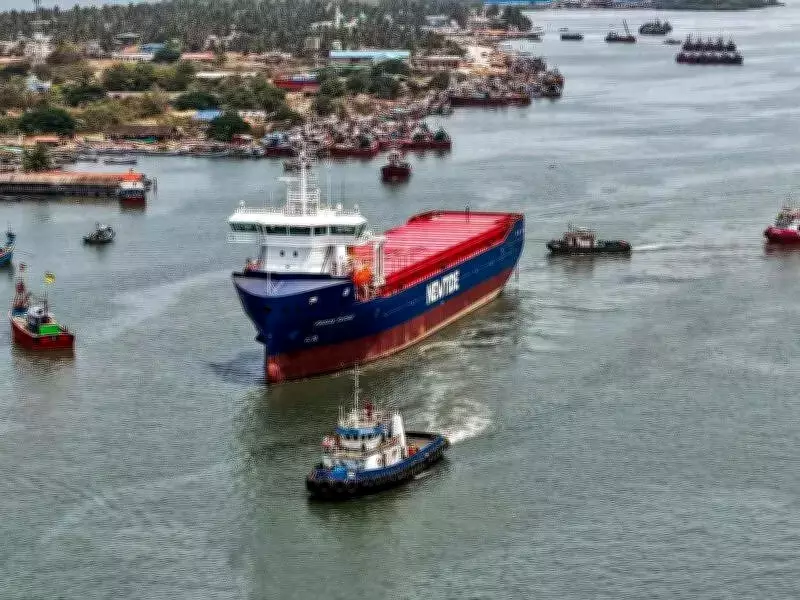
Mangaluru's Maritime Heritage Reawakens with Dutch Bulk Carrier Delivery
The historic port city of Mangaluru has witnessed a significant revival in its shipbuilding legacy with the recent handover of a locally manufactured vessel to a Dutch client. This development marks a fresh chapter for the coastal city's maritime industry, which had experienced a prolonged period of stagnation.
The Frisian Future: A Made-in-Mangaluru Achievement
The newly delivered ship, named Frisian Future, represents a notable achievement for local shipyards. This small bulk carrier measures 113.18 metres in length with a deadweight tonnage of 8,500. Its design features a less-than-five-metre draft, making it particularly suitable for short maritime routes where deeper vessels cannot operate efficiently.
Recovery from Prolonged Industry Lull
Industry stakeholders have expressed confidence that this delivery signals the beginning of a sustained revival for Mangaluru's shipbuilding sector. The industry had experienced a significant slowdown following the 2008 global financial crisis, with particularly challenging conditions between 2014 and 2023.

Pavithran Alokkan, founder and CEO of Tritonex Marine Solutions, explained the difficult period: "The lull in shipbuilding was witnessed particularly between 2014 and 2023. People lost jobs and there was a freeze on salaries. Many highly skilled workers migrated to other fields."
Alokkan noted that workers are gradually returning to the industry, though salary levels have not yet recovered to their 2014 benchmarks. "Now, people have slowly started coming back. However, 2014-level salaries remain," he added.
India's Position in the Global Shipbuilding Landscape
While China, South Korea, and Japan dominate global shipbuilding, accounting for the majority of worldwide orders, India currently represents no more than 0.1% of the global shipbuilding order book. The leading shipbuilding nations employ highly sophisticated technology for constructing specialized vessels.
"Japan, for instance, works on LPG, LNG and ammonia-charged carriers, which are 10 times the cost of building a small bulk carrier like the one built in Mangaluru," Alokkan explained. These countries also export many key components used in Indian shipbuilding projects.
Opportunities in a Crowded Global Market
Despite the competitive landscape, Alokkan sees emerging opportunities for Indian shipyards. "While we want to improve our global share to 5%, with our skilled labour force giving us an advantage, a country like China has the edge of government-backed insurance at their shipyards," he noted.
However, current market conditions present openings for Indian manufacturers. "Yet, at present, these countries have their order books full and are not taking additional orders, which is where we step in," Alokkan further explained, highlighting India's potential role in the global supply chain.
Reconnecting with Historical Maritime Legacy
Mangaluru MP Brijesh Chowta emphasized the city's deep-rooted maritime connections in a social media post. He recounted how "long before modern shipyards, the rivers and coasts of Tulunadu built vessels that sailed across the Arabian Sea."
Chowta noted that this legacy had faded over time but is now experiencing a revival. "Today, with the revival of shipbuilding in Mangalore, that maritime relationship is being re-established," he stated, specifically praising the delivery of the Frisian Future by Chowgule Shipyard.
The delivery of the Frisian Future represents more than just a single commercial transaction—it symbolizes the potential resurgence of Mangaluru's shipbuilding industry and India's broader ambitions in the global maritime sector. As shipyards in the coastal city regain momentum, stakeholders anticipate further developments that could strengthen India's position in international shipbuilding markets.






