Nagpur Orange Crop Failure Drives Prices to Record Highs, Kinnow Emerges as Affordable Alternative
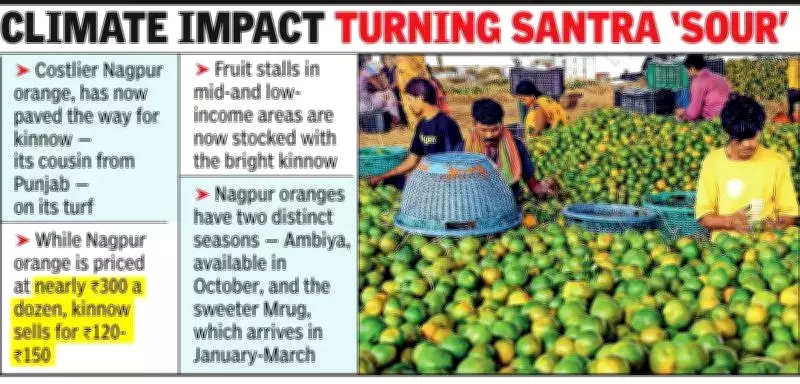
Nagpur's famous Mrug variety of santra (orange), typically available from January through March, is experiencing a dramatic price surge this season due to significantly reduced fruiting caused by unfavorable climatic conditions. This development has fundamentally altered the citrus market dynamics in the region.
Climate Impact on Nagpur's Signature Crop
The Nagpur orange has two distinct harvesting seasons: the Ambiya variety arrives in October, while the sweeter Mrug variety becomes available during the January to March period. The Mrug crop's success depends heavily on the monsoon season, with flowering typically occurring in June and July. This year, erratic and insufficient rainfall during these critical months resulted in poor flowering and substantially reduced fruit output across orchards.
"Farmers are currently receiving ₹50 to ₹70 per kilogram at their orchards, which translates to approximately ₹300 per dozen in urban retail markets," explained Manoj Jawanjal, director of Maha Orange, the state government agency responsible for marketing Nagpur oranges. "This represents one of the most significant price increases we've witnessed in recent years."

Kinnow's Market Invasion in Nagpur's Heartland
The price escalation of Nagpur oranges has created an unexpected opportunity for kinnow – the citrus cousin from Punjab – to establish a strong presence in Nagpur's traditional santra territory. While premium Nagpur oranges now command nearly ₹300 per dozen in certain retail pockets, kinnow is being sold at a much more accessible ₹120 to ₹150 per dozen according to local traders.
Fruit vendors across mid-income and lower-income neighborhoods have noticeably shifted their inventory, with bright kinnow fruits now dominating display shelves that traditionally featured Nagpur santra. Many consumers, priced out of the Mrug variety market, are actively choosing kinnow to satisfy their citrus cravings.
Market Perspectives and Consumer Shifts
Darpan Chaudhary, a vendor operating at Nagpur's Santra Market, confirmed the unprecedented pricing situation: "This year's rates for Nagpur oranges are among the highest we've seen in recent memory. While many loyal customers still prefer the authentic Nagpur santra, kinnow's competitive pricing has definitely made a substantial impact on purchasing decisions."
Another experienced trader revealed his strategic shift: "I made the complete transition to kinnow several years ago primarily due to its consistent affordability and more stable pricing throughout the season. Although true connoisseurs continue to favor the distinctive flavor of Nagpur santra, kinnow has unquestionably become the go-to choice for price-conscious buyers."
Broader Implications for Citrus Agriculture
The current market scenario highlights several important agricultural and economic factors:
- Climate vulnerability of traditional crops and their economic sustainability
- Market dynamics when premium products become inaccessible to average consumers
- Inter-regional competition within agricultural sectors
- Consumer adaptation strategies during price inflation periods
Jawanjal of Maha Orange acknowledged the changing landscape: "Kinnow is increasingly being perceived as a viable and affordable alternative to Nagpur oranges, particularly during seasons when our local crop faces production challenges. This represents a significant shift in consumer behavior and market preferences."
The situation continues to evolve as the Mrug season progresses, with agricultural experts monitoring whether this represents a temporary market adjustment or signals longer-term changes in Nagpur's citrus industry dynamics.