

Nashik Summer Onion Crops Devastated by Unseasonal Rains, Production to Drop 15%
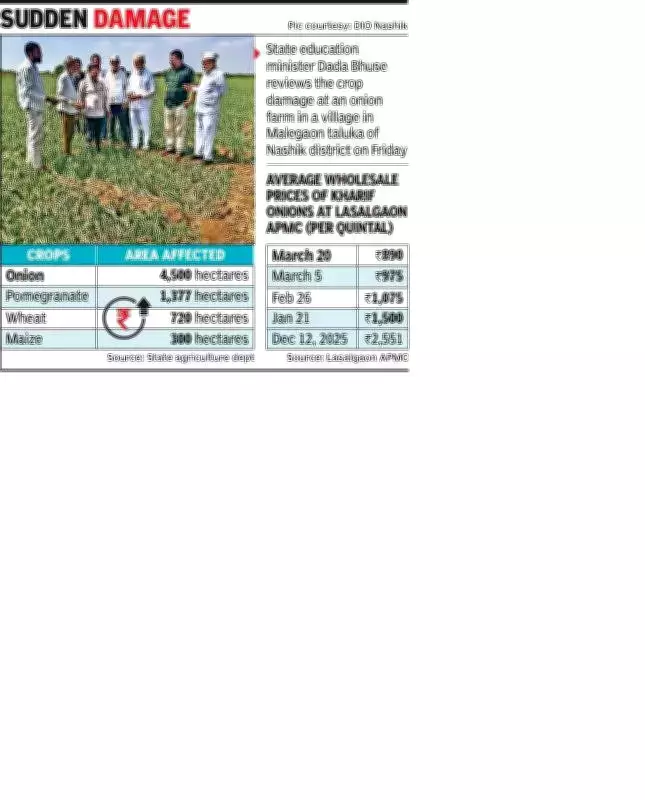
In a severe blow to farmers, summer onion crops spread across more than 4,500 hectares in five talukas of Nashik district have suffered extensive damage due to unseasonal heavy showers that lashed parts of the region on Thursday. Officials from the state agriculture department estimate a significant 12% to 15% decline in overall production for this season, threatening market stability and farmer livelihoods.
Primary Assessment Reveals Widespread Losses
The initial assessment conducted by the agriculture department highlights the highest losses in Malegaon taluka, where 1,646 hectares of summer onion crops have been affected. This is closely followed by Satana taluka, with 1,598 hectares hit by the adverse weather conditions. The remaining crop loss of 950 hectares has been reported from Nandgaon, Niphad, and Sinnar talukas, underscoring the widespread nature of the damage.
This year, the area under summer onion cultivation in Nashik had already seen a notable decrease, with acreage dropping by approximately 10% to 1.6 lakh hectares from last year's 1.8 lakh hectares. The sudden showers have exacerbated this situation, damaging nearly 4,500 hectares of crops and leading to projections that summer onion production could decline by 12% to 15%. Consequently, the output is expected to fall from last year's 39 lakh metric tonnes to around 34 lakh metric tonnes this year.

Hailstorms and Rain Cause Multi-Crop Damage
On Thursday, hailstorms coupled with heavy rain wreaked havoc on agricultural lands, damaging crops on nearly 7,000 hectares across the district. While summer onions accounted for the maximum loss, pomegranate orchards also suffered extensive damage, with 1,377 hectares affected—including 1,264 hectares in Malegaon taluka alone. This dual impact on key crops has heightened concerns among local farmers and agricultural authorities.
Market Dynamics and Farmer Distress
Despite the crop damage, summer onion arrivals in the district's Agricultural Produce Market Committees (APMCs) have seen a gradual rise over the last 10 days. However, late kharif onions continue to dominate the market, accounting for nearly 80% of the arrivals. On Friday, around 3,600 quintals of summer onions were auctioned at Lasalgaon APMC, the country's largest wholesale onion market, at an average price of Rs 1,250 per quintal, with prices ranging between Rs 555 and Rs 1,500 per quintal.
In contrast, late kharif onions fetched an average of Rs 890 per quintal, with 10,200 quintals auctioned on the same day. Farmers have expressed deep distress over the sharp fall in wholesale prices over the last three months. Onion farmer Nivrutti Nyaharkar highlighted the financial strain, stating, "The cost of production is around Rs 1,800 per quintal. We suffer heavy losses if the selling price falls below that. Prices have remained below cost for months now. We want the state government to provide a grant of Rs 1,500 per quintal to farmers who have sold onions at a loss."
Importance of Summer Onions for Market Stability
Summer onions play a crucial role in maintaining market stability due to their extended shelf life of six to seven months, compared to kharif and late kharif onions, which last only 25 to 30 days. These summer crops are typically harvested in March and April and sustain supply until the kharif crops arrive by mid-October. Any disruption in this cycle, such as the current damage from unseasonal rains, often leads to scarcity and price volatility, affecting both consumers and producers.
The extensive damage to summer onion crops in Nashik district not only threatens local agricultural output but also has broader implications for onion supply chains across the region. As officials continue to assess the full impact, farmers are calling for immediate government intervention to mitigate losses and support their livelihoods during this challenging season.






